E-Paper



Assam cabinet’s in-principle nod to hold traditional buffalo, bull fights: Sarma
Buffalo fights called Moh-Juj in Assamese are popular in several parts of the state and held during the Magh Bihu celebrations in mid-January every year


GUWAHATI: The Assam cabinet on Friday gave ‘in-principle’ approval to issue detailed standard operating procedures to organise traditional buffalo and bull fights in the state, chief minister Himanta Biswa Sarma said after the cabinet meeting.
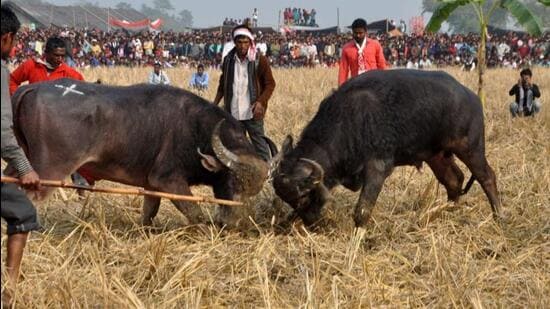
Buffalo fights called Moh-Juj in Assamese are popular in several parts of the state and held during the Magh Bihu celebrations in mid-January every year.
“In principle approval to the issue of detailed procedure/SOP for permitting traditional buffalo and bull fights to be organised during Magh Bihu at Ahatguri in Marigaon district, Nagaon district or in any other part of Assam,” the chief minister said in a post on X, formerly Twitter.
The statement added that the SOP will aim to ensure that there was no deliberate torture or cruelty on the animals and that their well-being was provided for by the organisers during the Moh-Juj festival, “an integral part of the centuries-old Assamese cultural tradition”.
The Supreme Court outlawed Jallikattu and bullock cart races in Tamil Nadu and Maharashtra respectively in 2014, and later stayed a central government order in 2016 to permit them. In May this year, a five-judge constitution bench, however, upheld the validity of laws passed by Tamil Nadu, Maharashtra and Karnataka to allow the bull-taming sport Jallikattu, bullock-cart races and buffalo racing sport Kambala in their respective region.
Despite the Supreme Court’s ban in 2014, buffalo fights on a smaller scale have been held in recent years at the Lakshmi Nath Bezbaruah Kshetra in Ahatguri, 100km east of Guwahati, the most famous spot for the event, and at other locations on a much scaled-down manner.