E-Paper



Assam likely to use Meghalaya formula to resolve border disputes with other states
Soon after the agreement with Meghalaya, Assam Chief Minister Himanta Biswa Sarma held meetings with his counterparts from Nagaland and Arunachal Pradesh, Neiphiu Rio and Pema Khandu respectively, where they discussed the existing border disputes and ways to sort them.


The Assam government is likely to use the same give and take formula of land swapping, that it agreed upon with Meghalaya, to resolve similar border disputes with three other neighbouring states.
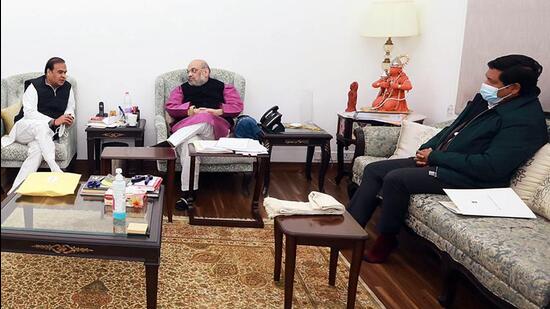
Earlier this month, chief ministers of Assam and Meghalaya met Union home minister Amit Shah in Delhi and apprised him of the recommendations of regional committees of the two states which suggested division of 6 of the 12 disputed border areas between them with the help of a give-and-take formula of swapping land.
The CMs also urged the Centre to take necessary action so that the recommendations get implemented.
As per the recommendations, of the total 36.79 sq km disputed land in six areas-Gizang, Tarabari, Boklapara, Khanapara-Pilingkata and Ratacherra-- Assam would get 18.51 sq km while Meghalaya would get 18.28 sq km. The recommendations, which sought to end the five-decade old border row between the two neighbours, were approved earlier by cabinets of both states.
Soon after the agreement with Meghalaya, Assam Chief Minister Himanta Biswa Sarma held meetings with his counterparts from Nagaland and Arunachal Pradesh, Neiphiu Rio and Pema Khandu respectively, where they discussed the existing border disputes and ways to sort them.
“We would like to start talks on the border issue with Arunachal Pradesh. With Mizoram, we will form a committee after discussion with them. If both state governments agree, we should be able to resolve the issues based on spirit of accommodation,” Sarma said in Guwahati on January 23.
A day after his meeting with Sarma, Nagaland chief minister Neiphiu Rio said in Kohima that his government is in favour of settling its six-decades-old border dispute with Assam outside the court.
A decision in this regard was taken at a meeting of the state assembly’s select committee and Rio said he was hopeful that the Assam-Meghalaya model of setting up of a local body from both sides and resolving on division of disputed areas can be done to resolve the Assam-Nagaland border issue.
“We had gone to Guwahati and had fruitful discussions on the border issue with Sarma. Both governments are in favour of an out-of-court settlement, and maybe our teams will meet Shah in the first part of February to discuss and formulate how to go about it,” Rio said.
Nagaland and Assam share about 500 km boundary and disputes along the border between the two states were stated to have been going on as early as 1963 after Nagaland attained statehood.
Past attempts made by the two state governments to resolve the perennial issue had not worked. Both states have refused to accept recommendations of two commissions set up by Centre to solve the issue and a suit is pending in Supreme Court on the issue since 1988.
“(We) had detailed discussion on the boundary issue between the two states. We will sincerely work towards a permanent solution on this long pending issue,” Arunachal Pradesh Chief Minister Pema Khandu tweeted after his meeting with Sarma in Guwahati.
Assam shares an 804 km long boundary with Arunachal Pradesh. Though there was no dispute initially, over the years allegations of residents of one state encroaching land on the other have led to disputes and violence.
A suit has been pending in Supreme Court since 1989 on the issue. In July last year, both states agreed to sort their border dispute out of court through meetings.
In November, exactly four months after violent clashes between police forces of both states left 6 Assam policemen dead, Assam and Mizoram agreed to resolve their contentious boundary dispute by forming committees and through discussions. Chief Ministers of both the north-eastern states took the step following a meeting with Union home minister Amit Shah in Delhi.
Though the committees are yet to be formed, it is expected that they could be on the lines of similar committees formed by Assam and Meghalaya governments to address the border dispute between the two states.
Assam and Mizoram share a 164.6 km of inter-state border and there has been a long-standing dispute on the exact boundary. In Mizoram’s side the bordering districts are Aizawl, Kolasib and Mamit, while in Assam’s side, the border sharing districts are Cachar, Hailakandi and Karimganj.
As per official data presented in Assam assembly, the total disputed area with the four states is around 690 sq km. There are apprehensions among some in Assam that if the formula agreed upon with Meghalaya is used to sort out all these disputes, the state could lose nearly 345 sq km of its land allegedly encroached by neighbours.
“In past there have been different committees set up to sort out the border disputes, but there recommendations were not accepted by both disputing states. So, the only way out is to sort it through mutual discussions and taking civil society groups on board,” said H Srikanth, political science professor at Shillong-based North Eastern Hill University.