
 E-Paper



There’s no difference between Pak military and militants: Rajnath Singh
Speaking at 27th Kargil Vijay Diwas celebrations in Dras, Singh asserted there was no distinction between military and militants in Pakistan where terrorism was a part of state policy.

 Prefer HTon Google


Defence minister Rajnath Singh on Sunday said Operation Sindoor demonstrated India’s ability to retaliate against any Pakistani misadventure with force beyond its imagination, ruling out talks with the neighbouring country on any issue other than Pakistan-occupied Kashmir.
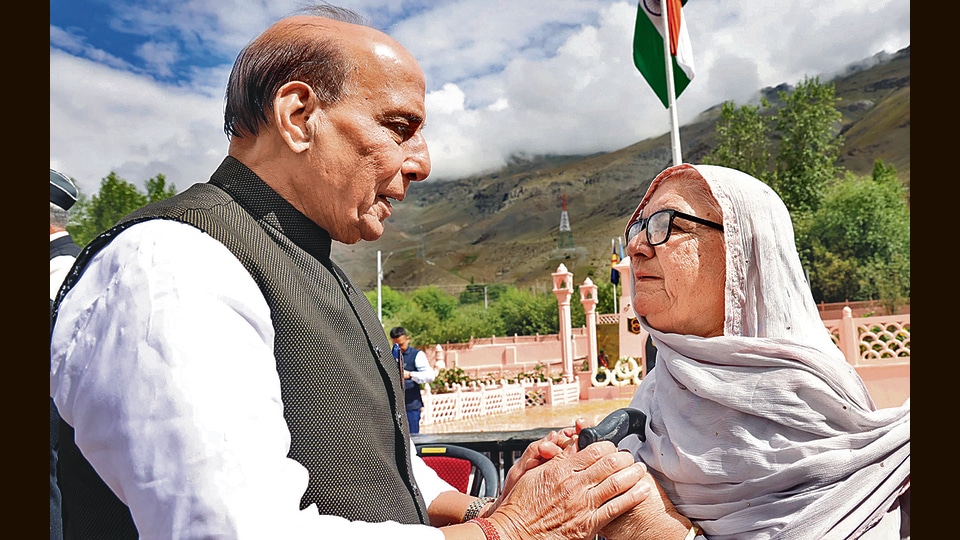
Speaking at 27th Kargil Vijay Diwas celebrations in Dras, Singh asserted there was no distinction between military and militants in Pakistan where terrorism was a part of state policy.
“Pakistan’s military not only shelters terrorist organisations but also works with them. That is why, during Operation Sindoor, we made it clear that India no longer views terrorists and the governments that nurture them as separate entities,” he said.
Kargil Vijay Diwas celebrations highlight how Indian soldiers overcame daunting odds to drive out a treacherous enemy from the strategic heights it had occupied in the Kargil sector in the summer of 1999. Army chief General Dhiraj Seth also attended the event in Dras to commemorate victory in the limited war—India’s fifth—fought along a 170-km mountain frontier, stretching from Mashkoh Valley to Turtuk in the Kargil sector.
Singh said every nefarious act by Pakistan against India’s sovereignty would be met with the same resolute response that Indian forces delivered to terrorists and their patrons through Operation Sindoor. The defence minister said 27 years after the Kargil War, the two countries have taken divergent paths, highlighting how the neighbouring country backs terrorists and their activities.
“While India is exploring new avenues of innovation, Pakistan is seeking new routes for infiltration. India is engaged in chip design, whereas Pakistan is busy designing terror. India is building a start-up ecosystem, while Pakistan is constructing a terror ecosystem. India is manufacturing semiconductors; Pakistan is preparing suicide bombers. India is recognised for space missions, while Pakistan is running proxy missions,” Singh said.
India, he added, is sending satellites into space, whereas Pakistan focuses on sending terrorists across the border. “India is providing software to the world, while Pakistan is exporting sleeper cells. India is establishing data centres; Pakistan is setting up radicalisation centres. India is connecting the world through UPI, while Pakistan is linking terrorism with hawala networks.”
As many as 527 Indian soldiers were killed during the Kargil war. While there is no definitive account of Pakistani army casualties, different estimates peg the number between a few hundred and a few thousand. A few months after the Lahore peace declaration was signed, thousands of Pakistani intruders exploited gaps in Indian defences and sneaked across the Line of Control (LoC) to capture several commanding heights.
“Kargil War has taught us that we must remain ever-vigilant at our borders in every season and under all circumstances,” Singh said. The lessons learnt from the war and the events that led to it resulted in the overhaul of India’s intelligence set-up, far-reaching military reforms, modernisation of the armed forces and vastly improved border management.
Singh invoked Kargil war hero Captain Vikram Batra’s iconic victory slogan “Yeh Dil Maange More” in his speech in the context of indigenisation in the defence manufacturing sector.
“We have developed the next-generation Akash missile. India’s first indigenous aircraft carrier ‘INS Vikrant’, Light Combat Aircraft ‘Tejas’, Light Combat Helicopter ‘Prachand’, Advanced Light Helicopter ‘Dhruv’, Main Battle Tank ‘Arjun’, ‘Pinaka’ multi-barrel rocket launcher, ‘Astra’ air-to-air missile, and modern drones and counter-drone systems are also strengthening the combat readiness of the defence forces. But, ‘Yeh Dil Maange More.’ We will continue working to manufacture even more modern weapons, next-generation fighter aircraft, submarines, and missiles right in India,” Singh added.


