E-Paper



At Vietnam security dialogue, Dy NSA stresses firm stand on freedom of navigation
Deputy national security adviser Vikram Misri, who led the Indian side at the talks, reiterated India’s “firm stand” for the freedom of navigation and overflight and unimpeded lawful commerce in national waters in line with international laws

 Prefer HTon Google


NEW DELHI: Vietnam has appreciated India’s role in promoting peace and security in the region and in shaping the Indo-Pacific architecture during the second security dialogue between the two sides in New Delhi on Tuesday, people familiar with the matter said.
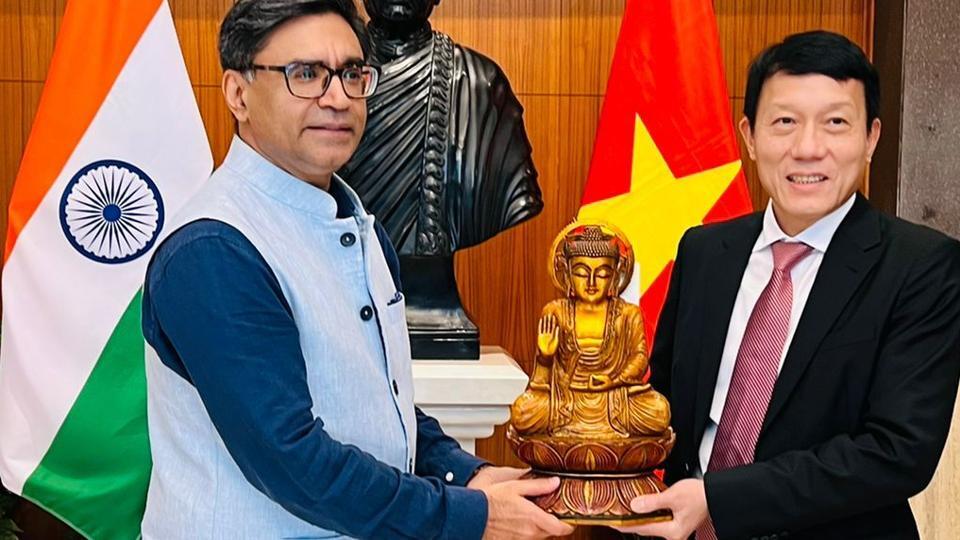
The security dialogue is an outcome of a memorandum of understanding signed by India’s National Security Council Secretariat and Vietnam’s Public Security Ministry in 2016 to establish an institutional mechanism between the two bodies. The two sides had a “frank discussion” on a number of issues of mutual interest during Tuesday’s meeting, the people said.
Deputy national security adviser Vikram Misri, who led the Indian side at the talks, reiterated New Delhi’s focus on the Indo-Pacific Oceans Initiative (IPOI), which is a collaborative effort to better manage, sustain and secure the maritime domain, and which shares strong convergence with the Asean Outlook on the Indo-Pacific.
The Vietnamese side, led by the deputy minister of public security, Senior Lt Gen Luong Tam Quang, appreciated India’s role in promoting peace and security in the region and in shaping the Indo-Pacific architecture, the people said.
Misri reiterated India’s “firm stand” for the freedom of navigation and overflight and unimpeded lawful commerce in national waters in line with international laws, especially the United Nations Convention on the Law of the Sea (UNCLOS), as well as respect for sovereignty and territorial integrity of nations.
The proposed “code of conduct” on the South China Sea should be fully consistent with relevant UN conventions and negotiations should not prejudice the legitimate rights and interests of nations that are not a party to the discussions, the people said.
The two sides agreed to collaborate and cooperate on counter-terrorism measures. They further agreed that coordinated efforts are needed to combat the nexus of radicalisation, terrorism and the production and trafficking of illegal narcotics and arms in the region.
The two sides discussed the sharing of best practices to combat piracy and illegal fishing. As maritime countries, both India and Vietnam have an interest in ensuring peace and security in their shared maritime space and the two sides agreed to exchange views in areas such as blue economy, sustainable oceans and marine connectivity, the people said.
India offered to continue helping Vietnam’s capacity-building programme, including providing training to public security officials for UN peacekeeping missions. The Indian side also offered to share expertise and knowledge in cyber-security.
Lt Gen Quang also met National Secretary Adviser Ajit Doval and secretary (East) Saurabh Kumar of the external affairs ministry. He will also travel to Bodhgaya during the visit.
The inaugural India-Vietnam security dialogue was held in Hanoi in April 2018. Doval had travelled to Vietnam and Thailand as part of his visit to the region in April 2015.