
 E-Paper



Being Mulayam Singh Yadav: A 55-year tryst with heartland politics
Yadav’s roots, rise reflected the dramatic shifts in politics of the Hindi belt in the last six decades and his political code enabled his success, but also engineered the downfall

 Prefer HTon Google


Mulayam Singh Yadav’s 55-year political journey is a remarkable story of personal success and failure, but it is also a larger story of the evolution of politics in the Indo-Gangetic plains.
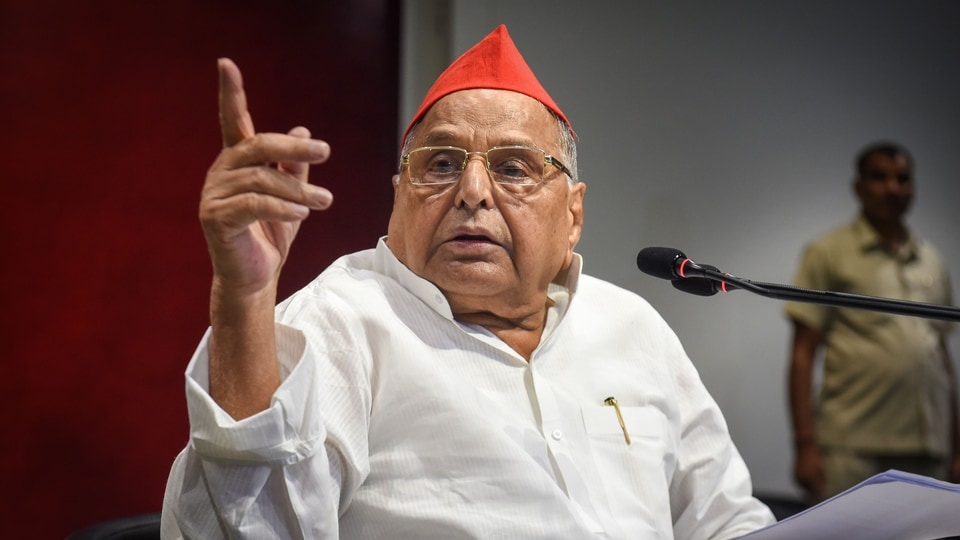
If Yadav’s roots reflected the socialist ethos that was a key pillar of Indian politics for decades, his rise represented the confluence of the politics of caste and religion framed within the label of “social justice” that altered Indian society forever.
If Yadav’s success derived from the rootedness of a grassroots politician enmeshed in his kinship and social networks, his failure emanated from viewing State power as a mere instrument in dispensing resources, patronage, and power to just these networks.
If Mulayam Singh Yadav’s politics interrupted the rise of the Bharatiya Janata Party (BJP) in Uttar Pradesh (UP) in the 1990s and 2000s, the consequences of his politics and the failure to reimagine it enabled the rise of the BJP from 2014 onwards.
The roots
The former wrestler’s early socialisation in politics was within the socialist fold. In UP’s context, this strand married backward caste assertion and peasant politics, with opposition to the Congress.
It was the 1960s and 1970s. The Congress’s Brahmin-Muslim-Dalit coalition had left a vacuum as other social groups, particularly backward communities with some economic and landholding muscle began to assert themselves.
Yadav found himself cutting his teeth in national and state politics at precisely this historical juncture. The 1967 elections marked the first break in Congress hegemony in North Indian politics. And this is when Yadav became a member of the legislative assembly for the first time. In the early years, his inspiration was Ram Manohar Lohia; in the later years, Yadav’s leader was Chaudhary Charan Singh
A degree of suspicion towards the Congress, which only got buttressed with the Emergency, was a lifetime inheritance from this period, as was a commitment to certain tenets of socialist politics and backward class assertion. Along with it was another unlikely inheritance that would get reflected years later in Yadav’s tenure as raksha mantri (defense minister) — a fierce nationalist commitment and a clear-eyed view of the threat from communist China, for socialists, never shared the Left’s and ultra Left’s romantic view of Chairman Mao.
The rise
In the next phase of his career, Yadav displayed remarkable political skills in first taking over the combined mantle of the Janata Dal and Bharatiya Lok Dal in India’s largest state. In the case of the first, it was formal and institutional; in the case of the latter, it was more informal and political as Yadav overshadowed Ajit Singh in claiming his father’s legacy.
In the 1980s and 1990s, as Mandal and Mandir collided, Yadav cemented an electoral alliance between Muslims and backward communities and then Muslims and Yadavs. It was a time when the Congress’s credibility with minorities had dipped and Hindutva was rising as a potent political force, driving Muslims across the Hindi heartland to look for political alternatives.
In the wake of the Mandir agitation, Yadav filled the gap in UP, just as Lalu Prasad had done in Bihar. This represented a dramatic shift in UP’s power structure — note that Mulayam Yadav replaced ND Tiwari as CM in 1989; the Congress has not returned to power in UP since. Socially too, newer groups began asserting themselves as power arrangements shifted.
It was no surprise that this phase — despite its electoral ebbs and flows — coincided with the peak of Yadav’s political power, from being the raksha mantri of India to the chief minister of UP multiple times. Public distance from the BJP was a legacy of this period, as was a public image of being defender of Indian “secularism”.
He showed flexibility, or what would critics would call opportunism, in embracing corporate capital when in power. He deployed his cunningness in navigating the minefield of coalition politics, both in Delhi and Lucknow, through these decades. And his often cynical moves and unpredictability became legendary.
In this period, Yadav emerged as a master tactician — a socialist who was comfortable with industry and glamour, a Yadav leader who took pride in Muslims adopting him as their own, and a ruthless political operator who kept channels open with all national parties, covertly with the BJP, overtly with the Congress, while being at home with the Left and the third front. Regimes came and went but no political dispensation, including the current one not known for its large-heartedness towards rivals, targeted Yadav on a personal level.
The code
To understand Yadav’s success, it is instructive to turn to an element of his personal style that never got as much attention as his larger politics, for it was the feature that both enabled his rise and proved to be his and his party’s undoing.
Beyond the ideological-political narrative that Yadav stitched up and the political tactics that he deployed, there was perhaps a simpler secret to Netaji’s longevity and success. It did not rest on his public speaking, for he could be famously hard to comprehend. It did not rest on his elite networks, for they were a product and not a cause of his success.
Yadav’s biggest strength was that he knew every nook and corner of India’s largest state. He knew the mechanics of politics and social arithmetic in each district of UP. And, most importantly, he knew people — directly knew people by name — in every kasba, even every Panchayat, in his state.
Travels through UP in the past decade, when Netaji was well past his prime and barely campaigning, was a reminder of the extraordinary connection he had with political workers, village elders, and supporters. From Etawah to Azamgarh, from Maharajgunj to Mahoba, supporters recalled tales of when he came to their family weddings; when he identified them by their names in a crowd and asked about family members; when he instructed them on where to invest organisational energies; when he called them up when they were in trouble; when he saw them in Lucknow in the party office and instantly recalled their village. Given the centrality of caste in UP’s social networks, it is not surprising that his deepest connections were with Yadavs, who found in him their leader.
It was this personal touch — largely but not exclusively confined to his caste — across the length and breadth of UP that enabled Yadav to build among the most successful regional parties in India’s political history.
The Samajwadi Party (SP) is what it is due to Yadav. And he was what he was because he never forgot that the route to democratic power — despite all the machinations at the top — rested on ground-level political strength. This came from hard work, from travelling relentlessly, from that personal nod and acknowledgment to supporters, from social engineering on the ground, and, most importantly, from being there for his base — supporting them when possible, protecting them when necessary, and empowering them when in power.
The limits
But it was precisely this feature that also proved to be Yadav’s undoing. A leader who helped deepen democracy by mobilising various social segments began to be seen as catering only to only those social segments, at the cost of others.
Rule of law didn’t matter. Law itself didn’t matter. The business of governance and delivery of public goods on a universal basis barely mattered. All that mattered was sustaining the electoral coalition.
And this translated into two practical consequences.
When Netaji was in power, as the joke in non-Yadav circles UP went, every Yadav strongman in every village thought he was the CM. Yadavs claimed they were merely finding their rightful place in the power structure as their political representation increased, as did other benefits that come from State power — contracts, tenders, appointments, and transfers. Patronage opportunities in the bureaucracy had a strong caste subtext, with Yadavs suddenly getting a large share of police positions, and to a lesser extent, administrative positions. Local officials found it hard to push back against the party’s Yadav supporters, for they feared that following the rulebook would result in a call from Lucknow and mean a curtailment of their tenure. And as State authority eroded, or its legitimacy dipped, or some were seen to be more equal than the rest, lawlessness spread.
All of this sharpened the divide within the broader heterogeneous category of Other Backward Classes (OBCs), as other backward communities grew resentful of the disproportionate benefits derived by one caste in the name of backward empowerment. The sense of Yadav hegemony also alienated other social groups. Upper castes, already sore at losing power, became angrier, as they waited for a political opportunity to return. So did Dalits, who often saw Yadav landlords as one of their main exploiters in terms of class relations.
Yadav, who was once a leader of all backward communities in UP, saw his base shrink as he became a leader of the Yadavs within the expanse of the Hindu caste fold. The failure to deliver on development metrics and alleged corruption only eroded his appeal. The distribution of political patronage within the family opened it, validly so, to the charge of nepotism and converting from a socialist to social justice to a caste to a family party.
And the BJP was able to exploit precisely these fault lines as it expanded in UP in 2014 and beyond. It politically sliced OBCs among Yadavs and non-Yadavs and leveraged the discontent among the latter; gave upper castes a successful political home; made inroads among Dalits; and weaved these careful social alliances within the broad rhetoric of development, anti-corruption, and anti-nepotism.
The second consequence of Yadav’s political approach was what was seen as an excessive emphasis on Muslim rights during his tenure.
But a caveat is important. Even during the peak of SP’s power, Muslims were never over-represented given their share of the population in UP. It is also important to remember that after Babri Masjid, giving Muslims a sense of security and power was a service to Indian democracy.
But under SP, some highly visible Muslim political figures, such as Azam Khan, began running their own fiefdoms and espousing communal rhetoric. There was a perception in the police administration that when it came to disputes which involved Muslims — especially those who may have political links — leniency was better than following the rulebook. During Hindu-Muslim disputes, there was a narrative that SP was partial to Muslims. There was a view that Muslims were getting development benefits that others, even those of the same socioeconomic class, didn’t. And from industrialists to the landed elite, from bureaucrats to journalists, and among both upper castes and more marginalised social groups, the narrative that SP was a “Muslim party” increasingly gained traction.
How much of this was real, how much of it was manufactured did not matter. But SP did not contest it, for it suited Yadav just fine for two decades — it helped cement his Muslim base and keep away competition for that vote (remember both the Congress and Bahujan Samaj Party wanted the Muslim vote too).
But when the BJP built on this narrative and changed the rules of the political game — decrying any Muslim representation as “appeasement”; rendering the Muslim vote irrelevant and entirely excluding Muslims from the power structure — the image of being soft on Muslims was to come back to haunt the SP.
Under Yadav’s rule, the State came to be seen as favouring two communities politically; law and order were a casualty administratively. These twin features of his political and governance record discredited both the politics of social justice and the politics of secularism. It eroded the State’s reputation as an impartial enforcer of law and arbitrator of disputes. It led to the entrenchment of a toxic form of identity politics and crony capitalism, with little heed to issues of development and governance. And it opened up the pathway for the BJP to combine a new leader, a new vocabulary, and new social arithmetic, with the politics of hope and resentment. Narendra Modi’s success in UP is a direct result of Yadav’s failure.
The legacy
Like tacticians often fail to convert their brilliance into strategic success, Yadav too failed in achieving the kind of strategic success as he may have defined it.
He did not become Prime Minister, though he came close to it in 1996 after the communists refused to lead the union government. He did not complete a single five-year tenure as UP CM, though, along with his son, Akhilesh, he did help his party win an outright majority for the first time in 2012. And towards the end of his political career and life, he saw a family feud between his brother and son; he saw the party he had built lose two state elections (2017 and 2022) and two national elections (2014 and 2019) in a row. Some of this can be traced to the failure of Yadav’s political imagination and inability to go beyond the Mandal paradigm.
But at the same time, this failure cannot take away from the fact that a boy with no privilege, from a marginalised caste background in a central-west district of Uttar Pradesh, devoted 55 years of his life to Indian democracy, and made it to the highest offices of the land — in both Lucknow and Delhi.
He also emerged as a kingmaker, not once but repeatedly, in national and state politics and shaped the course of Indian history. If Pranab Mukherjee became president, it was due to Yadav who, along with Mamata Banerjee, almost forced the Congress leadership’s hand. If the nuclear deal passed through parliament, it was due to Yadav’s support after the Left withdrew support from the Manmohan Singh government. If Sonia Gandhi could not become PM when she thought she had the numbers after Atal Bihari Vajpayee’s government fell in the late 1990s, it was because Yadav pulled the rug. If HD Deve Gowda and IK Gujral became prime ministers of this country, it was because Yadav agreed. And he was an active part of the entire VP Singh-Devi Lal-Chandra Shekhar fracas of the late 1980s.
In the inner sanctum of Indian politics, Yadav’s friends and his adversaries always had a degree of respect for the man’s tenacity and political skills. They had seen his hunger, they admired what he had built from scratch in a competitive political landscape, they liked his personal warmth, and they often laughed about his cynicism or pragmatism — but this was often laced with grudging admiration, for politicians like other politicians who are open to deals. For them, as for a large segment of UP’s population who saw in him their leader, Yadav’s end represents the end of an era. Admire him or critique him, he will occupy an important place in the story of Indian democracy.


