
 E-Paper



Beyond the news: INDIA ahead in Punjab — for now
The BJP’s boycott is apparently payback for the Centre not allowing agitating farmers to enter Delhi

 Prefer HTon Google


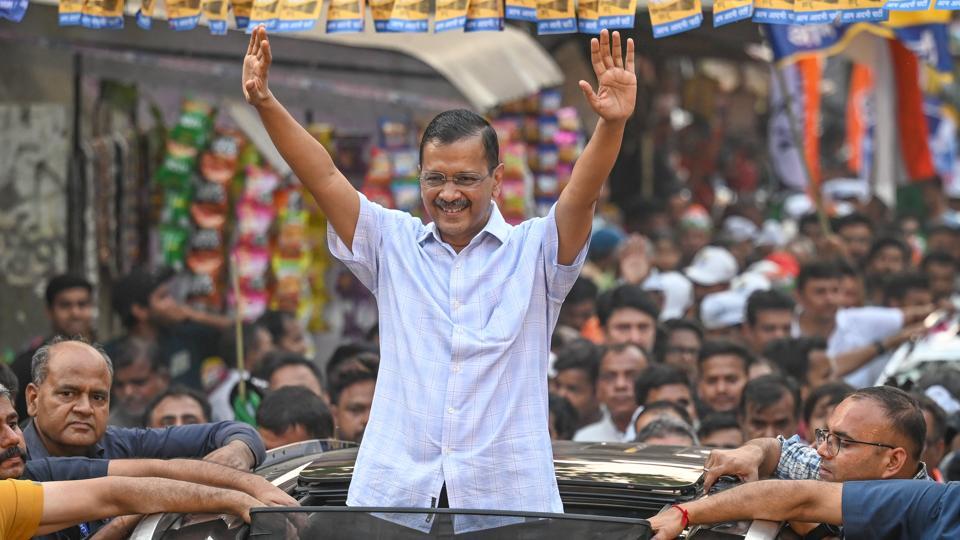
Arvind Kejriwal’s interim bail in the excise policy case couldn’t have come at a more opportune time for the Aam Aadmi Party in Punjab. The emotions, the euphoria of the 2022 polls (which AAP swept) have dissipated. It’ll be a bit of an exaggeration to say that love has flown out of the window — but reality certainly is at the door.
One doesn’t have to be a pollster to know the fight in most of the 13 Lok Sabha seats is between the Congress and the AAP led by CM Bhagwant Mann. In that limited sense, the lineup is similar to that in Kerala. No matter which side is victorious, the seats eventually will be in the INDIA grouping’s kitty.
But Kejriwal’s arrival on the scene could well be a crowd-pulling cameo, the much-needed “tadka” (seasoning) on Punjab’s poll platter. The tempering however would need to be mild, not unduly spicy! The favourable forecast could go wrong if the presumably friendly AAP-Congress contest turns cantankerous, the way it did in the CPI-M ruled Southern state.
An excessively caustic electoral discourse between the principal contestants could revive the sagging appeal and prospects of other parties in the fray. For unlike in Kerala, Punjab’s polity has ceased to be bipolar with the advent of the AAP and the breakup of the Shiromani Akali Dal-Bharatiya Janata Party alliance. The non-INDIA formations are down but not out in vote-share terms.
The no-holds-barred exchange that saw the AAP and the Congress abandoning the idea of a joint fight in the state isn’t a reassuring precedent. In the event of an ugly encore, the pre-match prognosis of their “pre-eminence” (in what’s on paper a five-cornered battle) could go badly wrong. They’ve to keep the tenuous entente in the lead-up to the June 1 vote, to take advantage of the SAD’s weakened appeal and the farmers’ blockade of the BJP across the Punjab countryside.
The BJP’s boycott is apparently payback for the Centre not allowing agitating farmers to enter Delhi. The resultant uneven playfield gives others an unfair advantage .
The BJP might not be mighty popular in villages but has tangible support among beneficiaries of the Centre’s ₹6,000 a year PM-KISAN, free food grain and health insurance benefits. Dalit Sikhs and other poor communities that partake of such relief aren’t always led by the nose by Jat Sikhs who are at the forefront of the “banish” BJP movement. “Ander khatey vote payega bhajpayen nu (BJP has silent voters in villages),” said Attari’s Sukhvinder Singh, a local leader who joined AAP from SAD.
To drive home the Centre’s outreach, the BJP draws attention to the AAP’s unkept promise of ₹1,000 stipend per month for women. Unlike in Uttar Pradesh, questions remain, however about electoral benefits of such welfarism in Punjab.
The criticality of such debates to manage public perceptions isn’t lost on any of the five regular parties in the game. One isn’t counting among them the Akali Dal (Amritsar) of Sangrur MP Simranjit Singh Mann whose panthic (conservative religious) pitch is a study in itself. For now, the hopes of SAD and the BJP are restricted to Bhatinda/Anandpur Sahib and Hoshiarpur respectively. The fifth contestant, the Bahujan Samaj Party, is broadly seen as a spoiler. It’s in the fight, essentially to safeguard its residual base in the state where it was founded by Kanshi Ram in the early 1980s.
AAP’s problem of plenty
In the state assembly, the Congress has 15 members, the SAD three, the BJP two and the BSP one. With 91 legislators in a house of 117, the Mann government looks invincible.
But in reality, the AAP’s is a problem of plenty .
The legislative resource it commands is humongous yet below par. “That’s why they’ve picked up ten year’s anti-incumbency in two years,” bemoaned Sahil Sharma. An Amritsar-based member of a traditional Congress supporting family, he regrets rising to the Kejriwal-Mann duo’s 2022 “ik mouqa” (one chance) call. Seconded by his employer Ritesh Sharma, Sahil’s disillusionment has resonance in most parliamentary constituencies with a preponderance of AAP MLAs. The sentiment finds expression in urban middle class voters in all three geographical regions of Punjab: Majha, Malwa and Doab.
“Ours is the angst of lovers in a failed relationship,” chuckled a young man who joined this writer on morning walk one day. Illustrative of the mood are such vox pops in Amritsar where the AAP holds all but one of the nine assembly seats that constitute the Lok Sabha constituency.
On account of the legislators’ image crisis, the party’s Kuldeep Singh Dhaliwal, a minister in the Mann regime, has an uphill battle against the Congress’s two-time MP, Gurjeet Aujla. Making the contest quadrangular are the BJP’s Taranjit Singh Sandhu, who till recently was India’s ambassador to the United States and Anil Joshi, a BJP turncoat travelling on SAD ticket.
In an election shorn of a major issue, urban voters are willing to forsake party allegiances for good candidatures. A shining example of it is Joshi, a former BJP minister whose work fetches all round appreciation. He may not win the parliamentary seat but will draw substantial support at the BJP’s cost in Amritsar city and rural Majitha, where his SAD colleague, Bikram Majitha is a force to reckon with.
What applies to Joshi applies in some measure to Aujla. An accessible, down-to-earth man, he’s the front-runner despite his unexceptional record. That’s largely because the human resource on offer in AAP is uninspiring. The MLAs elected in the 2022 wave are widely perceived to be ill-equipped to redress public issues, ignored as they often are by the local bureaucracy in Chandigarh.
The apathy or disconnect is only compounded by the overwhelming presence in parliamentary sweepstakes of several AAP ministers, state assembly members and defectors/lateral entrants to the party from the Congress and SAD. The candidate selection is a proof of paucity of talent available to Mann, a first time CM. The gap is glaring also because Punjab is used to seasoned leaders who were several times chief ministers.
What’s keeping the party afloat is its free electricity scheme that’s a big relief for the urban-rural poor and recruitment in government jobs. In its public outreach the AAP deftly leverages the reins of power in the state with the political messaging: “yaad karlao ki kam karaun vaste te sadhe kol he aaoge (remember that you’ve to come to us to get your work done).”
The reminder works as an alarm bell, awakening people’s native pragmatism to the incumbent party’s advantage. One heard of it as much in Ludhiana and Jalandhar as in Gurdaspur, a Lok Sabha seat adjoining Amritsar. There, the AAP’s Amansher Singh Kalsi’s main opponent is Congress heavyweight Sukhjinder Randhawa.
In the previous assembly polls, the Congress won six of the nine assembly segments in Gurdaspur. Among the factors that worked in its favour was the BJP’s film star MP Sunny Deol’s chronic absenteeism.
But like AAP’s Dhaliwal in Amritsar, it isn’t a cause for celebration for Randhawa. For the Dera Baba Nanak MLA seeking to enter parliament, his fellow legislators aren’t force-multipliers. They are a collection of self-serving men incapable of being team players, complained a Congress insider.
“Most Congress MLAs here are crabs in a bucket,” remarked a politically active grocery store owner in Gurdaspur’s main bazaar. He believed Randhawa would be better off fending for himself rather than “depending on the undependable.”
Leadership vacuum
It’s ironical but true that Punjab today has big names, not big leaders . The passing away of Prakash Singh Badal and the veritable retirement of Capt Amarinder Singh brought to an end a generation that “walked and talked” Punjab. There indeed is a vacuum waiting to be filled.
But is anyone ready to step into their shoes? The face-offs in Ludhiana, Jalandhar and Patiala can be journalistically passed off as key contests. But can the tag be earned merely on a candidate’s fame?
Objectively speaking, Ludhiana arouses interest, not awe, for being a match between the Congress’s state unit chief, Amarinder Singh Raja Warring and Ravneet Bittu, grandson of former CM Beant Singh who recently crossed over to the BJP. But the result there will only throw up an MP, not a pan-Punjab leader.
The third corner in the contest is occupied by another Congress renegade, Ashok Parashar who wears the AAP badge.
“It’s Congress versus Congress in Ludhiana. Where’s the choice for the voter,” asked Ayurveda practitioner Vatsyayan Ravindra. Sitting in Jalandhar which is over an hour’s drive from Ludhiana, one actually wonders as to who’s aping whom? There, the AAP’s Pawan Kumar Tinu and the BJP’s Sushil Kumar Rinku are habituated party hoppers. Even the SAD’s Mohinder Singh Kaypee is a convert from the Congress.
A media professional engaged by Kaypee accepted that his client wasn’t in the fight. The political opportunism of other candidates, he said, has enhanced the Congress’s former CM Charanjit Singh Channi’s draw in the city known as the hub of Punjab’s vernacular press. “He looks an angel in a crowd of sinners.”
Post-script
Guesstimates about individual tallies of AAP and the Congress range from six each to 5:8. If a senior police officer is to be believed, the state intelligence has forecast a 9:3:1 outcome for AAP/Congress/BJP.
Be that as it may, the debate primarily is over the size of the INDIA constituents’ share in the poll pie.


