
 E-Paper



‘Big brother’ charge, border dispute: Why India is keeping a close eye on Nepal election results
As Nepal holds significant elections post-uprising, the outcome could affect its complex relationship with India, with a backdrop of protests, border disputes.

 Prefer HTon Google


Nepal has voted for its first general elections since the ‘Gen-Z’-led uprising last year toppled the KP Sharma Oli government and brought Sushila Karki as the interim prime minister.
Key figures vying for power include a Marxist former prime minister seeking a return to office, a rapper-turned-mayor - Balen Shah - bidding for the youth vote, and the newly elected leader of the powerful Nepali Congress party.
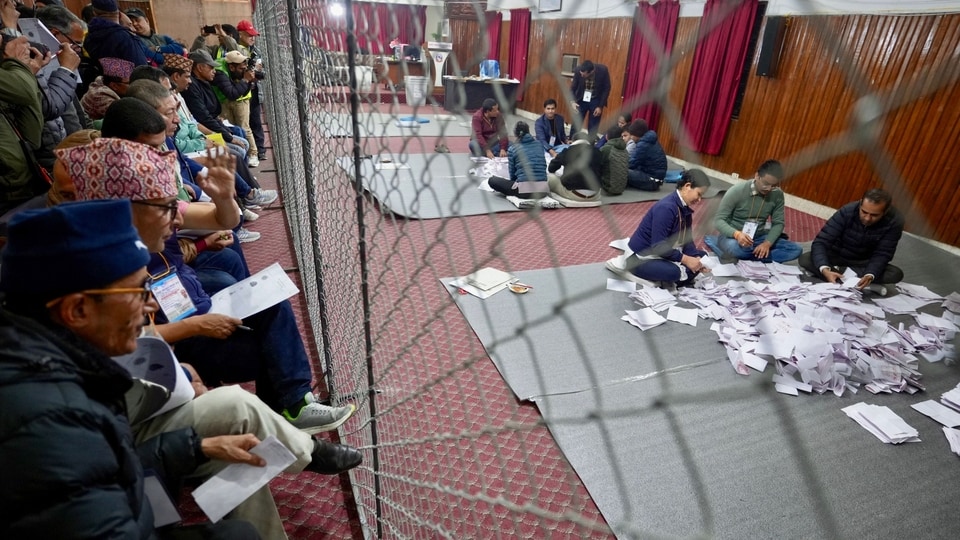
Counting of votes is underway and will decide the fate of 3,406 candidates vying for 165 seats under direct voting, and 3,135 candidates vying for 110 seats through proportionate voting.
The election is a crucial event for India as well as it takes place in a neighbouring country it has close yet a complex bilateral relationship with - shaped by geography, history, culture, and economic interdependence. Track Nepal election results here
India-Nepal ties and recent pain points
The India-Nepal relationship has witnessed a lot of ups and downs over the years, and recent political developments in Nepal, especially the political turmoil of 2025 and the 2026 general elections, have again placed bilateral ties under strain.
Nepal's current political journey is one that was preceded by deep domestic turmoil. In September 2025, large-scale youth-led protests against corruption, unemployment, and government restrictions on social media erupted across the country. The protests, led by Gen Z, resulted in the resignation of Prime Minister KP Sharma Oli, dozens of deaths, and the formation of an interim government.
These protests reflected broader frustrations among young voters over economic stagnation and perceived nepotism among political elites.

The political uncertainty preceding these elections has led India to adopt a cautious diplomatic approach, pausing major initiatives with Kathmandu until a stable government emerges.
Key factors behind recent strains in India-Nepal ties
Territorial disputes: Kalapani-Lipulekh issue
One of the biggest pain points of India-Nepal relations has been the dispute over Kalapani, Lipulekh, and Limpiyadhura along the India-Nepal border. Nepal released a revised political map in 2020 including these territories, which India administers as part of Uttarakhand.
Most recently, in November 2025, India strongly criticised Nepal’s decision to issue a new NPR 100 banknote showing the disputed areas of Lipulekh, Limpiyadhura and Kalapani as part of its map.
The Ministry of External Affairs (MEA), in a statement, said the move was a “unilateral act” that “does not change the ground reality.”
‘Big-brother attitude’ Accusation of interreference
Nepal's internal political competition often involves strong nationalist narratives, particularly among left-leaning parties. Leaders have occasionally accused India of interference in Nepal's internal affairs, a claim that resonates with sections of the electorate.
Following the promulgation of Nepal's constitution in 2015, Nepal accused India of interfering in its domestic affairs and enforcing a four-month-long blockade to support the demands of Madhesi groups. India strongly denied these claims, citing safety concerns due to violent protests.
Many in Nepal’s political circles also see India as acting with a "big-brother" attitude.
India, rejecting the blockade allegations, had said in Parliament back then, “There is no blockade by India, which we have repeatedly clarified, of supplies going to Nepal. Obstructions are by the Nepalese population on the Nepalese side, in which GoI cannot interfere. There were incidents of violence resulting in death and injury in regions of Nepal bordering India following the promulgation of this Constitution. Our freight companies and transporters also voiced complaints about difficulties of movement and security within Nepal.”

The then external affairs minister, Sushma Swaraj, had rubbished the charge of India imposing a blockade of supplies while asserted that Narendra Modi government would follow the policy of the previous government with regard to Nepal.
Trade
In August 2025, India's Ministry of External Affairs condemned Nepal's remarks on the resumption of trade between India and China through the Lipulekh pass, calling them unjustified and not based on historical facts or evidence.
The condemnation was triggered by the then KP Sharma Oli-led Nepali government's statement claiming that the official map of Nepal, included in the country's Constitution, shows Limpiyadhura, Lipulekh, and Kalapani east of the Mahakali River as "integral parts of Nepal".
Nepal's foreign ministry said in an official statement that it also urged India to refrain from carrying out any activities in Nepali territory.
The Indian government condemned these claims and said, "As regards territorial claims, our position remains that such claims are neither justified nor based on historical facts and evidence. Any unilateral artificial enlargement of territorial claims is untenable."
Nepal's foreign ministry further said in its statement, “It is also known that the Government of Nepal has been urging the Government of India not to carry out any activities such as road construction/expansion, border trade in the said area. It is also known that even the friendly country China has been informed that the said area is Nepali territory.”

India-Nepal relations have gone through a difficult phase in recent years, shaped by domestic political upheaval, rising nationalism, and unresolved territorial disputes. But what lies ahead for bilateral ties after the 2026 Nepal elections remains uncertain. While there is hope that the formation of a stable government in Kathmandu could offer both countries an opportunity to reset relations and rebuild diplomatic momentum, there is also the fact that Balen Shah, the frontrunner to be the next PM, is considered anti-India among his supporters.


