
 E-Paper



‘Biggest strategic worry since 1971’: 5 key points Shashi Tharoor-led panel made on Bangladesh crisis
One witness told the parliamentary standing committee that a key concern was “a potential strategic realignment away from India.”

 Prefer HTon Google


The situation unfolding in Bangladesh has emerged as India’s most serious strategic test since the Liberation War of 1971, a parliamentary standing committee on external affairs-led by Congress leader Shashi Tharoor warned on Thursday.
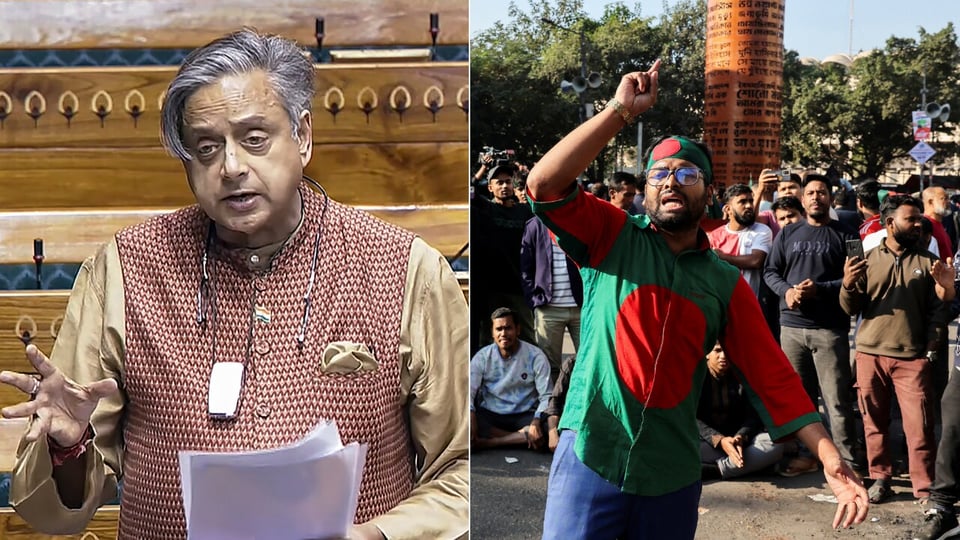
Notably, the findings were presented hours before a fresh series of violence ensued across Bangladesh after the death of a student leader. Sharif Osman Hadi, who gained popularity after the 2024 uprising, was shot on December 12 and died during treatment in Singapore on Thursday, triggering unrest in Bangladesh. Mob torched media offices, vandalised several establishments and hurled stones at India mission in Chattogram, as reported by BD News24. Follow Bangladesh violence live updates.
However, the findings by the Shashi Tharoor-led panel preceded the fresh violence in the border nation. It had also pointed out that New Delhi must tread carefully even as it ruled out a slide into complete chaos.
The report outlined the growing political instability, security concerns and regional power shifts in Bangladesh that could directly impact India. Below are five key takeaways from the panel’s findings:
1. ‘Greatest strategic challenge since 1971’
The committee said recent developments in Bangladesh amount to India’s “greatest strategic challenge” since the country’s liberation in 1971 — a view echoed by non-official witnesses who testified before the panel.
According to a report by news agency PTI, one witness told the committee: “India faces its greatest strategic challenge in Bangladesh since the Liberation war of 1971. While the challenge in 1971 was existential, a humanitarian and a birth of a new nation, the latter was of a graver, a generational discontinuity, a shift of political order, and a potential strategic realignment away from India.”
The witness cautioned that failure to recalibrate policy now could see India lose influence in Dhaka “not to war, but to irrelevance”.
2. How the current unrest unfolded
Tracing the roots of the turmoil, the panel said the instability is the result of multiple factors coming together, including the rise of Islamic radical elements, increasing Chinese and Pakistani influence, and the weakening grip of Sheikh Hasina’s Awami League.
The report noted that political developments since August 2024 have created deep uncertainty, with democratic elections still not clearly scheduled.
“The political events of August 2024 have created significant instability and uncertainty with incidents of violence, attacks and intimidation of minorities, tribal communities, media groups, intellectuals, journalists, academicians, etc., becoming the norm,” the committee said, as reported by PTI.
3. Human rights, protests and economic strain
According to the panel, political instability has spilled over into widespread social unrest, with protests breaking out across Bangladesh. At the same time, economic pressures have intensified public frustration.
“Concerns have been raised about human rights issues, including restrictions on freedom of speech and assembly,” the report said.
Rising inflation and a slowing economy — worsened by the global economic downturn — have added to people’s hardship, creating a volatile mix of political and economic stress.
4. India’s engagement with interim government
The committee said the Ministry of External Affairs (MEA) has told lawmakers that India is maintaining engagement with Bangladesh’s interim government while backing the aspirations of its people.
“While communicating our support, the government of India has underlined that our policies are people-oriented and not aimed at any particular political dispensation,” the MEA said, according to the report.
The MEA also stated that efforts have been made to “insulate bilateral relation” from the impact of Bangladesh’s internal political churn.
5. The 1971 legacy
The MEA flagged several ongoing challenges in ties with Bangladesh, including “illegal immigration, radicalisation and extremism, regional security and extremist rhetoric against the sovereignty and territorial integrity of India”.
India, the ministry said, remains concerned about attacks on minorities in Bangladesh and has raised the issue at multiple levels.
Quoting India’s foreign secretary, the report said: “Even as the relationship is becoming more multidimensional and there is a new generation that is growing up in Bangladesh, we have no doubt that the legacy of 1971 will continue to foster goodwill and reinforce the sense of historical brotherhood between our two countries.”
At the same time, the foreign secretary acknowledged challenges from groups seeking to undermine that shared history, adding: “We do have to tackle the vested interests that would like to pursue a counter-narrative to the spirit of 1971.”
The panel examined the subject ‘Future of India-Bangladesh Relationship’ over multiple sittings in 2024 and 2025, taking evidence from MEA officials and external witnesses.
(With PTI inputs)


