
 E-Paper



Bihar loss deepens Opposition slump in Hindi-speaking belt since 2014 polls
Senior Congress leaders admitted confusion over seat distribution and ineffective mobilisation, noting Rahul’s EBC outreach and voter yatra failed to resonate.

 Prefer HTon Google


In the 26 assembly elections in North India since Narendra Modi became the Prime Minister in May 2014, the Opposition has won 12. The Bihar assembly election—the 27th in North India-- is not just another feather in the NDA’s cap, but a low-point for an opposition that managed just 35 seats in the 243-member assembly.
Out of the 12 victories for the BJP’s rivals, the Congress accounts for five (on its own), underlining the woeful state of the party that once governed vast swathes of North India in the pre-Mandal era.In the 2025 Bihar election, the party won six of the 61 seats it contested—for an abysmal 9.8% strike rate. The leader of the Grand Alliance, the Rashtriya Janata Dal, won 25 of the 143 seats it contested, a strike rate of 17.5%.
The Congress won 19 seats in the 2020 Bihar election with a strike rate of 27% and the RJD won 75 at a strike rate of 52% . The Bihar election showed that while in other parts of India, especially in the south, opposition parties have managed to halt the BJP’s march or challenge its dominance, they have been unable to do so in North India whose 14 states and Uts (Gujarat has been excluded) account for 45% (245 ) of 543 Lok Sabha seats.
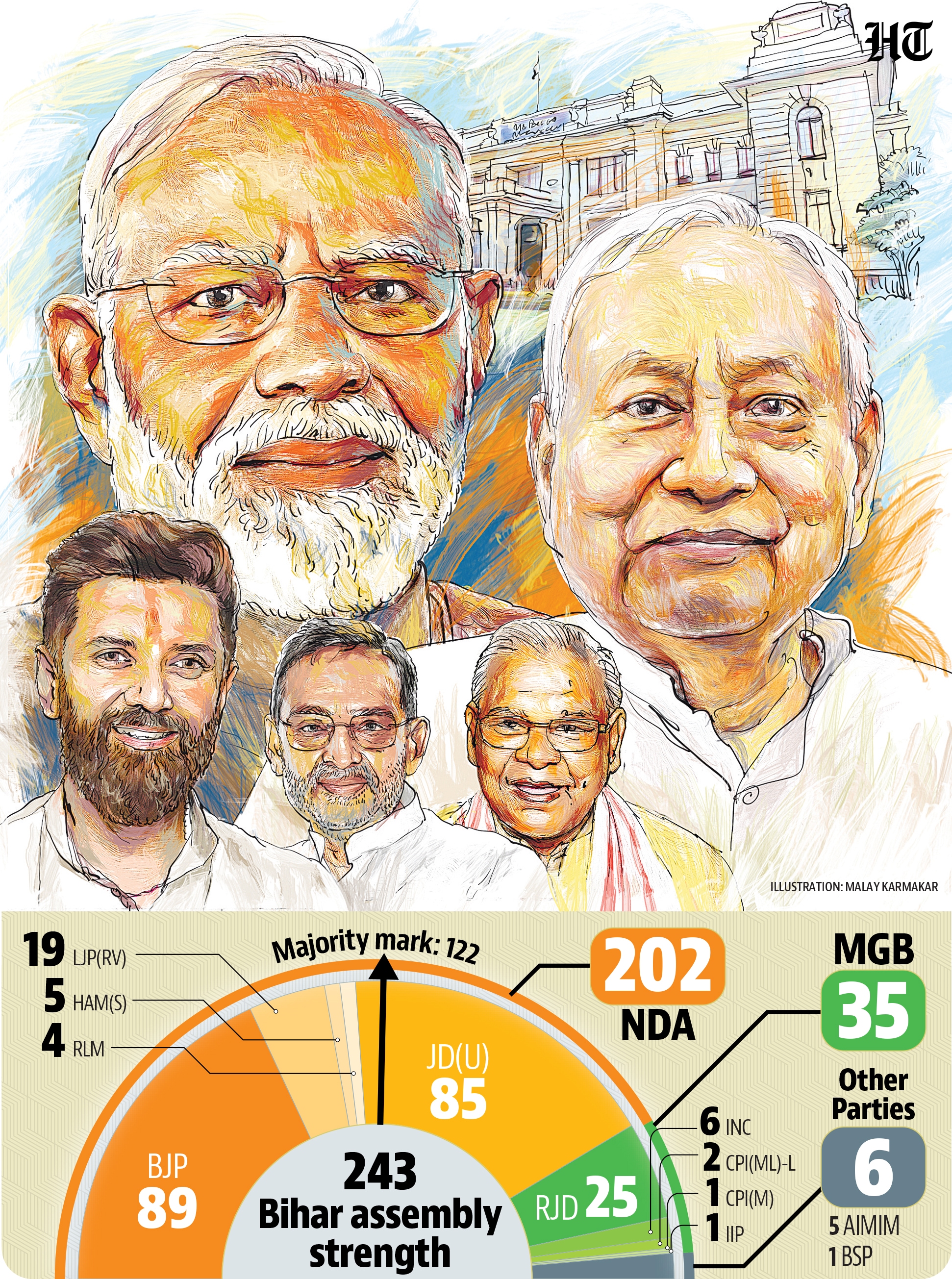
A performance such as the Grand Alliance’s—it won 35 seats to NDA’s 202—in Bihar suggests that everything that could have gone wrong with the campaign, did.
That started with the choice of candidates.
“From the beginning, the seat distribution was done in a haphazard manner. There was no clarity in the seat distribution till a few days before the first phase of the poll. This didn’t go down well among the voters,” a senior Congress leader who was involved in the Bihar campaign said on condition of anonymity.
It continued with the communication effort.
“Leader of the Opposition Rahul Gandhi rolled out a Nyay Patra for the extremely backward castes (EBCs), but the Congress failed in its outreach for the EBC,” this person added.
Also Read | NDA's landslide win will cause ripples far beyond Bihar
Indeed, the EBCs stuck with Nitish Kumar’s Janata Dal (United), remembering his record of good governance (an appeal sweetened by pre-poll doles).
“The Congress has not been able to create its own vote bank in Bihar and banked on the same Yadav-Muslim votes of the RJD. In contrast, the NDA reached out to the upper castes, EBCs, non-Yadav OBCs such as Koiri, Kurmi and Kushwahas, and Dalit sub-castes such as Paswan and Mushahar,” said Pramod Kumar, a Muzaffarpur-based political analyst.
And it picked the wrong issues.
A section of the Congress insists (with the benefit of hindsight) that Rahul Gandhi’s focus on the Special Intensive Review of the Election Commission was unnecessary and he should have spent more time on other pressing issues. “The 15-day long Voter Adhikar Yatra undertaken by Gandhi travelled across RJD bastions and it didn’t help towards rejuvenation of the Congress in Bihar,” said a second party leader, who too asked not to be named.
All of these were exacerbated by the fact that the Congress doesn’t have strong leaders with mass appeal in Bihar -- only to be expected in a state where it has been a minor player since 1990. Friday’s results suggest this will likely continue to be the case.


