
 E-Paper



Karnataka elections: BJP’s strategy and challenges
The BJP faces a crucial test in the Vokkaliga-dominated Old Mysuru region, where the party has never won more than 11 out of the 61 seats in previous polls

 Prefer HTon Google


Bengaluru At a party meeting sometime towards the end of 2022, Union home minister Amit Shah is learnt to have expressed annoyance over the lack of preparations by the leaders of the Karnataka unit if the Bharatiya Janata Party (BJP) for the upcoming assembly polls. Shah, at the time, flagged the failure to groom new leaders and identify issues that would form the bedrock of the election narrative, and most of all, the lag in strengthening the booths in the Old Mysuru region, which sends nearly a third of the legislators to the 224-member assembly.
“He (Shah) was livid...,” recalled a party leader privy to the meeting, requesting anonymity.
The leader said that Shah, who is also the party’s chief strategist, was disappointed with the state unit’s plans to breach the opposition bastion, identified as a significant factor to propel the BJP towards winning a majority on its own — something that has been elusive in the past elections.
While the BJP has a reasonably strong presence in the north and central regions of the state where the politically powerful Lingayat community sustains the party’s growth, and in the coastal region where its ideological fountainhead the Rashtriya Swayamsevak Sangh (RSS) has helped make inroads, the party faces a crucial test in the Vokkaliga-dominated Old Mysuru region. The BJP has never won more than 11 out of the 61 seats in the region in previous polls.
Eyeing the Vokkaliga bastion/ weak seats
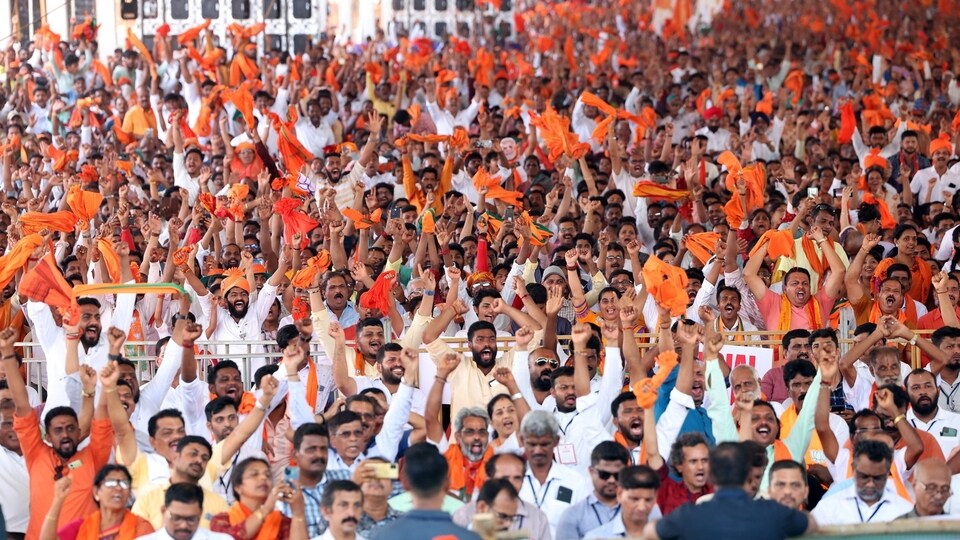
To address this, a concerted campaign with senior party leaders making multiple visits has been mounted in the Old Mysuru region. Shah, party president JP Nadda, and a bevy of national and state leaders have already addressed rallies in the region ahead of the May 10 assembly elections.
“In Tumkur, Chikkaballapura, Kolar, Kodagu, Ramanagar, Mandya, Hassan, (and) Chamrajanagar, the party began work on a two-pronged approach… We inducted strong leaders and are targeting our opponents on issues such as poor performance and dynastic politics,” said the party leader quoted above.
The BJP has also redoubled efforts in constituencies where its candidates lost by a slim margin in 2018, and identified 17 such seats across the state where the loss margin was less than 3,000 votes. “If we add these 17 to the 104 that we won in 2018, it puts us in a comfortable position to win,” said a second party leader, also asking not to be named.
Though the party has given prominence to Vokkaliga leaders such as Lok Sabha MP Shobha Karandlaje, party general secretary CT Ravi, and state minister CN Ashwath Narayan, it is still banking on community leaders from other parties to facilitate its entry into the Janata Dal (Secular), or JD(S), bastion. The party is hopeful that Congress leaders who defected in 2019 and helped the BJP wrest the power from the JD(S)-Congress combine, will be able to add seats to its tally.
“The entry of leaders such as D Sudhakar, HT Somashekar, V Gopalaiah, among others, gave a fillip to the party’s Vokkaligga outreach. The party’s bypoll win in 2019 in KR Pete and Sira for the first time has kindled hope of a better show this time,” said the first functionary.
Caste balance
Overtures towards the Vokkaliga community included initiatives such as the installation of Kempegowda’s statue at the Bengaluru International Airport. But the outreach towards the community that wields clout in 40-plus seats also puts the BJP at risk of upsetting other castes. So there is an attempt to retaining support of the so-called upper castes, and the Lingayats, even as the BJP wants the Scheduled Castes, Scheduled Tribes and other backward classes (OBCs) to back its quest for retaining power.
“The SC, ST and OBCs are not the exclusive domain of any party. So, the effort has been to prop leaders in each community without disturbing the equations. The Congress had an AHINDA formula to woo the Alpasankhyataru (minorities), Hindulidavaru (backward classes) and Dalitaru (Dalit) communities. Our social engineering strategy was retaining the LIBRA (Lingayat plus Brahmins) and adding the AHINDA by rejigging the reservation,” said a third state leader.
The Karnataka government announced the scrapping of 4% reservation for Muslims and redistributed it equally among the Vokkaligas and Lingayats. Additionally, it increased the reservation for STs from 3% to 7% and for SCs from 15% to 17%. The new policy will not come into effect till after the elections.
By fielding 47 Vokkaliga, 68 Lingayat, 37 SC, and 18 ST candidates, the BJP is hoping that its claims of “politically empowering” all castes will hold it in good stead.
Referring to the importance of caste in the state’s polity, Sugata Srinivasaraju, political commentator and author said, “Caste is a central idea in Karnataka and the electoral contest in the state has mostly centred around caste. But this time, there is an assertion by the sub-castes that are looking for bigger political representation and share in power.”
Double engine/ leadership crisis
While the party made its “double engine” governance — used in reference to BJP-led governments at the Centre and in the state — the mainstay of its electoral campaign to override issues of anti-incumbency and administrative deficiencies, the absence of a clear chief ministerial candidate is another challenge that the ruling party has to overcome.
The BJP’s bid to capitalise on the “clean image” of incumbent chief minister Basavaraj Bommai appeared to come a cropper after allegations of graft and the Congress’s aggressive “PayCM campaign” to target the government on issues of corruption.
There is strong support for former CM BS Yediyurappa, a Lingayat strongman who was replaced by Bommai in 2020, and Prime Minister Narendra Modi commands a strong following from across castes, especially among the youth. However, the party is facing a predicament since the Lingayats want a clear announcement about the CM candidate. “CM Bommai, a Lingayat, has not been able to secure the kind of following that BSY (Yediyuappa) has,” admitted the first leader. Withstanding pressure to name a CM, the party high command has opted for a cautious approach of leading with the Modi-Yediyurappa combination.
The BJP has also sought to alleviate concerns that it overlooked the Lingayat leadership. Yediyruppa’s announcement of not contesting polls and the exit of senior leaders like former CM Jagdish Shettar gave the opposition a chance to accuse the BJP of marginalising the community. The BJP, however, has been able to counter the narrative by asserting that the replacements for those who exited are from the Lingayat community itself.
Rebels/anti-incumbency
Another challenge that the party faces is the possibility of rebels playing spoilsport and adversely impacting its electoral fortune, as it happened in Himachal Pradesh. Though senior leaders had reached out to the state unit, explaining the need to give new faces a chance to be able to buck anti-incumbency, there has been a lot of resentment over dropping sitting legislators.
Apart from Shettar, several other leaders such as former deputy CM Laxman Savadi, and Ayanur Manjunath, now contesting on a JD(S) ticket from Shivamogga central constituency, went public with their disappointment at being dropped. Senior leaders, barring KS Eshwarappa, have not supported the party’s bid to encourage new leadership by fielding 72 new faces.
Narrative
While the Congress has accused the state government of administrative lapses, faulted the Union government for failing to tame inflation and harped on the issue of corruption, the BJP is hoping that the image and popularity of PM Modi will overshadow local issues.
The BJP has had to reconsider its poll narrative from being overtly polarising, given the impact it had in consolidating the minority votes in favour of the Congress and the little impact issues such as enforcing ban on hijab and halal food had in the state.
Referring to the BJP sidestepping issues such as interfaith marriages and religious conversions, and its bid to recast Tipu Sultan as an anti-Hindu ruler, Srinivasaraju said, “The BJP has had to reconfigure its election narrative from Hindutva to caste because ideological issues did not find great traction across the state. Hindutva has resonated in the coastal belt, not so much in other parts of Karnataka. Even among the Lingayats, there is an assertion by the subcastes.”
The party is, therefore, banking on development projects and fiscal achievements and the “Modi factor” to counter the allegations of rampant corruption and infrastructure deficiencies.
On whether the PM will be able to set the narrative and help the BJP overcome the impediments it faces in retaining power, professor of political science at the Bangalore University, SY Surendra Kumar said, “Modi’s personality and the public opinion about him will play an important role in the elections. It will help the BJP overcome its weaknesses. His image among people, particularly the youth, who see him as a hard-working, honest leader who is driven to deliver is an advantage for the BJP.”


