
 E-Paper



BJP was first to adopt formal resolution for 33% women reservation: Meghwal
The Union law minister has termed the bill as the ‘Nari Shakti Vandan Bill’ and said that in this auspicious time of Amritkaal, this bill is an important step towards making India a ‘developed India’

 Prefer HTon Google


Union Law Minister Arjun Ram Meghwal on Wednesday moved the Constitution (128th Amendment) Bill 2023, to be taken up for consideration, which proposes to reserve a third of seats or 33% in the Lower House and state assemblies for women.
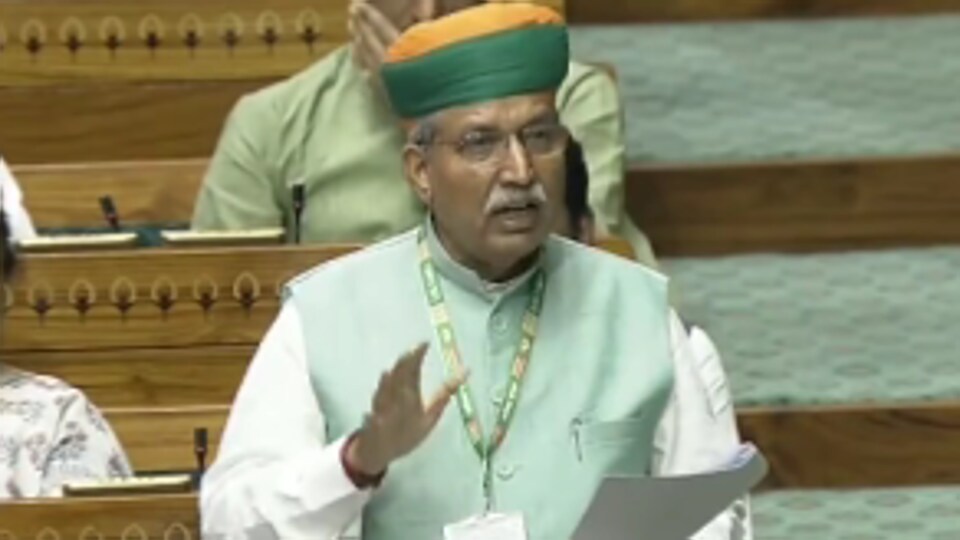
He said that the Bharatiya Janata Party (BJP) has been trying its level best to bring this reservation for women.
The BJP was the country’s first political party to adopt a formal resolution in support of 33% reservation for women in Parliament and state legislatures, Meghwal said in the Lok Sabha on Wednesday as he moved for passage of the constitution amendment bill.
Meghwal’s statement was a reference to the meeting of the party’s national executive in Vadodara in July 1994 and comes against the backdrop of attempts by political parties to take credit for the legislation.
“When BJP was in opposition, we kept demanding this bill from the government, but Congress, blissful in the pleasure of power, never brought the bill and as their term ended on 18th May 2014, even the Bill lapsed,” Meghwal added.
The Union law minister said that socio-economic welfare schemes and progress for women in this country had been bolstered after Narendra Modi was elected as Prime Minister.
Also Read: Women’s Reservation Bill tabled in Lok Sabha. 5 things to know about this legislation
“On 25th November 1949, BR Ambedkar had said that on 26 January 1950, we would get political equality, but the social issues that would be left out must be rectified by the next governments,”
Soon after Modi came to power in 2014, he introduced several schemes to rectify social and economic causes, Meghwal said.
Megahwal said that the Bill, once implemented, will give equal power and opportunities to women. He said that the government is trying to bring with this Bill four essential clauses – “…with Article 239 of the Constitution, we are joining 239 (AA) which would reserve 33% seats for women in the Delhi Assembly,” he said.
“We are also bringing clause 3 and adding a 33 (A) section in the 330 amendments of the Constitution, which will give women 33% reservation in Lok Sabha. And amendments according to clause 4 of the Bill, we will add another Article 33 (A), which will provide women 33% reservation in the state legislative Assembly,” Meghwal added.
“…and under clause 5, under article 334, a new article 334 (A) will ensure that this reservation will be fixed for 15 years,” he added.
Meghwal further outlined that a similar reservation was brought in the previous administration, but it never came up for discussion in the Lok Sabha.
Also Read: Sonia Gandhi declares support to women’s reservation bill
“When BJP was in opposition, we kept demanding this bill from the government, but Congress, blissful in the pleasure of power, never brought the bill and as their term ended on 18th May 2014, even the Bill lapsed.”
Earlier, Meghwal said that discussion on the Bill will be held through the day in the Lok Sabha and it has nothing to do with politics.
“Discussion on the Bill will be done throughout the day. It will begin at 11am, and it has been scheduled to continue till 6pm. This has nothing to do with politics,” he said outside the new Parliament building.
Meghwal introduced the bill on Tuesday in the first sitting of Lok Sabha in the new Parliament building. He said that once the Nari Shakti Vandan Adhiniyam is passed, the number of seats for women in Lok Sabha will increase to 181.
Meghwal said that the Bill will enable greater participation of women as public representatives in policy-making at State and national levels.
The long-awaited bill — which will apply to the Lok Sabha, the Delhi legislative assembly and state Houses — also inserted quotas for women within the existing quantum of seats set aside for scheduled castes and scheduled tribes, but its implementation might take a few years. If passed into law, political reservation for women will only come into effect after delimitation — an exercise comprising revision of seat numbers and redrawing of constituency boundaries – that can only happen after 2026, and after the relevant census figures are published.


