
 E-Paper



Bommai’s maiden Budget promises growth on borrowed money
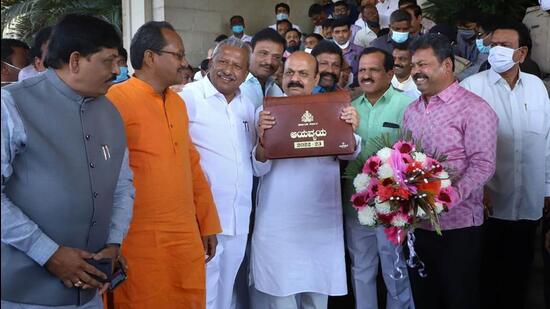
Karnataka chief minister (CM) Basavaraj Bommai on Friday presented his maiden Budget promising growth for the pandemic-hit population with borrowed money even as the state’s debt situation increases to alarming levels


Karnataka chief minister (CM) Basavaraj Bommai on Friday presented his maiden Budget promising growth for the pandemic-hit population with borrowed money even as the state’s debt situation increases to alarming levels. “In the current financial year, I propose to restrict the borrowings to ₹ 63,100 crore instead of the budgeted ₹67,100 crore. For the year 2022-23, we are planning to borrow ₹72,000 crore,” Bommai said.
“The total liabilities at the end of 2022-23 are estimated to be ₹5,18, 366 crore, which is 27.49% of the GSDP (gross state domestic product),” Bommai said. The total liabilities at the end of 2021-22 stood at ₹4,57, 899 crore or 26.95% of the state GSDP.
Experts opined that the short-term approach with upcoming elections in mind threatens to undo decades of fiscal discipline, which has the potential to keep the southern state submerged in debt for a long time, affecting long-term asset and job creation as well as increasing pressure on successive governments.
Bommai, like his predecessor, BS Yediyurappa, presented a revenue deficit Budget for the second consecutive year even as the size of the budget increased.The size of the budget increased to ₹2,65,720 crore against a revised estimate of ₹2,57,042 crore in the previous year, registering an increase of 3.37%.
The CM did not increase tax on any of the commodities under state control as any hike on the financially-strained population would have been counter intuitive to the Bharatiya Janata Party (BJP) plans of returning to power in the 2023 assembly elections.
“The economy in 2021-22 is on the road to recovery. In these circumstances, I am not willing to put (an) extra burden of additional taxes on (the) common man. Tax collection targets will be achieved by ensuring all the tax departments perform better,” Bommai said in his speech.
The revenue deficit Budget is estimated to be ₹14,699 crore in 2022-23 as against ₹15,134 crore in the corresponding year. The fiscal deficit is expected to be ₹61,564 in 2022-23 or 3.26% as against ₹59,240 crore or 3.48% in the corresponding year.The state government has earmarked ₹55,657 crore for boosting economic development.
Despite the severe fund-crunch, Bommai-led BJP government has projected 9.5% (advance estimates) for the year 2021-22. “There is growth in resource mobilisation as well as a general growth in economy,” Bommai replied while answering to a query on the projected growth rates.
Karnataka, like several of its counterparts, is heavily reliant on income it generates from its own taxes in the Goods and Services Tax (GST) regime, which leaves most of the states at the mercy of the union government.
Bommai said much of its hope for growth comes from a revival in collection of its own taxes.
The commercial taxes department has set a target of ₹70,757 crore until the end of February this year as against a target of ₹76,473 crore. The government has set a target of ₹ 77,010 crore for 2022-23.
In stamps and registrations, the government has already collected ₹12, 105 crore (till February end) as against the target of ₹12,655 crore in 2021-22. The government has revised this target to ₹15,000 crore.The revenue from excise has seen a sharp rise in expectations from ₹24,580 crore (in 2021-22) to ₹29,000 crore (in 2022-23).
The target for the transport department has been muted from ₹7,515 crore (in 2021) to ₹8,007 crore (in 2022-23), according to the budget.
“They should not compare the growth with the corona-affected year. They should compare it with the year which was not impacted by the pandemic,” Siddaramaiah, the Congress leader of the Opposition said on Friday.
While Bommai has earmarked ₹55,657 crore to ‘encourage economic development’, much of the asset creation has been on borrowed money.
According to the Medium Term Fiscal Plan 2022-2026, “state’s capital expenditure is mainly funded by borrowings. The capital expenditure was ₹44,237 crore for 2021-2022 budget estimates (BE) and it was revised to ₹42,366 crore as per 2021-22 revised estimates(RE). Similarly, the revenue expenditure was ₹1,87,405 crore for 2021-22 BE and was revised to ₹1,95,814 crore as per 2021-22 RE.”
Capital expenditure refers to asset creation which can provide jobs while revenue expenditure is mostly payment of salaries for government employees and other operational costs incurred by the government.
Economist and faculty at National Institute of Advanced Studies (NIAS) Narendar Pani said that making a comparison to a recovery year as growth is not tenable. The amendment to the fiscal responsibility act, which capped borrowings at under 3% of the GSDP, puts a huge amount of pressure on the process of fiscal discipline, Pani said. “Whatever has been done for decades will now be pushed back. This is even if they stick to the numbers that they have,” he said.


