
 E-Paper



Book Box: Jaipur Lit Fest, from fight-or-flight to the comfort of books
Deleting Instagram, hearing birdsong, and other prescriptions from the world’s greatest literary festival

 Prefer HTon Google


Dear Reader,
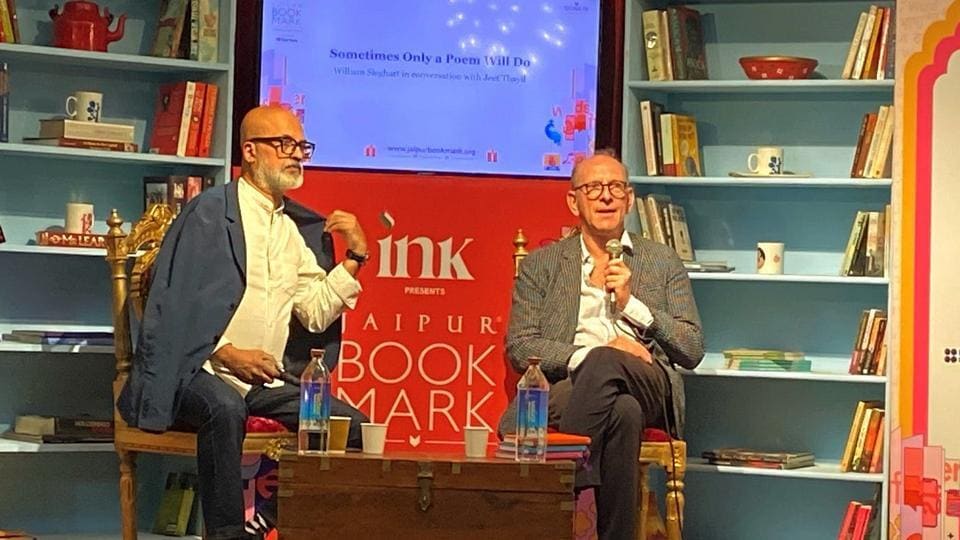
My knee has been screaming at me for days. I’ve been ignoring it, because of course slowing down feels impossible and loser-like. Until Philip Larkin, recited from memory in a room full of strangers, makes me finally stop.
It’s the end of Day 1 of the Jaipur Literary Festival and I am sitting at the edge of my chair. Facing me are William Sieghart, editor of The Poetry Pharmacy, and poet Jeet Thayil, in rich red brocade chairs against a backdrop of books.
“It’s as if we have all gone on fight or flight mode these days,” says Sieghart. His cure for this malady is poetry. “Reading poetry reduces your heart rate, slows your blood pressure, it is really very, very good for you,” he says, reciting both Larkin and then Mary Oliver.
I sit back and breathe. A bit. My brain and bandwidth feel clogged. My legs are cramped, my knee throbbing. A minor injury, it should have settled by now.
Is it possible I have been in ‘fight’ mode all this time? Fighting my impulse to slow down, to put aside a whole set of to-dos that really aren’t that important in the larger scheme of things?
And now here I am at the Jaipur Literary Festival—where everything moves fast and nobody stops. Time accelerates.
By 10 am the next day, I am already faced with an impossible choice. On the Front Lawns, Stephen Fry talks to two Cambridge academics about the Odyssey. At Charbagh, Rahul Bhattacharya talks to chess champion Viswanathan Anand.
I get greedy. Like Will and Lyra in Philip Pullman’s The Subtle Knife, I keep switching—Odyssey to chess to democracy to tech.
One moment I am listening to two Cambridge academics quarrel about Odysseus and his wayward ways with women—he wasn’t enjoying himself sleeping with goddesses, says the man.

The next moment, I am in the high-stakes world of chess tournaments. School children stand to read questions from their notebooks: How do you deal with failure? How did you handle losing?
“You always get a chance to play the next game. The best cure for losing a couple of games is to win the next one,” the five-time world chess champion replies.
Emotions run high. Manu Joseph infuriates with his provocative comments on ‘the poor’ and by his pride at never having voted (this said in a session on democracy!). Words can inflame as much as soothe, I realize. A day ago at the very same venue, Javed Akhtar had us laughing out loud with his words. And Banu Mushtaq, author of the International Booker Prize-winning The Heart Lamp, left us inspired with her quiet conviction.
The authors, poets, and academics use words with such exquisite skill, getting to the heart of what ails me, what ails all of us. We take the messages we need. Mine is to slow down, and to move from the online world into the real-life one.
While the architects of the internet warn of its toxicity, the authors offer an alternative: the slow, tactile world of paper and ink.
Rahul Bhattacharya speaks of how he wrote Railsong longhand on A4 yellow pads, so he wouldn’t be pulled in by the online world. Kiran Desai talks of the 20 years it took to write The Loneliness of Sonia and Sunny. “I allowed myself the luxury of this time and I am glad I did,” she says.

Jimmy Wales, the founder of Wikipedia, says he believes people online can be trustworthy, just as they are in real life, as opposed to trolls and toxic algorithms. Tim Berners-Lee, the inventor of the World Wide Web, confesses he is dismayed by what’s happening online; maybe certain apps (the ones many of us are on) should be banned.
I look down at my phone. Instagram is open. I’ve been scrolling between sessions, filling every gap with more input. I delete it right there. Afterwards I book a flight home for the same evening, carrying my copy of The Outsider: A Memoir for Misfits, the laugh-out-loud stories by the comedian Vir Das.
At home, I wake up to birdsong—the krrr of the golden oriole, the squawking of the parakeets, the chee-cheeping of the sparrows. It is time to move from a Memoir for Misfits to the beautifully illustrated The Backyard Bird Chronicles by Amy Tan.
“Doing a portrait had its own importance. Each of the thousands of strokes I made to create feathers became my meditation,” writes Amy Tan of the many pencil sketches she has made in this beautiful journal. The book helps me move from the screen to the page, from chasing to observing.
My knee still aches, but for the first time in weeks, I am not fighting the urge to sit still. I am simply, finally, taking the rest I was prescribed.
(Sonya Dutta Choudhury is a Mumbai-based journalist and the founder of Sonya’s Book Box, a bespoke book service. Each week, she brings you specially curated books to give you an immersive understanding of people and places. If you have any reading recommendations or reading dilemmas, write to her at sonyasbookbox@gmail.com. The views expressed are personal)


