
 E-Paper



Book Box: The Golden Road
At a Mumbai club, William Dalrymple highlights ancient India's global impact, blending history with storytelling, captivating an Indian audience.

 Prefer HTon Google


Dear Reader,
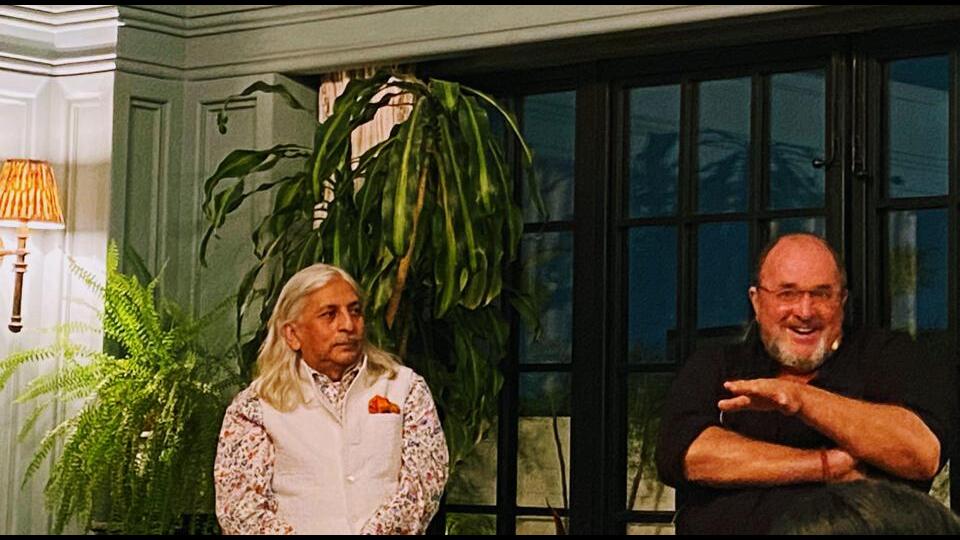
Who would have guessed that walking into a posh English club would be the way to learn about ancient India’s impact on the world?
Every time I am at Soho House in Mumbai, I feel I am in an English country house. This evening is no different. There are about thirty people on the eighth floor under the high roofed ceiling with crystal chandeliers, on sofas and elegant wickerwork chairs, against bookshelf covered walls with a view of the Arabian sea. At the L shaped bar there are glasses of red and white wine. Waiters circulate with avocado on crispy wafers and kebabs on a sheesh. Outside the Mumbai air is mildly muggy with the tang of the sea; inside it is deliciously dry and cool.
From a distance I see a platinum blond long haired man wearing a white Nehru jacket over a flowery shirt – it’s Sanjoy Roy, the emir of event management, who together with Dalrymple is the brawn and brains behind the Jaipur Literary Festival.
“Are you coming to Jaipur in January?” he asks us. We tell him this is our 20th year as a book club and that we travelled the silk route to Uzbekistan in celebration. “Then you must surely come to the Jaipur literary festival, we’ll give you an even more exotic experience”, he quips.
William Dalrymple, ‘Willie’ to those in the inner circle, arrives looking supremely at ease, a bon vivant, big with banter and bonhomie. Today the big bluff Scotsman is in black, in his trademark kurta and salwar.
Sanjoy Roy and William Dalrymple riff with each other, smiling, joking , inviting the audience into their charmed circle.
“Willie washed up on the shores of India 40 years ago,” begins Sanjoy Roy.
“Significantly slimmer’ interjects Dalrymple and everyone laughs.
Dalrymple is the man who made reading history sexy, says Roy, and for the next hour Dalrymple proceeds to prove him absolutely right.
Dalrymple has slides, he has beautiful illustrations of Chinese emperors, of a Buddha found in an ISIS stronghold in Egypt, of Ajanta caves, Ashoka inscriptions and Ankorvat. There are maps of the ancient world, of trade routes and of the areas where Roman coins were found.
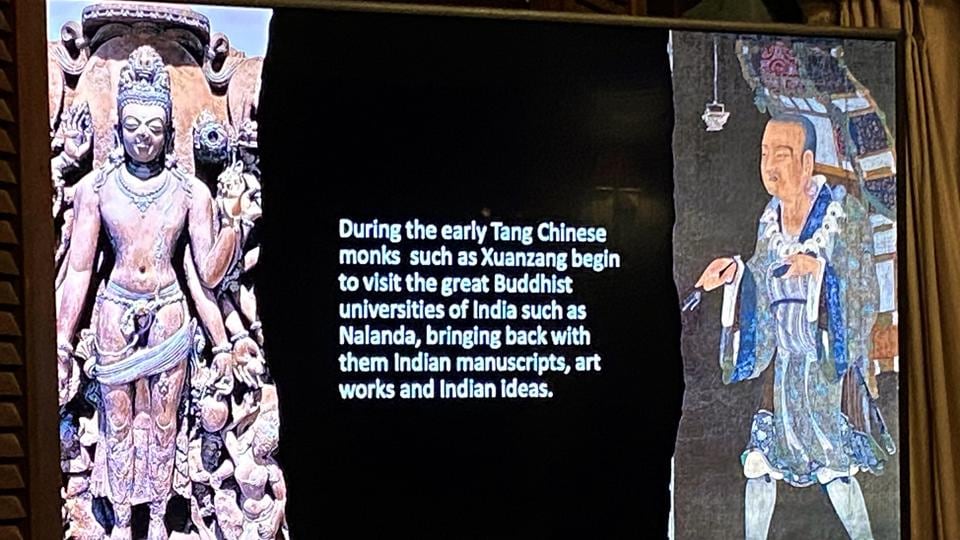
Ancient India’s contribution to the world has never been recognised, he intones. Part of the reason is colonialism – British colonialism.
“It’s worth getting angry about“ he declaims, quoting Macaulay saying a single shelf of a single library is worth more than all the literature of ancient India put together.
Ancient India gave the world Buddhism, Hinduism, the zero and the number system, Dalrymple summarizes.
And then he’s pulling us into his stories –of Zetian the 15 year concubine of the Chinese Emperor who schemes to become Empress. She makes Buddhism the state religion of China and appoints Indian Buddhists in positions of influence. Dalrymple re-tells our school history stories of Hieun Tsang and Ashoka, only this time we sit up and pay attention. This is the magic of Dalrymple - the erudition that he wears oh so lightly, his scintillating storytelling and his Scottish charm.
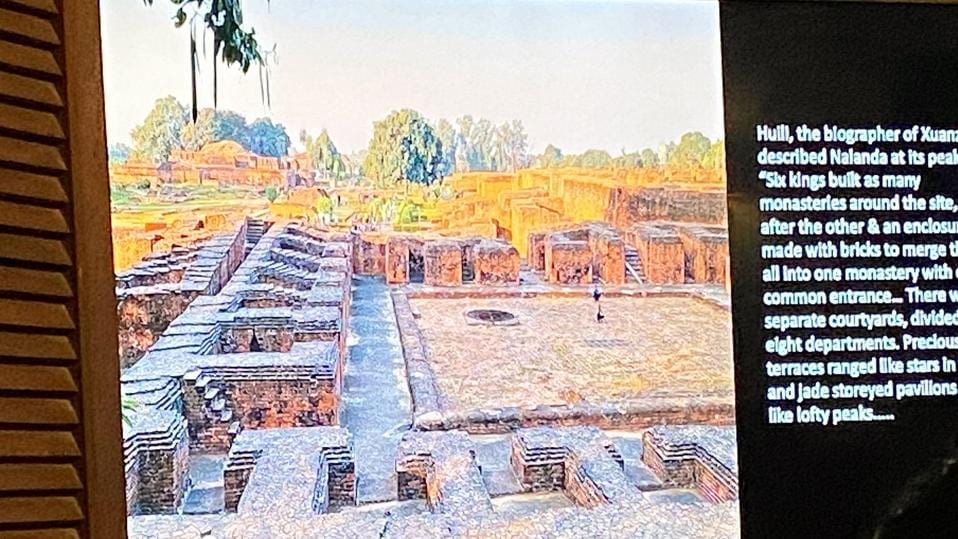
It’s all fascinating, we scribble notes and take pictures of his fantastic slides and then line up to have our books signed. Even though it does feel amusing to have a Scotsman tell us about how glorious we are, to prove it with his stories and his research and his hundreds of pages of footnotes.
“It’s odd, isn’t it ?” I tell my husband the next day. "An audience of Indians and he works the room brilliantly, telling us how fantastic our civilization was and then we all gush over him. Feels like we’ve been colonized all over again.”
“That’s the British for you - they are amazing historians. They plundered the world so efficiently that they had the leisure for intellectual curiosity, spending all day everyday in the archives. Indians will catch up,” he says matter of factly pointing towards our history shelf, heavy with books by Ramachandra Guha, Manu Pillai and Ira Mukhoty.
What about you dear Reader ? Who are your favourite history writers?
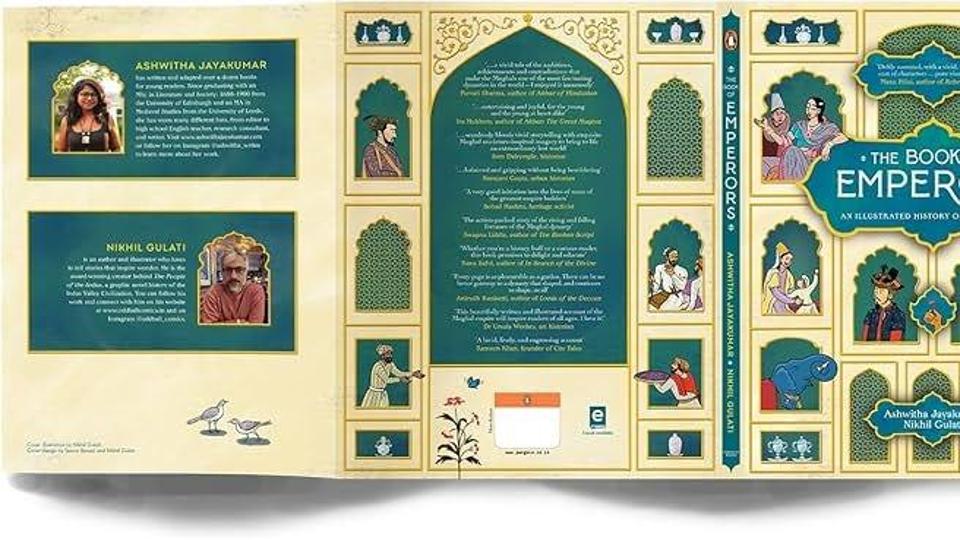
PS - On a related note, my favourite history book of this year, besides The Golden Road, is The Book of Emperors, exquisitely illustrated by Nikhil Gulati and written by Ashwitha Jayakumar. It’s so gorgeous I end up buying copies for all the children and teenagers I know.
Sonya Dutta Choudhury is a Mumbai-based journalist and the founder of Sonya’s Book Box, a bespoke book service. Each week, she brings you specially curated books to give you an immersive understanding of people and places. If you have any reading recommendations or suggestions, write to her at sonyasbookbox@gmail.com
The views expressed are personal


