
Camera trap for Odisha tiger census spot 35 in Similipal reserve: Official
STR director Prakash Gogineni said the camera trap set up for the headcount indicate 35 tigers in the reserve
BHUBANESWAR: Trap cameras set up in Odisha’s Similipal Tiger Reserve (STR) as part of the state’s headcount of tigers have spotted 35 Royal Bengal tigers, a senior state government official said on Monday.
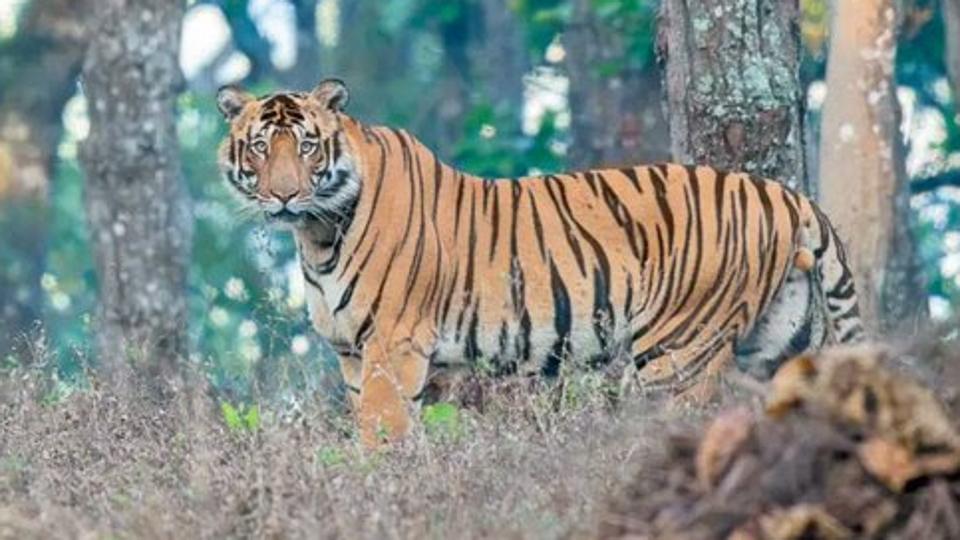
Odisha ordered the headcount after the ‘All India Tiger Estimation’ report suggested that the state’s tiger numbers have dropped from 28 in 2018 to 20 in 2022. In the Similipal tiger reserve, the report commissioned by the National Tiger Conservation Authority (NTCA) estimated 16 tigers.
STR director Prakash Gogineni said: “The complete data about the tigers will be known in January when the census gets over. It is learnt from the camera trap that there are about 35 Royal Bengal Tigers in the reserve. A clear picture will emerge after the counting concludes,” he said,
The Odisha government started its tiger census in October to back up its charge that the tiger census in STR did not accurately reflect the tiger population, arguing that a limited number of camera traps were put up. Besides, Odisha officials said the NTCA-led did not take into account suitable habitats in southern Odisha.
State wildlife officials argued that the NTCA methodology did not accurately reflect the presence, habitat occupancy and number of tigers in Odisha due to low sampling intensity.
“The NTCA report earlier said Similipal tiger reserve had a management effectiveness evaluation (MEE) score of 90.15 per cent which placed it among the 12 excellent tiger reserves of the country. We failed to understand how the number of tigers went down so much with such an MEE score,” a senior state official asked.
ABOUT THE AUTHORDebabrata MohantyDebabrata Mohanty is a senior assistant editor of Hindustan Times who works as state correspondent from Odisha covering the state's politics, governance, public policy, natural disasters, environment and its society for close to three decades. With his long years of reporting from the state capital of Bhubaneswar, Mohanty has been known as one of the most experienced and credible journalists covering Odisha for the national English dailies. His reporting combines on-ground detail with deep institutional knowledge detailing the state's changing politics, governance issues, administrative reforms and the functioning of its public institutions. He has regularly reported on issues ranging from legislative developments and public policy implementation. Politics is his core areas of expertise as he closely tracks Odisha's political landscape, including the rise and transformation of the Bharatiya Janata Party (BJP), the Biju Janata Dal (BJD), the two principal political parties in Odisha. His long association with the state's political establishment enables him to write on contemporary developments in a larger political context. Mohanty takes a deep interest in writing human interest stories, environmental issues and documenting the impact of cyclones, floods, heatwaves, and other climate-related events in one of the most disaster-prone states. His coverage extends to public health, governance reforms and stories on accountability of government institutions. Before joining Hindustan Times, Mohanty worked with The Indian Express, Mail Today, and The Telegraph, where he covered at least six general elections and as many assembly elections. In 2007, he was selected for the prestigious Chevening Young Indian Print Journalist Programme at the University of Lincoln, United Kingdom, where he received advanced training in print journalism. In 2009 he won the Press Institute of India-International Committee of Red Cross award on conflict reporting for his on-ground reportage of 2008 Kandhamal riots.Read More

E-Paper


