
 E-Paper



Can Grand Alliance 2.0 in Bihar avoid pitfalls of the past?
In the 2015 November assembly polls, the alliance had grabbed 174 of the 243 seats, posting a landslide victory against the Bharatiya Janata Party, which won just 53 seats.

 Prefer HTon Google


The likely formation of a second Grand Alliance government comprising Janata Dal (United), Rashtriya Janata Dal, Congress and the Left parties in Bihar has resurrected memories of the previous coalition from 2015 to 2017, when tensions over key decisions, especially on transfers and postings of officers in important departments, proved to be insurmountable.
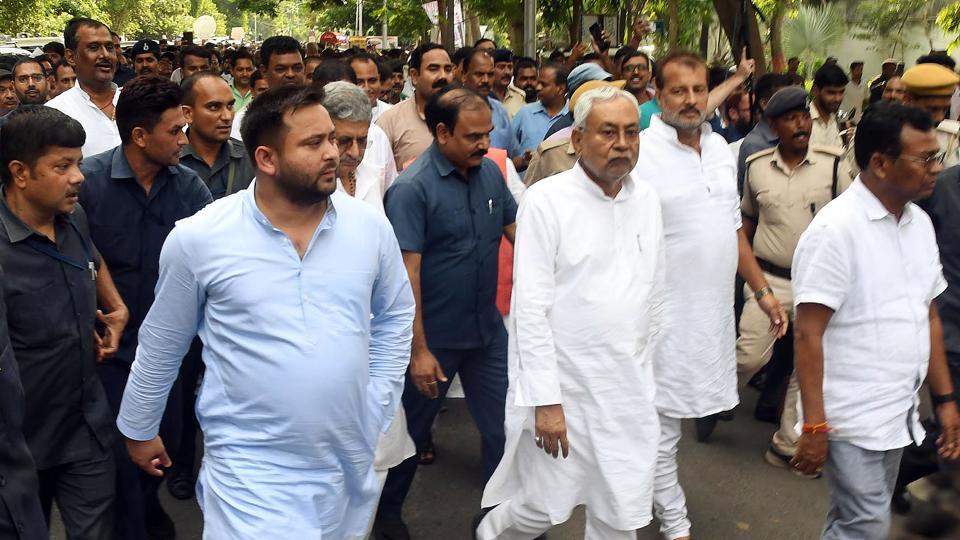
In the 2015 November assembly polls, the alliance had grabbed 174 of the 243 seats, posting a landslide victory against the Bharatiya Janata Party, which won just 53 seats. Chief minister Nitish Kumar headed the government and Tejashwi Yadav, younger son of ailing RJD chief Lalu Prasad, became youngest deputy chief minister of the state.
The performance of Grand Alliance government was a mixed bag, political observers recalled, with the JD(U) strongman pushing through his seven resolves programme (a poll manifesto to upgrade basic services such as infrastructure, health, education and environment, among others) and banning the sale and consumption of liquor in the state on 5 April, 2016.
The prohibition was seen as a stamp of authority of Kumar despite reports that RJD was not keen on a total ban. The RJD, however, had little choice but to approve Kumar’s decision as it did not want to antagonise the JD(U) leader just months after coming to power after losing it in 2005.
Also Read | Largest alliance partner, RJD eyes key portfolios, Bihar speaker’s chair
Another big project launched during that period was the six lane Kacchi Dargah-Bidupur bridge over Ganga that would connect Vaisali to Tajpur in Samastipur. The proposal went through with a key change in 2016; it also connected Raghopur, the assembly constituency of Tejashwi Yadav.
However, the two years of the Grand Alliance government showed signs of internal rift between the JD(U) and RJD over transfers and posting in key departments, especially those held by RJD ministers like road constriction (Tejashwi Yadav) , health (held by RJD chief’s elder son Tej Pratap Yadav), revenue and other departments.
The RJD started asserting itself and demanded autonomy in carrying out transfers and posting in the departments held by its ministers, which was not to the liking of the JD(U) chief on several occasions.
“In the Grand Alliance government, there was a visible change in the system of governance, with RJD trying to rein in the unbridled powers of bureaucrats, which was not liked by Kumar, who had given full powers to bureaucrats to carry out development work,” said D M Diwakar, social scientist and political observer.
The rhythm of development had changed in the previous Grand Alliance government, with ministers becoming more accountable to the people owing to pressure of coalition partners, Diwakar added.
The performance of the previous alliance was ordinary, and development works and governance was in doldrums due to pulls and pressures of the coalition partners, according to Nawal Kishore Choudhary, former principal of Patna College. “ With the JD(U) realigning with the RJD to form government once again, the governance in the state and development works would get affected once again because of pressure from constituents of the coalition,” he said.
The previous Grand Alliance government was also riddled with corruption charges and deterioration in law and order. BJP state leaders, including former deputy chief minister Sushil Kumar Modi, levelled allegations of soil purchase scam against Tej Pratap Yadav, who was accused of illegally awarding a contract to a company to fill earth at Patna zoo as environment minister. Later, Modi also accused Tejashwi Yadav of acquiring huge properties.
Chief minister Kumar snapped ties with RJD on July 27, 2017, alleging corruption by RJD ministers and realigning with the BJP to form a government.
The new edition of the Grand Alliance can learn from its mistakes and provide a better government in its second avatar, political observers said.
“If there is a better coordination between the alliance partners, and there is a common minimum programme, the pressure from allies would be less,” Diwakar said.


