
 E-Paper



Can’t let trial become punishment: SC grants bail to murder accused
A bench of justices Hrishikesh Roy and R Mahadevan stressed that an accused has a right to a fair and expeditious trial, as guaranteed under Article 21 of the Constitution


The Supreme Court has granted bail to an accused in a murder case, underscoring the importance of ensuring that the legal process does not itself become a form of punishment for the accused.
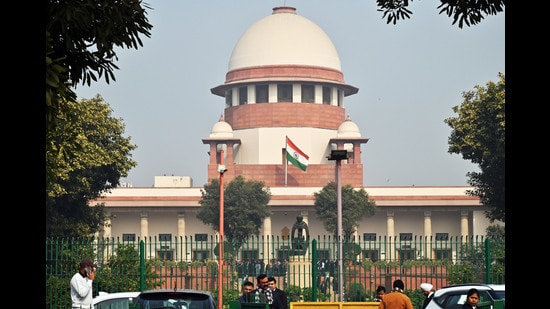
A bench of justices Hrishikesh Roy and R Mahadevan stressed that an accused has a right to a fair and expeditious trial, as guaranteed under Article 21 of the Constitution.
“An inordinate delay in the conclusion of the trial would infringe upon the right of an accused,” noted the court in its order on Monday, highlighting that while a hasty trial may jeopardise the defence, prolonged trials are equally concerning as they infringe upon the basic rights of the accused.
“An accused has a right to a fair trial and while a hurried trial is frowned upon as it may not give sufficient time to prepare for the defence, an inordinate delay in conclusion of the trial would infringe the right of an accused guaranteed under Article 21 of the Constitution,” stated the court order.
Quoting Oscar Wilde’s famous lines from “The Ballad of Reading Gaol”, the court empathised with the prolonged incarceration of those awaiting trial. “It is not for nothing the author Oscar Wilde… wrote... ‘All that we know who be in jail / Is that the wall is strong; / And that each day is like a year, / A year whose days are long,’” remarked the bench, citing the psychological toll of incarceration without a timely resolution.
The order added: “Considering the above and to avoid the situation of the trial process itself being the punishment particularly when there is presumption of innocence under the Indian jurisprudence, we deem it appropriate to grant bail to the petitioner – Balwinder Singh.”
With this order, the Supreme Court has once again reinforced the importance of maintaining the balance between a fair trial and preventing undue punishment through protracted legal proceedings.
In separate recent judgments, the top court has reiterated that bail is the rule, and jail an exception, even in cases filed under stringent laws such as the Unlawful Activities Prevention Act (UAPA) and Prevention of Money Laundering Act (PMLA). The apex court has also cautioned subordinate courts to be careful while staying bail orders. On Monday, in a detailed judgment, ruled that a person in custody for one offence can still apply for anticipatory bail in relation to a different offence, asserting that the right to personal liberty under Article 21 of the Constitution must be preserved unless explicitly restricted by law.
The court order came while granting bail to Singh, an accused in a 2020 murder case. In its order, the court noted that Singh was in custody for nearly four years since his arrest in June 2020, with significant delays in the trial.
The bench further pointed out that, of the 47 witnesses listed by the prosecution, only 21 were examined, and 17 more were yet to testify. Despite the Punjab and Haryana high court’s earlier direction to conclude the trial within five months, it became evident that this timeline would not be met due to the slow pace of proceedings.
The court expressed concern that the prolonged detention of Singh, particularly when six of his co-accused were already granted bail, was unjustified. It stated that the principle of “presumption of innocence,” central to Indian jurisprudence, must be upheld.
“In the present case, the prosecution wishes to examine 17 more witnesses, making it unlikely that the trial will conclude anytime soon. To avoid the situation where the trial process itself becomes a punishment, we deem it appropriate to grant bail,” the order read.
The court directed the trial court to impose appropriate bail conditions, ensuring Singh’s cooperation in the ongoing trial. It warned that any violation of these conditions could lead to the cancellation of his bail.
Ends


