
 E-Paper



CBSE, ICSE schools scramble to prepare for board exams
The exams for the remaining few CBSE Class 12 subjects are slated to be held from July 1 to July 15. But with the number of new cases climbing, the question arises whether it is advisable to hold exams involving thousands of students in such circumstances and should such exams be mandatory or optional.

 Prefer HTon Google


As the capital continues to witness an increasing number of Covid-19 cases in the past few days, schools across the capital are worried over the pending Central Board of Secondary Education (CBSE) and Indian School Certificate Examinations (ICSE) exams slated to be conducted in July.
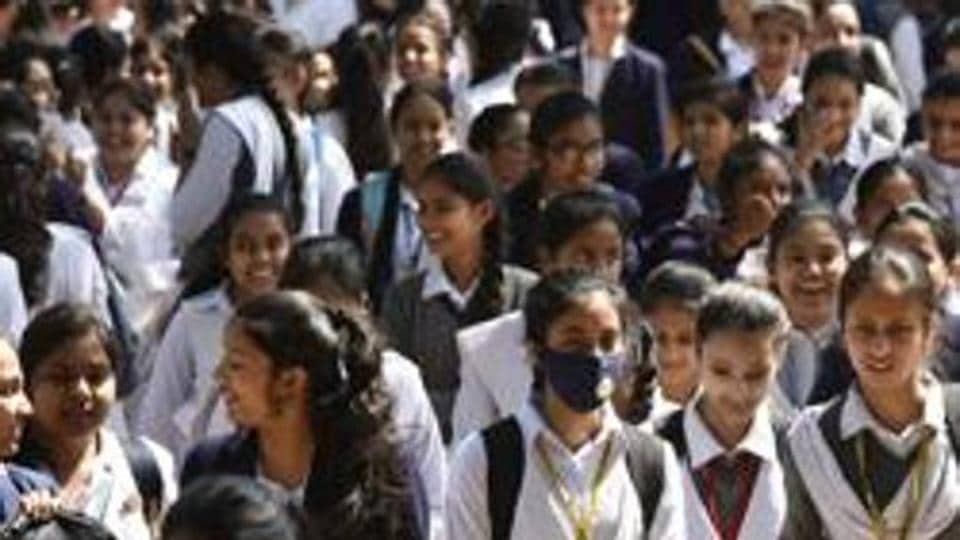
The exams for the remaining few CBSE Class 12 subjects are slated to be held from July 1 to July 15. But with the number of new cases climbing, the question arises whether it is advisable to hold exams involving thousands of students in such circumstances and should such exams be mandatory or optional.
Officials of the CBSE, however, are optimistic that they will be able to do a sound job even in the present scenario.
“We are confident that all norms set by the government for social distancing will be followed. The CBSE is planning to hold them in over 13,000 schools. So, naturally, there will be no crowding. We are confident that the proper distance will be maintained. The use of masks and sanitiser will be allowed. Safety is definitely important,” a senior CBSE official said, adding that there was a possibility of there being no more than 12 students in a classroom.
With schools are closed for the summer vacation, most principals are engaged in fumigating the premises regularly to prepare them for the board exams. They are also waiting for CBSE guidelines on how question papers will be shared with schools.
“We will switch off our air conditioning systems and instead open our windows and use fans. Students are likely to experience discomfort while writing their papers in the July heat while wearing masks,” Sangeeta Arora, principal of KR Mangalam School, Greater Kailash II, said. She also added that principals are concerned over what would transpire if a student’s temperature was slightly higher than the permissible limit on the school premises.
School administrators are also worried about managing students once they reach the school premises. “When children see their friends after a long time, they will want to sit with them and discuss the paper. The school will not be able to prevent from doing so. We may also require additional manpower for repeated cleaning,” she said.
Government schools are likely to face additional challenges as many are still functioning as dry ration distribution centres for the Delhi government. Heads of schools have planned separate entries for the students and those coming to the schools to collect ration.
Awadhesh Kumar Jha, principal of Sarvodya Co-ed Vidyalaya in Rohini, said conducting the board exams will be extremely difficult. “Getting the question papers to school is also a challenge. This will increase the chances of contact in the present circumstances. Students could try to hide their symptoms and come to write the exams because they wouldn’t want to skip them. Teachers are already afraid of coming to the premises because distributing answer sheets and collecting them means there will be a lot of contact,” he said.
Asked if rather than make it mandatory, they could give the students the option to appear in exams or be assigned marks according to a set formula, the CBSE official cited above said those decisions could only be taken after a detailed discussion. “There are options on the table. However, as of now, we are moving ahead with the exams,” the official said.
The CBSE has already decided to not hold exams in foreign schools affiliated to it.
“We have detailed bylaws for examinations. And these bylaws also empower the chairman of the board to take important decisions. We are preparing rules for every aspect of the exams. This is a challenging time, but we must keep in mind that CBSE has decades of experience in holding exams,” another CBSE official said.
Principals have reported that many workers refuse to come and sanitise the schools as they can be high-contact areas. While thermal screening measures will be available at exam centres, the students’ temperatures are likely to be recorded higher than actual body temperature due to the heat.
Tania Joshi, principal of Indian School, said, “Extra care will have to be taken while cleaning chairs and tables and working out the invigilation duties of teachers. We are still planning on how to procure sanitiser, masks and gloves for the students. The weather in July is humid and students may have difficulty writing while wearing gloves. We have to keep these things in mind.”
Meanwhile, several parents have been taking to social media to express concerns about the safety of their children. A Twitter poll conducted by one of the users showed that nearly 84% of parents had concerns about their children’s safety.
A petition has also been filed in the Supreme Court arguing that the exams were putting the safety of students in peril, but the matter is yet to be heard.
Several schools, including around 200 Kendriya Vidyalayas and Jawahar Navodaya Vidyalayas, are functioning as quarantine centres. AIIMS director Randeep Guleria had earlier indicated that Covid-19 could peak in India in July.
Significantly, Delhi’s Shastri Bhawan, from where the HRD ministry functions, has seen scores of Covid-19 cases in the past few days.
A senior HRD ministry official said the government was aware of the situation and would take a decision keeping all facts in mind.
“The ministry is constantly monitoring the situation. It is aware of the concerns. Decisions will be taken keeping all aspects in mind,” said an official. Significantly, the ministry has lined up the JEE and NEET exams once the CBSE exams are over. A decision on the CBSE exams could have a bearing on the entire academic calendar.
Meanwhile, a group of parents also expressed concerns on the Class 12 exams planned by the ICSE board.
In a statement released to the media, the parents asked a range of questions: Who will ensure the safety of our children? One asymptomatic child or invigilator can infect all others in that classroom. The viral load of being in the same room for four hours is very high. How would children who use public transport travel? What happens if a student is infected before the exams? What if the exam centre or the child’s home is in a containment zone? Specifically, for Class 10, why is it so essential to hold exams?
The ICSE board has also said that it would hold the remaining exams for classes 10 and 12 in the first fortnight of July. Attempts to get a response from ICSE did not fructify.
As for CBSE, it would conduct 27 exams in the first half of July.
It is estimated that the maximum number of students will appear for the Business Studies exam for Class 12. Over 3.5 lakh students are expected to take this exam. Among other subjects, the Hindi exam will see around 3 lakh candidates, Geography over one lakh, Home Science around 60,000 and Sociology around 50,000 candidates.
With inputs by Kainat Sarfaraz


