E-Paper



Centre, Delhi take slew of steps to cut pollution
Delhi CM Rekha Gupta announced the formation of a high-powered expert committee to monitor, review and recommend measures to manage pollution in the Capital


The Centre and the Delhi government shored up their action against the persistent pollution crisis in the region on Wednesday, announcing a state-level monitoring panel and ordering over 2,000 industrial units to install real-time emission trackers and control systems by the end of the year.
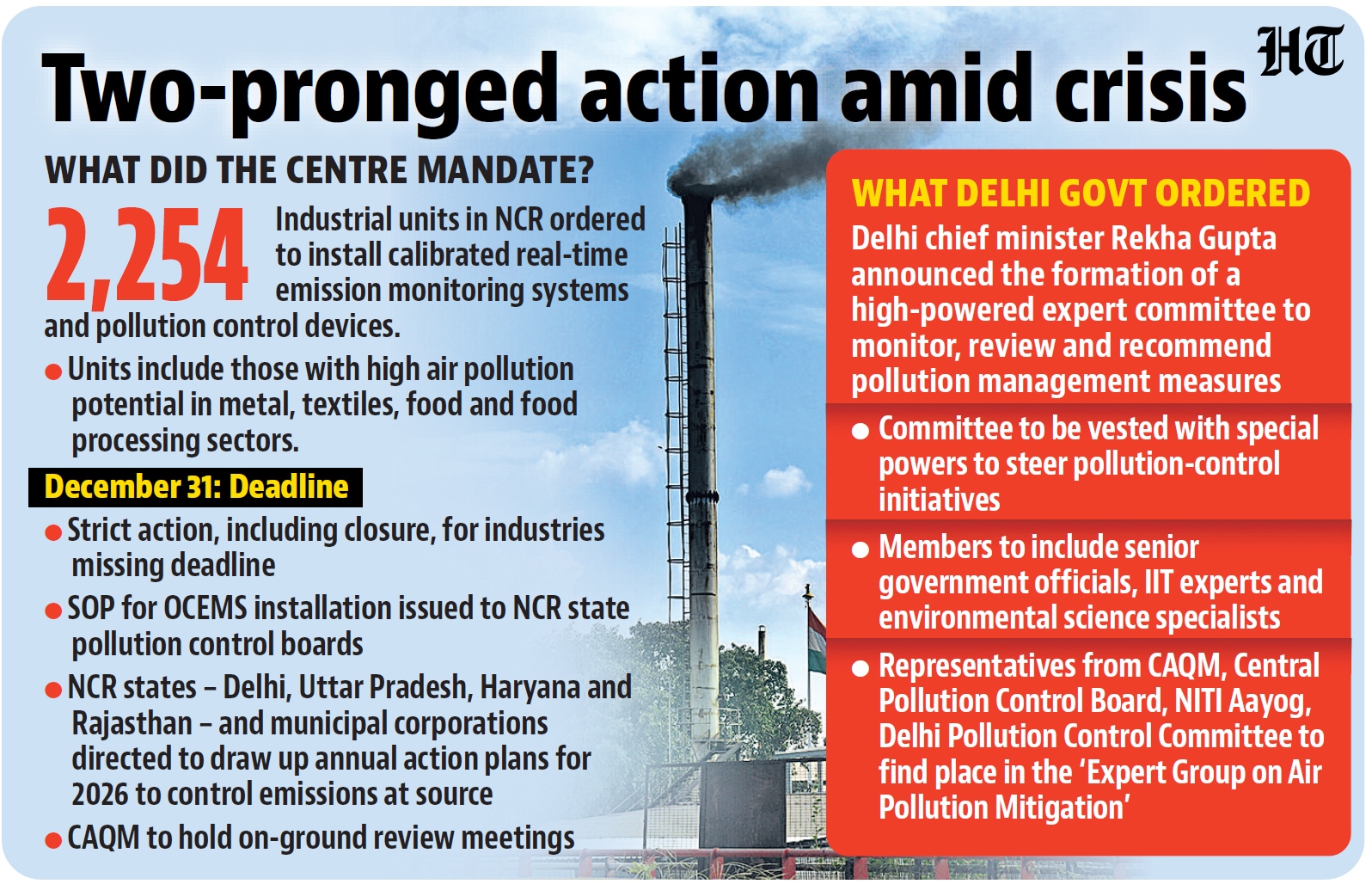
At the central level, the Union environment ministry ordered 2,254 units – labelled as those with “high air pollution potential”, or “red” category industrial units – to bake in calibrated Online Continuous Emission Monitoring Systems (OCEMS) and Air Pollution Control Devices (APCD) by the end of the year. Units that don’t comply may be shut, said officials aware of the matter.
At the state government level, Delhi chief minister Rekha Gupta announced the formation of a high-powered expert committee that will continuously monitor, review and recommend measures to manage pollution in the Capital.
Speaking at a review meeting of key departments, Gupta said the expert committee would be vested with special powers to steer pollution-control initiatives with greater urgency and effectiveness.
“The committee will include senior officials from the concerned government departments, as well as experts from IIT and specialists in environmental science. The committee will also be granted special powers by the government,” Gupta said.
The Centre’s decisions were taken at a review meeting chaired by Union environment minister Bhupender Yadav, as Delhi breathed another day of “very poor” air.
NCR houses 2,254 units labelled as those that have “high air pollution potential”. All of these were ordered to install calibrated Online Continuous Emission Monitoring Systems (OCEMS) and Air Pollution Control Devices (APCD) by the end of the year.
“Though this year we have seen fewer severe air quality days compared to last year, air pollution is an issue of concern for Delhi and the entire region. So in the six meetings since August 8, we have considered and directed several measures on controlling emissions at source,” said Yadav. “We, along with CAQM, have asked Delhi government and other NCR governments to prepare an annual plan for the next year. We have discussed the issue of installing emission monitoring devices, paving of roads to keep dust down and most importantly addressing traffic congestion at 61 traffic hot spots.”
Representatives of NCR state governments, civic bodies, police, ministries of road transport and housing, as well as from CAQM were represented at the Centre’s meeting.
To be sure, none of these industries – which primarily deal with metal, textiles, food or food processing – is located in Delhi. Haryana has nearly 2,800 red category industries across the state, with over 1,200 located in Manesar, Faridabad and Ballabhgarh alone.
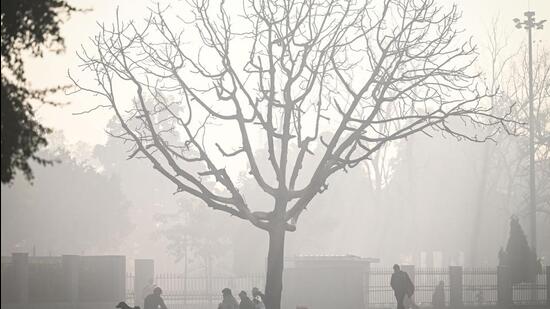
The moves come as the national capital finds itself in the centre of yet another streak of hazardous winter air.
Delhi’s environment minister Manjinder Singh Sirsa, speaking about the high-level panel that is likely to be known as the Expert Group on Air Pollution Mitigation, underscored the need for a holistic and evidence-based approach.
“With rising concerns over deteriorating air quality, the Delhi government has decided to constitute this expert advisory group to guide, suggest, evaluate and strengthen its actions on air pollution abatement and mitigation. The experts will monitor the implementation process by the government agencies and suggest scientific measures that need to be adopted to reduce pollution in Delhi,” he said.
The group is expected to function as a high-level advisory body that will drive policy, suggest technological interventions and ensure course-corrections where required. Members will comprise representatives from national and regional regulatory bodies such as the Commission for Air Quality Management (CAQM) and the Central Pollution Control Board (CPCB), along with strategic policy experts from NITI Aayog. The chairman of the Delhi Pollution Control Committee (DPCC) and the state’s environment secretary will also be part of the committee.
Specialists from institutions such as The Energy and Resources Institute (TERI) and technical institutions including the Indian Institutes of Technology (IITs) and the Indian Institute of Science (IISc) will weigh in with scientific inputs.
As an additional measure, around 128 units in Delhi have been asked by DPCC to install OCEMS by December 31, said Sirsa.
Speaking about the Centre’s plans, the CPCB chairperson Vir Vikram Yadav said 2,254 highly polluting industries in Delhi-NCR have not yet installed and connected their Online Continuous Emission Monitoring Systems (OCEMS) to the CPCB server.
“Strict action, including closure, will be taken against industries that do not meet the December 31 deadline,” he said.
According to officials, the industries in question had been briefed and prepared about mandatory installation of OCEMS in August. Stakeholder meetings were also held for consultations, officials said.
All medium and large red-category units in the food and food processing, textile and metal processing sectors in Delhi-NCR are mandated to install OCEMS for real-time monitoring of emissions, stack gases and industrial operations, added Yadav.
Industries have also been told to install air pollution control devices by December 31, failing which action will follow, he said.
Delhi breathed 24 straight days of “very poor” or worse air between November 6 and 29, when the air quality index (AQI) stayed above 300. The Capital also clocked three days of “severe” AQI, from November 11 to 13, in this time.
OCEMS are devices that measure pollutant concentrations and flow in industrial chimney stacks and relay this information at frequent intervals to the state and central pollution control boards. APCDs include electrostatic precipitators, fabric filters, and scrubbers which help control emissions from industries at source.
There are around 3,500 industries in NCR that have been identified as having “air pollution potential”.
Officials said OCEMS will be connected to the Central Pollution Control Board (CPCB)’s server to hone in on industries that breach emission thresholds. Officials aware of the matter said that escalations in the market prices of these devices are being monitored closely, to not discourage industrial units and delay device installations, they added.
An SOP for OCEMS installation has been issued, and directions have been given to NCR state pollution control boards for ensuring early installation by industries.
At the meeting, it was also decided that NCR states – Delhi, Uttar Pradesh, Haryana and Rajasthan – and municipal corporations will draw up annual action plans for 2026, to control emissions at source.
Yadav said he expects the plans to be executed within strict deadlines, with clear weekly and monthly targets.
During the meeting, he also directed that on-ground review meetings be held to ensure that the action plans are being implemented. The meetings will be helmed by CAQM and will include discussions with the agriculture departments of Punjab and Haryana on stubble burning; with the Union housing and urban development ministry on steps to chalk out urban development; and with local bodies of NCR cities on tackling local contributors of pollution.