
Sign in

Centre intervenes as Odisha-Chhattisgarh dispute over Mahanadi boils

As politics over sharing of the Mahanadi boils, the union government has asked the Central Water Commission to look into Odisha’s concerns

Published on: Sep 24, 2016, 14:40:18 IST
By , New Delhi
Share
Share via
  • facebook
  • twitter
  • linkedin
  • whatsapp
Copy link
  • copy link

As politics over sharing of the Mahanadi boils, the union government has asked the Central Water Commission to look into Odisha’s concerns, but refrained from directing neighbouring Chattisgarh to stop work on 11 projects being developed on the river.
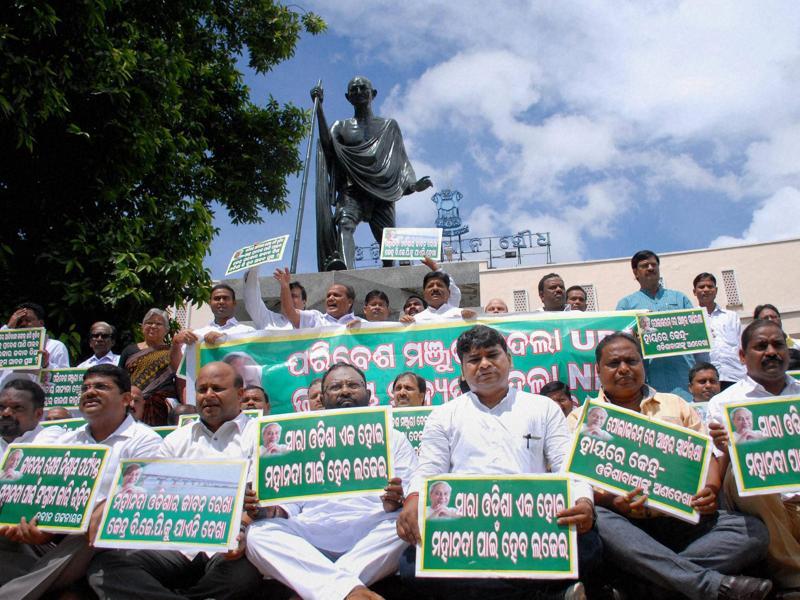
Biju Janata Dal MLAs sit on dharana on Mahanadi water issue near Mahatma Gandhi statue in Assembly premises on the 2nd day of monsoon session in Bhubaneswar on Thursday. (PTI Photo)

Odisha had been crying foul over Chattisgarh’s decision to maximise use of its share of the Mahanadi water for irrigation and industrial use by building reservoirs and inter-linking some of the river’s tributaries, saying it will reduce river flow and deplete Hirakund Dam.

Not perturbed by Odisha’s clamour, Chhattisgarh has started construction of six barrages — primarily for industrial use. Some of these projects were approved by the CWC after seeking comments from Odisha.

In addition, survey has started on four projects diverting water from Arpa river, a tributary of Mahanadi, and the Pairi-Mahanadi river-linking project.

The projects are basically to store excess monsoon water in the Mahanadi for use in lean period and will help industry and agriculture, a Chhattisgarh government official said. There will be no effect on water-flow to Odisha, he added.

In a presentation to the Water Resources ministry, the Chattisgarh government said the barrages will have a total capacity of 274 mcm (million cubic meter), much less than the lost storage in Hirakund due to siltation.

This means the dam does not have capacity to store excess water. Hirakud, built on Mahanadi in Odisha in 1957, had lost 995 mcm, which is 18% of its 5,518-mcm storage capacity.

“What we are taking from Mahanadi is not from Odisha’s share,” the official said. “In fact, the live storage capacity of our dams on the river have also done down by 345 mcm due to siltation. The storage capacity of new barrages would be less than that.”

The Chattisgarh government also claimed that Odisha’s own data shows an increase in the river’s non-monsoon water-flow, meaning its projects do not endanger the Hirakund.

Odisha, on the other hand, questioned the Chattisgarh government’s approach of treating the impact of each project individually and not in an integrated manner.

The water resources ministry officials said Odisha wants a cumulative impact study of all projects that have been developed by Chhattisgarh on the flow of water to Hirakund, rather than individual—on the ground that these projects “dramatically” reduce the water flow.

“The differences are huge between the two states, and could not be resolved,” the official said with reference to tripartite meeting at the ministry last week. “We have assured Odisha that the CWC will examine their claim that water flow to Hirakund will reduce if Chattisgarh is allowed to build the projects.”

The ruling BJD in Odisha had turned the Mahanadi dispute into a political issue to hit BJP — the party in power in Chhattisgarh — that aspires to form the next government in one of India’s poorest states. Elections in the state will happen with general polls in 2019.

Adversely hit, the Odisha BJP on Friday accused chief minister Naveen Patnaik of striking a secret deal with his Chhattisgarh counterpart Raman Singh, saying the CM of the BJP-ruled state has forgotten about the issue now.

Patnaik has already met Prime Minister Narendra Modi. His party MPs stalled Lok Sabha proceedings for a day, accusing the Centre of being biased in favour of Chhattisgarh.

  • Chetan Chauhan
    ABOUT THE AUTHOR
    Chetan Chauhan

    Chetan Chauhan is the National Affairs Editor looking into all aspects of news and features from across India. A Chevening scholar with over three decades of experience in reporting and news management, Chetan has extensively covered all important aspects of the social sector, political economy, environment and climate change nationally and internationally. He did a journalism course at the Reuters Institute of Journalism in Oxford and Digital Media training at Nanyang Technological University in Singapore. He started as a reporter with The Statesman in 1996 and joined the Hindustan Times in 2000 in the metro bureau covering environment, crime and Delhi politics. He covered hot local news, from the Jessica Lal murder case to the rebellion of Delhi Congress MLAs against then Chief Minister Sheila Dikshit, to the replacement of toxic vehicle fuel with cleaner compressed natural gas (CNG) in the national capital. Some of his stories on air pollution became part of the Supreme Court’s landmark MC Mehta versus Government of India case in the National Capital Region (NCR), forcing the government to take corrective measures. As part of the national political bureau since 2004, he covered important central sectors such as environment, education, social justice, labour, rural development, water resources, renewable energy, agriculture, broadcasting and the Planning Commission for more than a decade producing several exclusive and investigative breaking stories. His specialisation is the environment, having covered at least a dozen United Nations global conferences on climate change, biodiversity and wildlife including climate summits in Paris, Copenhagen and Bali. He also covered India’s two five-year plans ---11th and 12th and reported on drafting and execution of right based laws such as Right to Education, Right to Information and rural job guarantee law, MG-NREGA, now being introduced in new format as VG-RAM-G Act. He has in-depth knowledge of social sector issues. He was one of the first to report on tigers vanishing from Sariska and Panna wildlife reserves in 2004 and 2008, respectively, leading to the setting up of the National Tiger Conservation Authority (NTCA) and the introduction of stringent penal provisions for poaching. He has written extensively on the rising human-animal conflict in India and the degradation of India’s biodiversity hotspots because of mining and other activities. Since 2004, Chetan has covered Parliament comprehensively and participated in training on the nuanced coverage of Parliament proceedings. He has travelled extensively across India to cover national and provincial elections since 1998, especially in the Hindi heartland states, considered India’s road to power. He writes a regular column for Hindustan Times, Ecostani, on important national politics, economy, Himalayan ecology and environmental issues. His other responsibilities include providing inputs for edits and edit page articles for the publication, apart from managing news flow from across India.Read More

Get the latest India News, breaking headlines and real-time updates from across the country. Stay informed about politics, government policies, crime, weather and major national developments.