The Centre has moved the population count in Uttar Pradesh, Punjab, Goa and parts of Uttarakhand to December, two months ahead of the rest of the country, clearing the census out of the quarter in which all four states are expected to go to the polls, according to a gazette notification issued on Saturday.
Caste count to precede polls
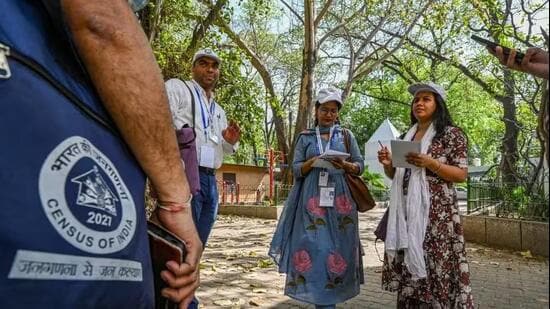
The advance means the first caste enumeration in independent India will likely be held weeks prior to people in these four states casting their vote.
Enumerators will begin door-to-door work in the four states on December 1 and finish on January 4, with a revision round — a short follow-up to update households that changed after the first visit — running to January 9. Self-enumeration, under which residents enter their household details online before an enumerator calls, opens on November 16.
The rest of the country will be counted from February.
Staff shortage drives schedule change
A senior official aware of the matter, who asked not to be named, said “the dates for poll-bound states have been advanced to have manpower available for elections as well as Census, because a large number of staff used in both the exercises are teachers or state government staff”. Teachers and state government employees staff both the census and polling booths.
In the last elections in these four states, polling began on February 10, 2022, with the model code of conduct having kicked in on January 8, 2022, the day the Election Commission announced the schedule.
{{/usCountry}}In the last elections in these four states, polling began on February 10, 2022, with the model code of conduct having kicked in on January 8, 2022, the day the Election Commission announced the schedule.
{{/usCountry}}The census will put 40 questions to every household, 11 more than in 2011. Question 10 asks respondents to declare caste in open-ended format, meaning enumerators record what is stated without matching it to any prepared list. Others seek parental details, passport, Aadhaar, voter ID, driving licence and mobile numbers.
Among the four poll-bound states, caste arithmetic is seen as a particularly key factor in Uttar Pradesh and Punjab.
Reference date advanced for four states
The notification, issued by registrar general of India Mrityunjay Kumar Narayan, also advances the reference date for the four states — the moment at which the data collected is treated as valid — to 00.00 hours on January 5, 2027. For the rest of the country it remains March 1, 2027.
Uttarakhand will be counted in two tranches. Its snowbound belt — 131 villages and three towns across Uttarkashi, Chamoli, Rudraprayag and Pithoragarh, covering about 52,000 people, according to the state census directorate — is being enumerated now, alongside Ladakh and the snowbound areas of Jammu and Kashmir and Himachal Pradesh, where field work began on September 1 against an October 1 reference date. The rest of the state follows in December.
Digital census rolls out nationwide
Census 2027 is the first to be conducted digitally, on a dedicated mobile application that works online and offline and a portal that monitors field operations in real time. The compressed five-week window in the four poll-bound states will run entirely on that system.
Data collection nationally is targeted to conclude by March 1, 2027, though officials have said collation and publication will take a further two to three years.
Voters in Uttar Pradesh, Punjab, Goa and Uttarakhand will go to the polls with the count taken and the results years away.
Opposition questions timing
The Opposition questioned the change in schedule. “This shows shoddy planning since it was known that these elections were due. Why the sudden dawn of wisdom? Undoubtedly there are some nefarious political calculations afoot,” senior Congress leader Jairam Ramesh said.
In a separate notification on Saturday, the RGI deferred the census in Manipur “till further declaration”, formalising a decision taken on August 31 amid violence and demands to update the National Register of Citizens before the population count.