E-Paper



Centre to soon launch Rhino conservation project: Bhupendra Yadav
The Pygmy Hog—the world’s smallest and rarest wild pig—will be included in the list of “critically endangered species” under a central conservation scheme.

 Prefer HTon Google


Union environment minister Bhupender Yadav on Thursday announced that a dedicated project for the conservation of the greater one-horned rhinoceros will soon be launched, while the Pygmy Hog—the world’s smallest and rarest wild pig—will be included in the list of “critically endangered species” under a central conservation scheme.
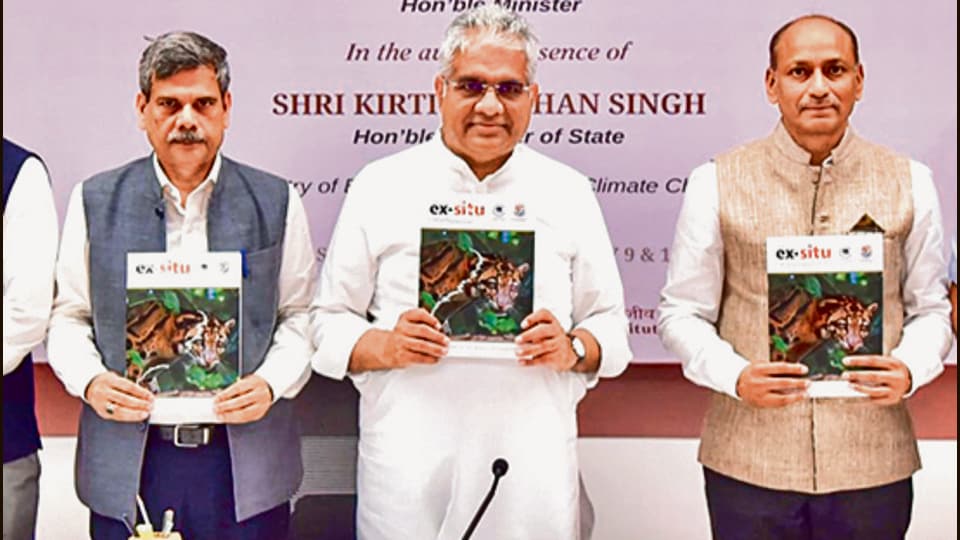
The announcements were made during a series of wildlife conservation meetings chaired by Yadav in Coimbatore, including the 91st meeting of the Standing Committee of the National Board for Wildlife (SC-NBWL) and 46th Meeting of the Central Zoo Authority (CZA), where the progress of Project Great Indian Bustard (GIB), Project Sloth Bear and other conservation initiatives was reviewed.
“A dedicated project for rhino conservation will be launched soon with the assistance of National CAMPA in the species’ range states,” the environment ministry said in a statement.
The ministry added that the Pygmy Hog would be included in the list of critically endangered species under the Centrally Sponsored Scheme of Integrated Development of Wildlife Habitats (CSS-IDWH), which provides financial assistance to states to protect certain species or wildlife areas.
The Pygmy Hog is the sole representative of the genus Porcula, a species first described by naturalist Brian Houghton Hodgson in 1847. Conservationists consider its survival crucial because its extinction would erase an entire evolutionary lineage of wild pigs.
The meeting also reviewed progress under the Great Indian Bustard conservation programme. Yadav said a second “jumpstart” attempt to reintroduce the critically endangered bird in Gujarat’s Naliya landscape had shown encouraging results, with a chick born on May 21, this year, surviving beyond the critical first 40 days.
The jumpstart technique involves placing an incubated fertile egg from a captive breeding programme into the nest of a wild female, allowing the chick to hatch and be raised in its natural habitat.
“Besides this, the total number of GIB chicks born in captivity in Rajasthan at Sam and Ramdevra have reached 98. The project will soon be entering into a re-wilding phase for which efforts are on,” Yadav said.
The Standing Committee also discussed a long-term conservation strategy for the greater one-horned rhinoceros based on a rhino DNA indexing system and reviewed more than 100 proposals involving roads, defence infrastructure, power lines, water supply and other development projects requiring wildlife clearances.
On the same day, the minister was involved in the 29th meeting of the National Tiger Conservation Authority (NTCA) where key policy, management and institutional issues relating to tiger conservation and wildlife management in the country were discussed. Following the meeting, two publications, one on the status of tiger reserves in the country and the second on rescue and rehabilitation of wild animals in tiger landscapes, were also released.
EOM