
 E-Paper



Char Dham road: Supreme Court asks Centre about concerns over landslides
To be sure, the panel’s minority view -- which has been backed by several experts -- said that expanding the roads would be detrimental to the fragile Himalayan ecosystem.


The Supreme Court on Wednesday asked the Centre to explain how it will assuage the concerns of people in landslide-prone zones falling within the Char Dham road expansion project in Uttarakhand, after a 26-member expert committee in December 2020 gave a majority opinion permitting expansion of the double-lane carriageway of three strategic roads leading to the Indo-China border up to 7 metres.
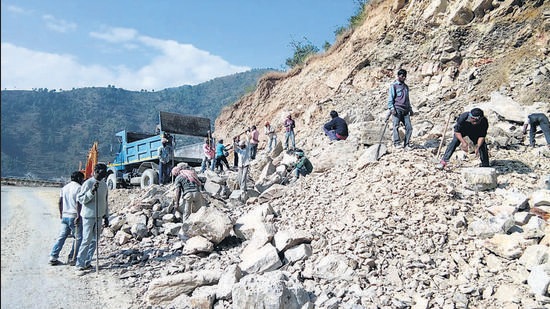
To be sure, the panel’s minority view -- which has been backed by several experts -- said that expanding the roads would be detrimental to the fragile Himalayan ecosystem.
Referring to the report by the High-Powered Committee (HPC) submitted to the court in December 2020, a bench of justices Dhananjaya Y Chandrachud, Surya Kant and Vikram Nath said: “The majority report, which allows you to expand, also says that within these areas there are certain zones which are landslide prone. What steps will you take to ensure agencies carrying out the development do not oversee these concerns? Also, tell us what modalities you wish to set out to assuage these concerns before we set out to consider your application.”
The court was hearing two applications filed by the Union defence ministry (MoD) and the road transport and highways ministry (MoRTH) seeking permission to extend the width of the Char Dham road project from the present 5.5 metre, fixed by the court in September 2020, to 7 metre (or 7.5 metre at raised kerb) along with paved shoulder space of 1.5 metres on both sides of the road. For its September verdict, the court went by a March 2018 circular of MoRTH which restricts width of roads in hilly terrain to 5.5m.
Later, in December 2020, the Centre modified the circular permitting feeder roads leading to the Indo-China border to have a carriageway up to 7m.
The Indian Army has cited operational exigencies in moving troops and heavy artillery to the India-China border through these narrow roads, and this element of national security in the principal ground in the Centre’s pleas.
After the fresh circular was issues, 21 out of 26 members of HPC favoured allowing the expansion. But the committee’s chairman, Ravi Chopra, and three members asked to stick with the Court-mandated 5.5m. Both majority and minority views, however, voiced concerns over the landslide-prone stretches existing on the ecologically sensitive Char Dham routes.
The three strategic roads sought to be expanded include 281km Rishikesh to Mana (NH-58), 231km Rishikesh to Gangotri (NH-94, 108) and 162km Tanakpur to Pithoragarh (NH-125), which form part of the 889km Char Dham road expansion project to link the Hindu pilgrimage sites of Badrinath, Kedarnath, Gangotri and Yamunotri.
Attorney general KK Venugopal, who appeared for the Centre, submitted to the court on Wednesday that the panel’s concerns have been addressed, and the steps taken in this regard shall be pointed out to the court on Thursday, when the matter is heard next. He told the Court that all agencies are conscious about these concerns and have put safeguards in place.
The Centre’s applications were opposed by the NGO Citizens for Green Doon, which said that the double lane with paved shoulder (DL+PS) carried out on some stretches of the Char Dham route showed a big increase in the number of landslides along those stretches.
Senior advocate Colin Gonsalves, who appeared for the NGO, told the court that to cut a 10 metre road (7m blacktop surface + 3m paved shoulder), the fragile Himalayan hills have to be cut deep to 14 -16 metres. He pointed out that army always wanted a neat, safe road, which they got with a width of 5.5 metre double-lane carriageway.
“Stable environment is the best defence. How can the army defend the country and its people if roads collapse due to human-made interventions and these roads remain blocked and highways washed out for months together?” he asked. He also read out a news report from September about three valleys in Uttarakhand’s Pithoragarh situated near Indo-China border that were cut off due to landslides for two months.
To this, the bench said, “We are aware of the problem that there are frequent landslides, but you must tell us how development and sustainability have to be balanced... Any further development does pose risk to the environment but it is not your case that the road should not be built. The moment you concede that needs of the society warrant development of roads, how do you achieve that balance is what you need to stress upon.”
Gonsalves, who concluded his submissions, told the court that he was not opposed to double-laning of roads but double laning with paved shoulder (DL+PS) has to go. “I am perturbed by this defence versus environment argument as we are on the proposed expansion that will affect lives of people in these areas. The change is already happening and it is irreversible,” Gonsalves said.
The bench allayed these concerns saying, “There is no such defence versus environment argument at all. In fact, if you travel to the remotest parts of the country, you find that the lives of army men and women and civilians are intertwined. You have to only balance both concerns.”


