
 E-Paper



Chhattisgarh govt sees hope for its state bird, Bastar Hill Myna
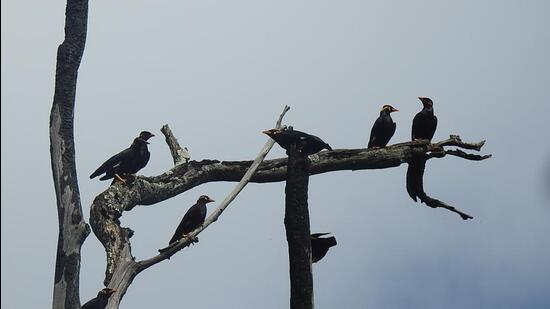
Chhattisgarh’s Kanger Valley National Park is considered the natural habitat of the Bastar Hill Myna (Gracula religiosa peninsularis), which was declared the state bird in 2002


RAIPUR: There is anecdotal evidence that the population of Chhattisgarh’s state bird, Mynah may have increased over the last year, the state forest department has said, a year after the launch of ‘Bastar Hill Myna Conservation Project’ that involved engaging 20 tribal youth to track the birds and protect their nests.
The tribal youth, called ‘myna mitras’ (friends of the myna), are given binoculars and trap cameras to monitor the birds.
“There was no survey to estimate the base population of the myna but the bird was hardly spotted in the past,” said a senior forest department official, claiming that this situation had started to change.
Chhattisgarh’s Kanger Valley National Park is considered the natural habitat of the Bastar Hill Myna (Gracula religiosa peninsularis), which was declared the state bird in 2002.
“The bird mimics the human voice and this is the reason it is poached by hunters, “a park official said.
Dhammshil Ganveer, Director, Kanger Valley National Park said a survey of the nesting sites was started in the first of the two-year project. So far, they have counted 36 nests and have quite some distance to go.
“Under this programme, local youth, myna mitras, were engaged for protection of the nest and regular monitoring of the nests for 12 months,” said Ganveer.
Ganveer said there were “encouraging results” and indications that the number of mynas is on the rise.
“Regular awareness among children by myna mitras has started on weekends to bring about behavioural change… for conservation of Bastar Hill myna,” Ganveer added.
Samlu Ram Nag, a resident of Kotamsar village who works with the forest department, said there was a change.
“It is tough to tell the exact count but undoubtedly the number of Bastar Hill Mynas has increased comparatively. Earlier, you could spot one or two Mynas on a Sal tree, now you can easily spot five to six of them,” Nag said
Wildlife activists, however, underlined that a more scientific method should be adopted to estimate their numbers.
A more technical method of counting mynas should also be used in the near future, as it is very important for the ecosystem as well,” Mohit Sahu, a wildlife activist based in Chhattisgarh, said, underlining that involving the local youth to monitor the bird was a good idea but there was need to study its migration route.
-kW0H-U20214218012MgB-250x250%40HT-Web.jpg)


