
 E-Paper



CJI anoints Justice Chandrachud as the next top judge
Justice Chandrachud, on his part, called it a “humbling experience” to get an opportunity to head the judiciary, and underscored the role of the courts in preserving the rule of law.

 Prefer HTon Google


Chief Justice of India (CJI) Uday Umesh Lalit on Tuesday set in motion the process of appointment of his successor by recommending to the Union government the name of the most senior Supreme Court judge, justice Dhananjaya Y Chandrachud.
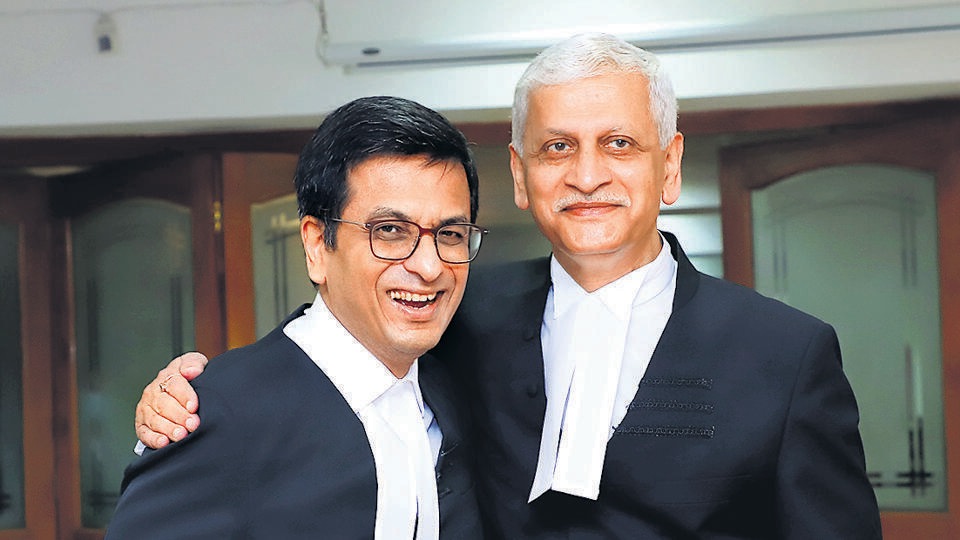
Justice Chandrachud, on his part, called it a “humbling experience” to get an opportunity to head the judiciary, and underscored the role of the courts in preserving the rule of law.
Speaking to HT hours after the incumbent CJI handed over the copy of the recommendatory letter to him in the customary presence of all the top court judges, justice Chandrachud, 62, elucidated the significance of the judicial position and the corresponding responsibilities.
“After six-and-a-half years in the Supreme Court, I continue to be in awe of this office and the responsibilities that come along with it. It’s a humbling experience to get an opportunity to be a part of the Supreme Court and to head the judiciary,” said the judge, who will take over as the 50th CJI on November 9.
Justice Chandrachud, highlighting the role of the judges, added: “Every judge in the country has an immense power to do good and with it comes a duty to serve society with compassion. Our institutions are vital to preserving the rule of law.”
On October 7, the government sent a letter to CJI Lalit, who is set to retire on November 8 following a tenure of 74 days as the CJI, to recommend his successor. According to the Memorandum of Procedure (MoP) which governs the process of appointment and transfer of judges in the constitutional courts, appointment to the office of CJI should be of the most senior judge of the Supreme Court considered fit to hold the office.
After the recommendation of the incumbent, the government will soon issue a notification appointing justice Chandrachud as the next CJI with effect from November 9.
Justice Chandrachud, who was elevated to the Supreme Court in May 2016, will have a term of two years as the head of the judiciary in India, and will retire on November 10, 2024.
History in the making
History will be created when justice Chandrachud will take oath as the 50th CJI next month. As the son of former CJI YV Chandrachud, this will be the only father-son duo to have served as CJIs. Justice YV Chandrachud had earned the distinction of being the longest-serving CJI as he remained at the helm for over seven years between February 1978 and July 1985.
Notably, the son has at least on two occasions set aside the judicial opinions of his father. While writing the lead verdict in the Supreme Court’s landmark judgment in 2017 on the right to privacy, justice Chandrachud overruled the opinion of his father in the controversial ADM Jabalpur case.
The senior justice Chandrachud was among four out of five judges who in 1976 upheld a presidential order to impose Emergency in the country and also affirmed suspension of the rights of a person to approach a court for enforcement of fundamental rights during the Emergency period. There was only one dissenting opinion, which was written by justice HR Khanna.
Striking a discordant note in the 2017 privacy judgment, justice Chandrachud overruled his father’s views. “The judgments rendered by all the four judges constituting the majority in ADM Jabalpur are seriously flawed. Life and personal liberty are inalienable to human existence. They constitute rights under natural law,” he held.
Again in 2018, justice Chandrachud underlined the contrasting story of evolving times and interpretation of the Constitution as he set aside his father’s views in upholding the law of adultery under Section 497 of the Indian Penal Code.
In 1985, the senior justice Chandrachud ruled that Section 497, which punishes men for affairs with women “without the consent or connivance of their husbands”, is constitutionally valid. Thirty-three years later, justice Chandrachud declared the penal provision to be unconstitutional and discriminatory, asserting that the adultery law destroys women’s dignity and rights as she was treated as the property of her husband.
Journey and judgments
After obtaining two advanced degrees in law from Harvard University, justice Chandrachud went on to become one of India’s youngest lawyers to be designated senior advocate at the age of 39. Immediately, in 1998, he was appointed additional solicitor general of India till he was appointed a judge in 2000 in the Bombay high court where he served for 13 years. Justice Chandrachud was appointed the chief justice of the Allahabad high court in 2013 and was elevated to the top court three years later.
Justice Chandrachud, during his tenure in the top court, has remained a voice of reason, dispensing justice through his decisive, fiercely independent and humane decisions. He has been associated with a string of high-profile and other important cases of social and constitutional importance.
From his judgments on privacy to gender rights, justice Chandrachud is known for his progressive views and impetus on personal liberty, rights, and autonomy.
Justice Chandrachud wrote the lead judgment for the nine-judge constitution bench in 2017 when it was unanimously held that the right to privacy constituted a fundamental right under the Constitution. He was also part of a five-judge bench that decriminalised gay sex between consenting adults while partly striking down the 158-year-old colonial law under Section 377 of the IPC.
In another five-judge bench, justice Chandrachud quashed the adultery law under Section 497 of the IPC on the ground of being arbitrary, archaic and violative of the right to equality and privacy.
Justice Chandrachud was also a part of the bench in the Ayodhya title dispute case, in which the five-judge bench ruled in favour of the Hindu side.
In the Sabarimala verdict of 2018, the judge held that the practice of prohibiting women of menstruating age from entering the Sabarimala temple was discriminatory and violative of women’s fundamental rights.
However, in a strong dissent, justice Chandrachud differed with other members of the five-judge Constitution bench which by a majority verdict upheld the constitutional validity of the unique biometric identity number Aadhaar. Justice Chandrachud held Aadhaar to be unconstitutional and violative of fundamental rights. He was also a part of the landmark judgment by a constitution bench that recognised “living will” made by terminally ill patients for passive euthanasia.
Recently, justice Chandrachud granted bail to Alt News co-founder Mohammed Zubair in the criminal cases registered against him over his tweets, emphasising that the criminal law and its processes ought not to be instrumentalised as a tool of harassment. “Arrest is not meant to be and must not be used as a punitive tool because it results in one of the gravest possible consequences emanating from criminal law — the loss of personal liberty,” he said.
In the last week of September, justice Chandrachud penned a landmark ruling on women’s reproductive rights and bodily autonomy, as he held that forceful pregnancy of a married woman can be treated as “marital rape” for the purposes of abortion. This verdict also interpreted the maternity termination law to declare that even an unmarried woman will be allowed to go for abortion up to 24 weeks, on par with married women.



