
 E-Paper



CJI Gavai inaugurates Gauhati high court’s permanent bench in Arunachal
CJI Gavai called it a historic step towards making justice more accessible and affordable in Arunachal and the Northeast


Itanagar: Chief Justice of India (CJI) B R Gavai on Sunday inaugurated the newly built permanent bench of the Gauhati high court at Naharlagun, calling it a “historic step” towards making justice more accessible and affordable in the state and the Northeast.
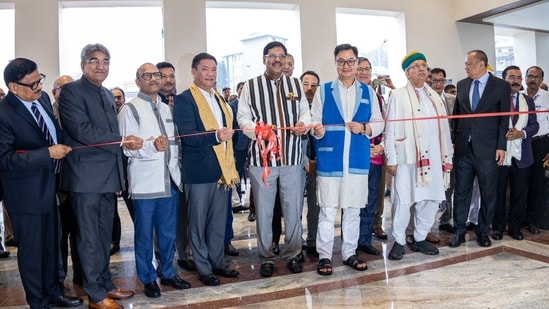
The inauguration was attended by Union minister for parliamentary affairs Kiren Rijiju, Union minister of state for law and justice Arjun Ram Meghwal, chief justice of Gauhati high court Ashutosh Kumar, judges from the Supreme Court, Gauhati high court, and the Itanagar permanent bench, along with several eminent judges from high courts across the country.
Addressing the gathering, Gavai advocated decentralisation of judicial services, stressing that justice must be delivered at people’s doorsteps. He said the judiciary, legislature and executive are meant to serve every citizen, not just the privileged few.
The CJI praised the Gauhati high court’s leadership for expanding judicial access in remote areas and lauded Arunachal’s cultural richness — home to 26 major tribes and over 100 sub-tribes. “Preserving and conserving our traditions is a fundamental duty under the Constitution,” he said, adding that progress must not come at the cost of heritage. Quoting B R Ambedkar, he described the Constitution as the “great granth” of the nation and underlined the importance of Schedules V and VI in safeguarding the rights and culture of tribal communities. “Political equality without economic and social equality has no value,” he said.
Chief minister Pema Khandu called the occasion “a momentous day in the judicial history of Arunachal Pradesh and India,” describing the state-of-the-art facility as “a symbol of hope, accessibility, and unwavering pursuit of justice.”
The foundation stone for the 19,000-plus square metre structure was laid on August 12, 2018, by Khandu. Despite challenges posed by the Covid-19 pandemic, difficult terrain, long monsoon seasons, and high logistics costs, construction was completed in less than four years at a cost of nearly ₹250 crore. The CM credited the achievement to the collaborative efforts of the Gauhati high court, members of the Bar, state government officials, the PWD, and the contractor.
Highlighting the state’s progress in judicial infrastructure, Khandu said Arunachal Pradesh had expanded from just two courts in 2016, when he first assumed charge, to 33 functional courts today, with eight added recently and 463 new posts created in the district judiciary. Welfare measures for judicial officers, procedural reforms, and dedicated NDPS courts in Tezu, Khonsa, and Yupia are also underway.
“The inauguration of this court is the fulfilment of a long-cherished dream of our people. It will enhance access to justice, ensure speedy resolution of cases, and strengthen the rule of law in our state,” he said, reaffirming his government’s commitment to strengthen the justice delivery system from the high court to district and CJM courts.
Gauhati high court chief justice Ashutosh Kumar said the new building reaffirmed the constitutional promise of justice unhampered by geography. “Let Arunachal be the place where justice comes first without delay, just as it witnesses the first sunrise,” he remarked, describing courts as “temples of constitutional morality.”
Union minister Kiren Rijiju and Supreme Court judges Ujjal Bhuyan, N Kotiswar Singh, Sandeep Mehta and Vijay Bishnoi also hailed the new facility as a leap forward for the frontier state.
Spread over more than 19,000 sq metres, the complex houses five modern courtrooms and state-of-the-art facilities, and was built by the public works department, marking a significant step in bridging the justice gap for one of the country’s most geographically challenging regions.


