
 E-Paper



CJI says judicial infrastructure improvement being done in ‘ad-hoc’ manner
The CJI also said that an effective judiciary can aid in economic growth and courts are essential for any society which is governed by the rule of law.


Chief Justice of India NV Ramana on Saturday said that judicial infrastructure is important for improving access to justice but noted that it was baffling to see that the efforts to improve it are being carried out in an ad-hoc and unplanned manner in the country, news agency PTI reported.
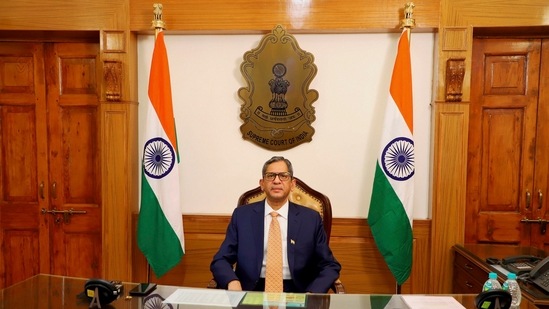
The CJI also said that an effective judiciary can aid in economic growth and courts are essential for any society which is governed by the rule of law. CJI Ramana was addressing the inauguration of two wings of the annexe building at the Aurangabad bench of the Bombay high court.
“We are faced with certain hard facts like several courts do not have proper facilities. Some courts function out of dilapidated buildings. Judicial infrastructure is important for improving access to justice. It is baffling to note that the improvement and maintenance of judicial infrastructure is still being carried out in an ad-hoc and unplanned manner,” CJI Ramana was quoted as saying by the news agency.
The CJI said that the building which was being inaugurated was envisioned in 2011 adding that the ‘success of today should not blind us to the issues that exist.’ “That it has taken 10 years for this vision to be implemented is extremely worrisome. This is a deeper problem that has plugged our judicial infrastructure planning in our country since Independence,” the CJI said.
NV Ramana also highlighted that he sent a proposal to the Union law minister for establishing the National Judicial Infrastructure Authority. He said that he is hoping for a positive response and also hoped that the issue will be discussed during the upcoming winter session.
He said that the prevalent mentality among the masses, which takes pride in saying that they have not visited a courthouse even once in their entire lifetime, needs to change. He said that it is a common notion that only criminals and victims approach the court.
“It is high time we take the efforts to remove this taboo for the affirmation of a citizen's rights. The common man deals with multiple legal issues during his lifetime. One must never hesitate to approach the courts. After all, people's faith in the judiciary is one the biggest strength of democracy," the CJI said.
CJI Ramana said that courts in India have always stood up whenever an individual or society is at the receiving end of executive excess. "It is an assurance that an individual, however weak, need not worry about the might of a state," he said.
Meanwhile, Kiren Rijiju, the Union law minister, said that every effort is being made to ensure that the judiciary is given space to become more robust. “Judiciary isn't only being given full support but also they're being given space to become robust. To make our democracy successful, a robust judiciary is of utmost importance,” Rijiju was quoted as saying by news agency ANI.
Justice Chandrachud highlights pending cases
Supreme Court judge Justice DY Chandrachud, who was also present at the function, said that the judiciary is confronted with the issue of addressing the issue of pending cases in the state and country.
He pointed out that there are over 48 lakh cases pending in Maharashtra with around 21,000 cases being more than three decades old. “ These are some of the problems we have to face. This calls for some introspection,” he said.
He also spoke about the importance of virtual courts which can help citizens across the nation gain access to court proceedings.


