
 E-Paper



What CJI said on police excess, pellet gun claims and message for protesting 'cockroaches' | 5 top quotes
Following the 'Cockroach Janta Party' protests and the alleged use of force on protesters, the SC emphasised the need for accountability in police actions.

 Prefer HTon Google


More than a week after the July 20 ‘Cockroach Janta Party’ Jantar Mantar protest brought parts of Central Delhi to a standstill and led to ripple effects in other parts of the country, the spotlight has shifted from the chaos on the streets to the questions surrounding the police response.
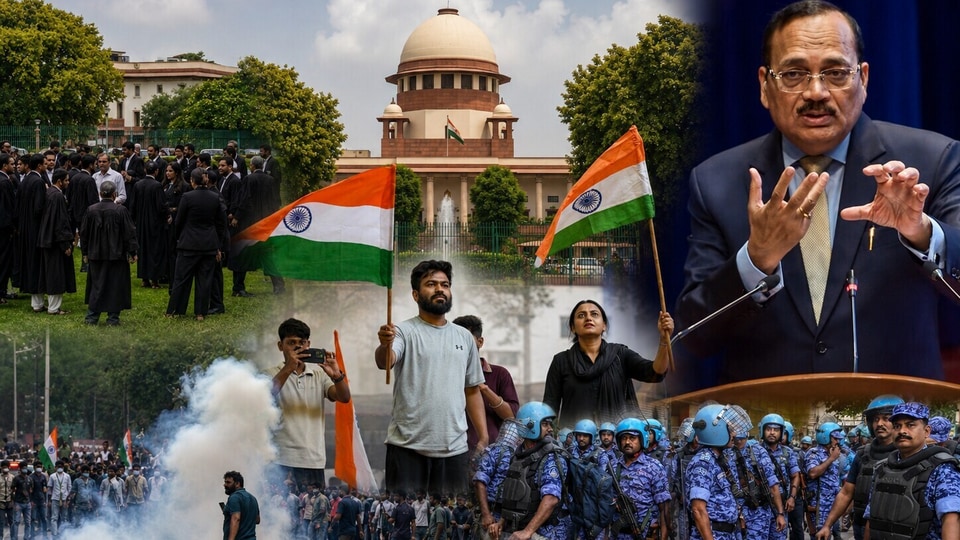
Dealing with a batch of pleas alleging police excesses against students protesting irregularities in exams and the NEET paper leak across the country, a bench headed by Chief Justice of India Surya Kant on Tuesday referred to many incidents of violence.
The Supreme Court bench indicated that allegations of police excesses during the student protests-including claims of the use of pellet guns, tear gas, lathi-charge, electric shock weapons and assault by security personnel-warrant an independent and transparent investigation.
While the court has not made any finding on whether pellet guns were used, it reportedly said the allegations make out a prima facie case for a fair probe and suggested it may constitute a Special Investigation Team (SIT) or a high-powered committee to examine the incidents. The bench also stressed that the exercise should go beyond fixing accountability and evolve a uniform national protocol for handling protests and crowd-control measures.
Top quotes from SC hearing
1. "Whoever has committed excesses and taken law in hand, and whoever has committed atrocities, they must be brought under the law."
The bench led by Chief Justice of India Surya Kant underlined that accountability would apply to all sides if violations were established. The court observed that once a uniform protocol governing protests and police action is put in place, anyone found to have committed excesses or atrocities would have to face the law, according to a PTI news agency report.
2. "Why should there not be an independent probe into these allegations?"
The CJI questioned why an independent inquiry should not be ordered after noting allegations of grievous injuries, assault on women, advocates and media persons. The court observed that, prima facie, the allegations make out a case for a fair, transparent and independent investigation and indicated that a high-powered committee or SIT could be constituted.
3. "Agitations in a democracy are bound to happen."
Calling protests an inevitable feature of a democracy, the Supreme Court said the focus should be on creating a clear nationwide protocol governing police response to demonstrations, according to ANI news agency. The bench said the proposed framework would require modifications to reflect changing ground realities and ensure better handling of future protests.
4. "Whosoever committed excesses, took law in their hands should be taken to task."
The court said accountability must extend to everyone involved in the violence. At the same time, it noted that the investigation should also examine attacks on police personnel and determine whether they were carried out by students or by "miscreants" who may have infiltrated the protests, as claimed by the Centre.
"The allegations prima facie warrant consideration of a fair and independent probe, which must also address the concerns of families of over 200 injured police personnel," PTI news agency quoted the CJI as saying.
5. "Once there is violation of defined protocol, law must take care of it."
The bench said adherence to a clearly defined protocol would be central to fixing responsibility in future cases. It added that the proposed inquiry should not only establish the facts surrounding the recent protests but also help frame guidelines for police action during public demonstrations.
Other key directions from the Supreme Court
Independent probe: The court said allegations of police excesses during the NEET protests make out a case for a fair and independent investigation.
Notices to states: Notices were issued to several states, including Maharashtra and Madhya Pradesh, seeking their responses.
Protection for minors: The Supreme Court directed all states to release protesting students below the age of 18 who do not have any criminal antecedents.
No coercive action: The bench ordered that no coercive action be taken against protesting students, while clarifying that the protection would not extend to persons with criminal antecedents.
Delhi FIRs: The court said the Delhi government may continue investigating FIRs already registered, but directed that no coercive action should be taken against eligible protesters during the process.
Preservation of evidence: The Supreme Court ordered that all CCTV footage, drone footage, body-worn camera recordings, wireless communication records and PCR calls related to the protests be preserved.
Protection of digital data: The bench also directed that any digital data collected from protesters be preserved but not made public, and that no personal details of protesters be disclosed pending further proceedings.
Ironically, the chain of events that culminated in the formation of what is at the centre of all of this - the Cockroach Janta Part (CJP), nationwide protests and the eventual resignation of education minister Dharmendra Pradhan - finds its trigger point CJI's own remarks on May 15.
During a hearing on May 15, CJI Kant drew a parallel between some unruly youths and "cockroaches", saying that if such elements were not dealt with, they would multiply and create larger problems. The comment quickly went viral, prompting Boston University graduate Abhijeet Dipke to launch the social media collective ‘Cockroach Janta Party’ (CJP) the very next day. What began as an online campaign soon evolved into an organised protest movement, eventually leading nationwide demonstrations over alleged exam irregularities, particularly NEET paper leak, and culminating in the resignation of Dharmendra Pradhan on July 25.


