E-Paper



Clay to glass: 3 artisan clusters in city make strides towards GI tag
Uttam Nagar’s terracotta potters, Seelampur’s woodcarvers and Sangam Vihar’s bead artisans are now on track to get long overdue official recognition


New Delhi: It is the crack of dawn in Uttam Nagar’s Prajapati Colony – the potters’ village – and 30-year-old Kehar Singh is already at work. A truck has rumbled in from Faridabad, delivering more than two tonnes of fresh clay, enough to sustain his work for the month. His mother is awake too, seated on the cool earthen floor with a mound of clay beside her. With movements that look almost ritualistic, she presses her fingers deep into the wet mass, folding and turning it in a way others knead dough. As the wheel spins, she raises her hands and coaxes the clay upward. It widens, narrows, curves – and soon transforms into a vase with a slender, graceful neck. In a few days, after hardening and baking, that vase will join the others displayed outside their home, waiting for a buyer.
The family has been doing this for three generations. They are among more than 400 families in the settlement who have shaped terracotta in this neighbourhood since the 1970s. Recently, Singh learned something that made his work feel heavier with meaning: Uttam Nagar’s terracotta craft is on its way to receiving a “Geographical Indication (GI)” tag – making it one of three unique crafts selected from Delhi for this recognition, alongside Sangam Vihar’s glass bead jewellery and Seelampur’s hand-crafted woodwork. For a city that, until now, had only one GI tag – basmati rice, shared with several northern states – this decision marks a long-overdue acknowledgment of the Capital’s own artisanal traditions.
Singh said the tag is more just a than a label for them. “If people across India know our work is special, they will value it more. It may finally bring us the respect and the price our art deserves.”
The approval to initiate the GI process came at the 54th board meeting of the Delhi Khadi and Village Industries Board (DKVIB) on October 24, chaired by Delhi industries minister Manjinder Singh Sirsa. The board had not met in nearly four years; the chairman’s post had been vacant since February. Sirsa, newly appointed to the position, said the absence of Delhi-specific GI tags had been a glaring gap. “Other states have dozens… Delhi’s crafts needed recognition, and the GI route gives our artisans a way to protect what is theirs,” he said.
Quest for a GI identity
India has more than 650 GI-tagged products – everything from Kashmir’s saffron and Karbi Anglong ginger to Kanchipuram silk, Banaras sarees and the famed Madurai jasmine. Uttar Pradesh leads the list with over 75 tags, Tamil Nadu follows close behind.
Delhi, however, didn’t have a unique one to call its own.
DKVIB managing director K Mahesh said that the absence weighed heavily on the board. “We promoted the GI products of other states but had nothing truly Delhi-based to show,” he said.
Before Sirsa’s appointment, the board approached the National Bank for Agriculture and Rural Development (NABARD), which has helped secure more than 140 GI tags across India. NABARD began the groundwork: mapping crafts, conducting on-site verifications, and speaking to artisans as well as officials from the Union textiles ministry and the Human Welfare Association, an NGO with experience in GI work.
NABARD general manager Nabin Roy said the idea was not just to find old crafts but to find crafts that still lived and thrived within communities. “We explored Kundan jewellery in Chandni Chowk. But couldn’t find enough practitioners. These three crafts, however, still exist in clusters where skills pass from one generation to the next. That continuity is crucial for a GI tag,” he explained.
A GI certification, officials say, has the power to not only offer greater visibility, but more importantly, it raises the value of the craft. “People are willing to pay a premium for a GI tag product, knowing it is both unique and authentic. There is a sense of trust and authenticity attached to it, which will give workers in Uttam Nagar, Seelampur and Sangam Vihar a tremendous boost,” Mahesh said.
At Uttam Nagar, tradition shapes itself anew
For families like Kehar Singh’s, the tag has come at a time when their craft is undergoing a dramatic transformation. His grandfather came from Karauli in Rajasthan in the 1970s, forming a cluster of families united by a skill. By the 1980s and 1990s, the neighbourhood had become synonymous with terracotta.
And while the craft remains the same, the demand for it has changed. “Customers come to us with screenshots and ask us to recreate something they saw online,” Singh said, pointing to a row of towering vases – each four to five feet tall – that now dominate wedding decorations. “These big vases sell for over ₹2,000 each. If we get a bulk order, it’s good money.”

Flower pots remain the old bestsellers, especially those shaped as animals. But the advertising here still runs on word-of-mouth.
Across the lane, 77-year-old Kanti Prasad – whose family worked the trade for a century – said that when he moved from Rajasthan in 1966, only a few potters were here. Then, slowly, families migrated in batches. “When one came, others followed… By the 1980s, this place had become a proper hub,” he said. A GI tag, he said, will give the community “a chance to usher into the future.”
In Seelampur, a rebellion against the machine
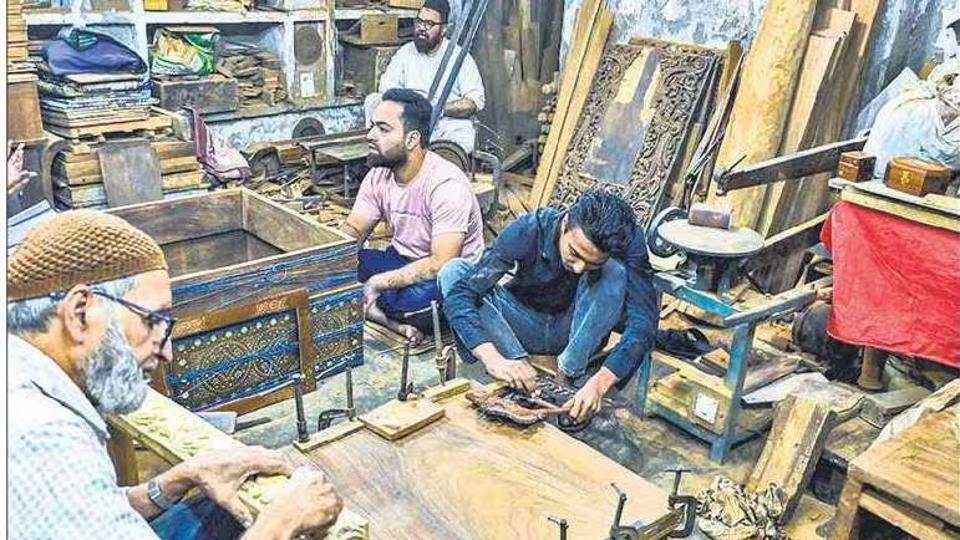
On the opposite end of the city, in Seelampur, a different craft is enduring against harsher odds. The rise of machine-made furniture has overtaken markets from Kirti Nagar to NCR’s factory belts, but in Seelampur, nearly 300 artisans still painstakingly carve wood by hand and chisel.
Mohammed Matloob, 50, said he has been carving since he was 10. His shop, Indian Royal Handicraft, is a narrow workshop with curls of wood dust coating every visible surface.
“I have survived because even when the world seeks ‘fast furniture’, there are some who want the intricacy of a hand-designed piece. These people have the patience to wait for a month or two months for a product,” he said.
Matloob has spent years passing his skill down to his son, Mohd Marghoob, 25, who has brought the business into the digital age. “My father’s business was held face-to-face, but I have the digital platform. It helps me connect with buyers not just locally but internationally as well,” Marghoob said. Through Instagram pages and catalogues sent on WhatsApp, he now receives orders from Indian embassies in Portugal, Italy, Iran and Thailand.
Still, Matloob wants to pass on the craft and legacy to even more people. Once a month, he takes workshops at schools and colleges such as Modern School Barakhamba and Guru Gobind Singh University.
In Sangam Vihar, one bead at a time
In Sangam Vihar, tucked in South Delhi’s labyrinth of narrow lanes, another craft thrives quietly: glass bead jewellery. Hundreds of artisans work from small homes or shared centres, making everything from bags and bangles to hair accessories.
The beads – bright and tiny – come from Kinari Bazaar in Chandni Chowk. But the transformation from beads to jewellery is anything but simple. It requires stitches so fine they resemble embroidery done with dots of light.

At one of the centres, 40-year-old Manju, who supervises training, said that teaching someone to become an artisan takes months. “The first 10-15 days are just learning how to hold the needle,” she said. “Then comes coordination with thread. After two months, they can do basic designs. But it takes a full year before someone can make an entire beaded bag.”
When HT visited, five artisans sat cross-legged on the floor, a wooden board before them, cloth stretched tight. Their hands moved in surefire rhythm – left hand anchoring the thread, right hand darting upward with a needle to stitch beads into patterns. “It takes a lot of patience, many who start learning leave in the first few months because they find it difficult to work with restricted movement,” said 40-year-old Shakil Ahmad who started working at the age of 15.
A future shaped by heritage
For the three chosen crafts set to represent Delhi – clay, wood and glass – the GI tag process represents more than formal recognition. It marks a moment where government machinery, for once, has moved in step with artisans whose work rarely finds its way into policy documents.
For Singh in Uttam Nagar, the tag could mean a better price for his mother’s vases. For Matloob in Seelampur, it could help preserve a craft that factories have pushed to the margins. And in Sangam Vihar, it means a steadier income. Together, they capture a cultural snapshot of Delhi – a city known for monuments, megaprojects, but whose most fragile legacies lie in the hands of its artisans.