
 E-Paper



Col, kin among 7 killed in Manipur ambush near Myanmar border; India vows strong response
Tripathi’s unit, 46 Assam Rifles, had disrupted several drug trafficking rings in the area and may have been targeted by the insurgents because of its successes in curbing the illegal money-spinning trade, HT has learnt. The aftershocks of the hit were felt in New Delhi with the government vowing strong and swift action against the insurgents.

 Prefer HTon Google


Armed militants on Saturday ambushed an Assam Rifles convoy near the porous India-Myanmar border in Manipur’s Churachandpur district; killing five soldiers including a colonel, his wife, their eight-year-old son, and injuring six personnel of whom four are critical and battling for their lives at a medical facility in the state, people familiar with the developments said.
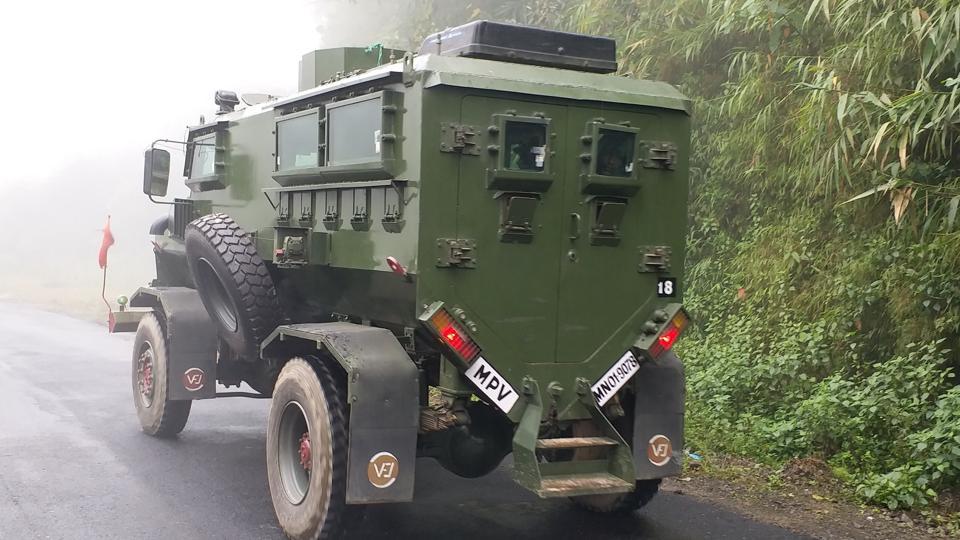
The commanding officer of the 46 Assam Rifles, Colonel Viplav Tripathi, and his quick reaction team (QRT) were returning from the Behiang border post and heading to the battalion headquarters at Khuga when the militants ambushed them at S Sehken village under Singhat sub-division at around 11 am, said one of the officials cited above.
Apart from Tripathi, his wife Anuja and son Abeer; Riflemen NK Nayak, Suman Swargiary, RP Meena and Shyamal Das were killed in the pre-planned attack. Family members of soldiers being hit by insurgents is a rarity and has sent shock waves through the military community. In May 2002, terrorists killed 31 people at an army base in Jammu and Kashmir’s Kaluchak area. The casualties were three soldiers, 18 family members (including a two-month-old baby girl) and 10 civilians. The 47 wounded were 12 soldiers, 20 family members and 15 civilians.
The attackers first triggered an improvised explosive device (IED) on the single-lane road in a densely forested area and then brought the Assam Rifles personnel under heavy automatic fire to inflict maximum casualties, bringing back memories of the June 2015 Chandel ambush in the state in which a Dogra battalion of the Indian Army lost 18 men, said a second official.
Five days after the Dogra unit was attacked in broad daylight in the Moltuk Valley, India’s Special Forces responded with a cross-border raid into Myanmar where they targeted and destroyed two insurgent camps.
Security forces on Saturday launched a massive manhunt for the insurgents but they may have slipped across the porous border into Myanmar.
Tripathi’s unit, 46 Assam Rifles, had disrupted several drug trafficking rings in the area and may have been targeted by the insurgents because of its successes in curbing the illegal money-spinning trade, HT has learnt.
The aftershocks of the hit were felt in New Delhi with the government vowing strong and swift action against the insurgents.
Prime Minister Narendra Modi condemned the attack and paid homage to the soldiers and family members who lost their lives in the ambush. “Their sacrifice will never be forgotten. My thoughts are with the bereaved families in this hour of sadness,” the PM wrote on Twitter.
Defence minister Rajnath Singh said the perpetrators of the attack would be brought to justice swiftly. “The cowardly attack on an Assam Rifles convoy is extremely painful and condemnable. The nation has lost five brave soldiers including CO 46 AR and two family members. My condolences to the bereaved families,” Singh said.
State chief minister N Biren Singh said security forces had launched a hunt for the militants and they would be brought to justice.
No insurgent group has so far claimed responsibility for the attack but the People’s Liberation Army of Manipur and People’s Revolutionary Party of Kangleipak (PREPAK) are among the outfits suspected to be involved, said a fourth official.
At least half a dozen main insurgent groups are active in the state including PLA, PREPAK, Kanglei Yawol Kanna Lup, Kangleipak Communist Party, Kuki National Army and Kuki National Front.
“Insurgents may have carried out the attack to impose caution on the Assam Rifles as this unit (46 Assam Rifles) was extremely successful in busting drug-trafficking networks in the area. These insurgent groups are involved in illegal narcotics trade,” said Lieutenant General Shokin Chauhan (retd), who headed the Assam Rifles in 2017-18.
The road on which the ambush took place is one of the alternative routes from Myanmar to Imphal, and is used for drug trafficking.
Chauhan doesn’t rule out a Chinese angle to the attack.
“The People’s Liberation Army of Manipur is known to be in sync with China. It is within the realm of possibility that it was ordered to carry out the hit to force India to deploy more forces in the area at a time when there’s tension along the Line of Actual Control (LAC) with China,” he said.
Chauhan, a counter-insurgency expert who understands the security dynamics of India’s Northeast, last year retired as the chairman of the Ceasefire Monitoring Group responsible for implementing ceasefire ground rules between the Centre and Naga insurgent groups.
He added that the attackers would have known that civilians were part of the Assam Rifles convoy but still carried out the hit.
According to figures obtained by HT in 2018, the average annual operations launched by the army and Assam Rifles in Manipur involve setting up 52,000 check posts, 42,000 patrols, more than 10,000 ambushes and 550 special operations.
Improvised explosive devices (IEDs) are one of the biggest challenges confronting soldiers deployed in insurgency-hit Manipur and mitigating that threat is a top priority for the security forces. The predominant weapon of insurgent groups, IEDs have killed, maimed or injured hundreds of soldiers in India’s north-east, including Manipur, over the last three decades.
The vast area that the security forces operate in, the state’s topography and a 398-km porous border with Myanmar are among the challenges faced by soldiers who operate from 180 bases scattered across Manipur, officials said.
The IEDs came to prominence in the Northeast, including Manipur, in 1990, when insurgents began emulating the Liberation Tigers of Tamil Eelam.
The latest ambush comes at a time when the security situation in the North-east had improved significantly in the army’s assessment, and a planned and gradual drawdown of soldiers is underway there.
In February 2021, army chief General Manoj Mukund Naravane said two army divisions had been pulled out of counter-insurgency and internal security duties in the Northeast, and were solely focused on their operational role along the China border.
Several parliamentary panels have made recommendations in their reports to reduce the army’s exposure to counter-insurgency and counterterrorism duties because it results in blunting the force’s focus on its main task - defending the country from external aggression.


