
Sign in

Cong narrows vote-share gap with BJP in Gujarat, but will it be enough?

While the BJP has made significant gains in Uttar Pradesh and Haryana, decimating political rivals by doubling its vote-share in a short span of time, Gujarat happens to be a different ball game.

Published on: Oct 16, 2017, 17:48:52 IST
Hindustan Times, New Delhi | By
Share
Share via
  • facebook
  • twitter
  • linkedin
Copy link
  • copy link

The BJP was way ahead of the Congress in the 2002 Gujarat assembly polls, but election commission data shows that the gap in vote share between the two national parties has narrowed in the last decade.
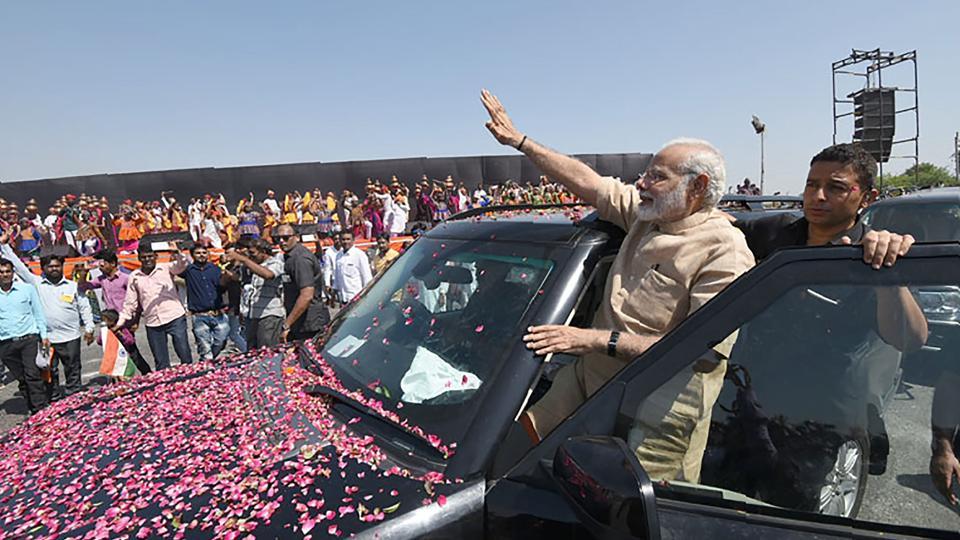
Prime Minister Narendra Modi greets people during a public rally at Vadnagar in Gujarat recently. (AFP/ PIB handout)

While the BJP has made significant gains in Uttar Pradesh and Haryana, decimating political rivals by doubling its vote-share in a short span of time, Gujarat happens to be a different ball game. The state is witnessing a Congress resurgence after spending 22 years under the BJP’s yoke, and this phenomenon has found apt reflection in several electoral contests held in recent times. For instance, the grand old party won 23 of 31 zila panchayats and 113 of 193 taluka panchayats in local body polls held through December 2015.

The Congress was aided by a protest for reservations in government jobs and education by Patidars, an influential social group that has traditionally backed the BJP. A Kshatriya counter-protest against this demand was then launched under the banner of the OSS (Other Backward Classes, Scheduled Tribe and Scheduled Caste) Ekta Manch. Both Patidar chief Hardik Patel and Manch leader Alpesh Thakor criticised the state BJP government, following which the BJP leadership replaced Anandiben Patel with Vijay Rupani as the Gujarat chief minister in December 2016.

“Recent political developments in the state suggest that the BJP is on the backfoot. However, a survey we conducted in August has showed that the party still has what it takes to sweep the upcoming polls,” said Sanjay Kumar of the Centre for the Study of Developing Societies (CSDS), a Delhi-based advocacy group.

A long-term vote-share analysis suggests that electoral contests in the state have been turning increasingly bipolar since the 1990s, mostly at the cost of smaller political parties and independents. The sole exception was in 2012, when the performance of both the national parties suffered. Ironically, the slump in the BJP’s vote share was nearly four times that of the Congress in terms of percentage.

Election Commission data shows that the Gujarat Parivartan Party, belonging to BJP rebel and former chief minister Keshubhai Patel, got 4% votes despite winning just two seats. “Keshubhai ate into BJP votes, but people ensured its victory by notching the highest-ever voting percentage (at 71.32%),” said political analyst Achyut Yagnik.

Patel isn’t around this time, but the Congress has upped the ante against a Modi-less Gujarat BJP. However, it still remains to be seen if Rahul Gandhi and his strategists will be able to bridge the nine percentage-point gap that existed between the two parties in the 2002 polls.

A similar vote-share jump had occurred in 1995, when the BJP came to power in the state after 391 days of Congress rule. Twenty-two years down the line, the grand old party has its task cut out in the light of the BJP pumping all its energy into the December polls.

  • Chetan Chauhan
    ABOUT THE AUTHOR
    Chetan Chauhan

    Chetan Chauhan is the National Affairs Editor looking into all aspects of news and features from across India. A Chevening scholar with over three decades of experience in reporting and news management, Chetan has extensively covered all important aspects of the social sector, political economy, environment and climate change nationally and internationally. He did a journalism course at the Reuters Institute of Journalism in Oxford and Digital Media training at Nanyang Technological University in Singapore. He started as a reporter with The Statesman in 1996 and joined the Hindustan Times in 2000 in the metro bureau covering environment, crime and Delhi politics. He covered hot local news, from the Jessica Lal murder case to the rebellion of Delhi Congress MLAs against then Chief Minister Sheila Dikshit, to the replacement of toxic vehicle fuel with cleaner compressed natural gas (CNG) in the national capital. Some of his stories on air pollution became part of the Supreme Court’s landmark MC Mehta versus Government of India case in the National Capital Region (NCR), forcing the government to take corrective measures. As part of the national political bureau since 2004, he covered important central sectors such as environment, education, social justice, labour, rural development, water resources, renewable energy, agriculture, broadcasting and the Planning Commission for more than a decade producing several exclusive and investigative breaking stories. His specialisation is the environment, having covered at least a dozen United Nations global conferences on climate change, biodiversity and wildlife including climate summits in Paris, Copenhagen and Bali. He also covered India’s two five-year plans ---11th and 12th and reported on drafting and execution of right based laws such as Right to Education, Right to Information and rural job guarantee law, MG-NREGA, now being introduced in new format as VG-RAM-G Act. He has in-depth knowledge of social sector issues. He was one of the first to report on tigers vanishing from Sariska and Panna wildlife reserves in 2004 and 2008, respectively, leading to the setting up of the National Tiger Conservation Authority (NTCA) and the introduction of stringent penal provisions for poaching. He has written extensively on the rising human-animal conflict in India and the degradation of India’s biodiversity hotspots because of mining and other activities. Since 2004, Chetan has covered Parliament comprehensively and participated in training on the nuanced coverage of Parliament proceedings. He has travelled extensively across India to cover national and provincial elections since 1998, especially in the Hindi heartland states, considered India’s road to power. He writes a regular column for Hindustan Times, Ecostani, on important national politics, economy, Himalayan ecology and environmental issues. His other responsibilities include providing inputs for edits and edit page articles for the publication, apart from managing news flow from across India.Read More