
 E-Paper



‘Vishwaguru's huglomacy’: Cong questions PM Modi as Pakistan plays US-Iran peacemaker
Cong comms chief Jairam Ramesh asked, rhetorically, if “self-declared Vishwaguru” Modi’s personal rapport with Trump had yielded any strategic returns.

 Prefer HTon Google


India’s main Opposition party, the Congress on Saturday launched a fresh attack on the BJP-led NDA government's foreign policy record, raising pointed questions about how Pakistan — a country India has sought to internationally isolate — became a mediator and the host for talks between the United States and Iran after a temporary ceasefire was struck in the West Asia war.
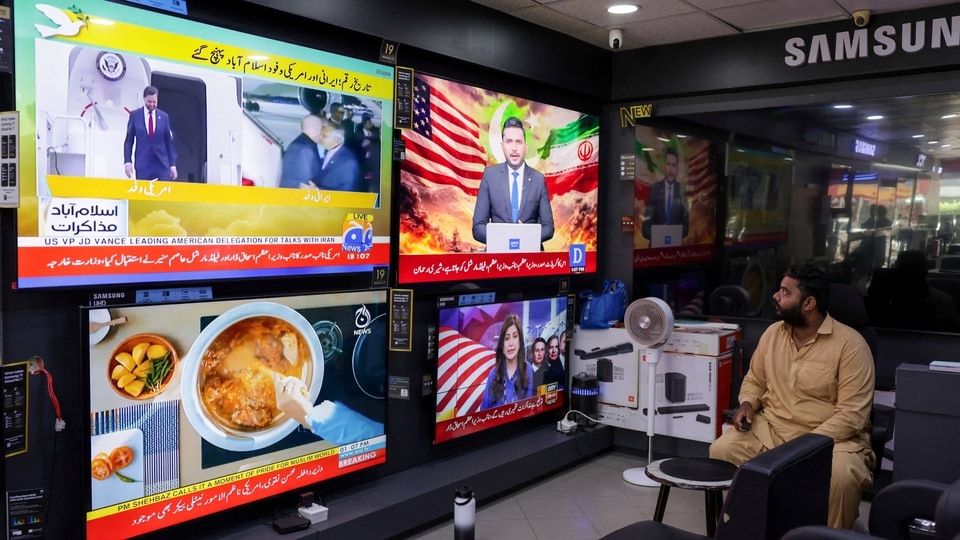
The party's jibes came as US Vice President JD Vance landed in Islamabad for negotiations with an Iranian delegation led by parliament speaker Mohammad Bagher Ghalibaf and foreign minister Abbas Araghchi. When the ceasefire was announced on April 8 with Pakistan taking a lead role, the Congress had called it a "severe setback" for Prime Minister Narendra Modi's diplomacy.
Congress general secretary (communications) Jairam Ramesh sharpened that critique further on Saturday, with a direct dig at PM Modi’s signature style of hugging world leaders. "Serious questions about the substance and style of the self-declared Vishwaguru's huglomacy arise," Ramesh wrote in a post on X, playing on the words ‘hug’ and ‘diplomacy’.
On post-Pahalgam diplomatic efforts
The party also questioned the effectiveness of India's diplomatic efforts to isolate Pakistan following the Pahalgam terror attack of April 2025 by Pak-backed terrorists. "How has Pakistan managed to carve out a new role for itself despite its role in the dastardly Pahalgam terror attack of April 2025 and the diplomatic engagement India mounted to isolate it following the attacks?" Ramesh, a member of the Rajya Sabha, asked in his post.
He invoked the record of the previous Congress-led UPA government as a contrast: "This failure is especially damning because the Dr Manmohan Singh Government had very effectively isolated Pakistan after the Mumbai terror attacks in November 2008.
PM Modi and the BJP often slam the Congress for alleged inaction after the Mumbai attack. After the Pahalgam attack, the Modi government sent all-party delegations to multiple countries, statedly to expose Pakistan as a terror base. Some Congress leaders such as Shashi Tharoor and Manish Tewari were picked by the government to be part of the teams, though the party was incensed at not being asked to nominate its members.
‘Even after Namaste Trump’, why no BRICS statement
Ramesh also asked, rhetorically, if PM Modi’s personal rapport with US President Donald Trump had yielded any strategic returns at all. How has India allowed the US to accord Pakistan this new role even after the Namaste Trump, Howdy Modi, and Phir Ek Baar Trump Sarkar campaigns of Mr Modi and his cheerleaders?" he asked, referring to events from Trump’s first term.

He further alleged that India had agreed to a "very clearly one-sided" trade deal with Washington in which it gave "much more than what it got”.
Broadening the critique, he also asked why the BRICS+ grouping, headed by India at present, could not play mediator. The group includes Brazil, Russia, India, China and South Africa, besides Egypt, Ethiopia, Iran, Indonesia, and the United Arab Emirates (UAE).
"Why didn't India, as the current President of BRICS+, launch any peace or mediation initiative — especially since Iran, the UAE, and Saudi Arabia are members of the BRICS+?" Ramesh asked.
Iran has also sought a stand by BRICS — and “independent role” — in the matter, and conveyed this in conversations with Indian leaders.
Ramesh also raised India's recent reset with Beijing, five years after border clashes. "What has India gained from its calibrated capitulation to China in the past eighteen months — especially in view of China's pivotal role in Pakistan's response to Operation Sindoor and its continued propping up of Pakistan?" Ramesh said. India has carried out military strikes in Pakistan under Operation Sindoor after the Pahalgam terror attack.
Ramesh, however, also expressed hope that Saturday's talks would produce results.
"The Strait of Hormuz must once again revert to the situation that prevailed before the US-Israel assault on Iran began,” he said. The strait is a major route through the Persian Gulf that transports about a third of global oil supplies, including a large part of India’s imports.
Questions were raised on Modi’s Israel visit, Iran ship bombing
The statement is the latest in a series of Congress attacks that have escalated in step with the US-Iran conflict itself. When the US and Israel launched strikes on Iran on February 28, the Congress pointed out that that came just two days after Modi a "most ill-advised and ill-timed visit to Israel".
The Opposition party had also demanded that the government “break its silence” on the targeted killing of Iranian Supreme Leader Ayatollah Ali Khamenei. The government eventually sent the foreign secretary to sign a condolence book for Ali Khamenei at the Iranian embassy in New Delhi.
The criticism intensified on March 5, when a US submarine torpedoed and sank the Iranian frigate IRIS Dena in international waters off the coast of Sri Lanka — a vessel that had, days earlier, participated in India's own MILAN 2026 multilateral naval exercise in Visakhapatnam.
"This US action has enormous implications for India as well and it is shocking that there has been no official response to it till now. Never before has the Indian government looked so timid and fearful," Ramesh said at the time.
Rahul Gandhi, Leader of the Opposition in the Lok Sabha, has been equally unsparing. "The conflict has reached our backyard, with an Iranian warship sunk in the Indian Ocean. Yet the Prime Minister has said nothing. At a moment like this, we need a steady hand at the wheel. Instead, India has a compromised PM who has surrendered our strategic autonomy," Gandhi wrote on X.
When news of Pakistan's mediating role first emerged in late March, Rahul Gandhi also escalated his language. He called it the "most damning indictment of both the substance and style of Prime Minister Modi's diplomacy, which has been full of bombast and marked by cowardice”.
Pushback from govt
The government and the BJP have hit back at the Congress, particularly at an all-party meeting convened on March 25, chaired by defence minister Rajnath Singh and attended by home minister Amit Shah and external affairs minister S Jaishankar.
At the meeting, Jaishankar said India does not see itself as a "dalaal" (broker) nation, and that there was "nothing new" in Pakistan's role as a conduit, adding that Washington had been using Islamabad as a channel to stay engaged with Tehran since 1981.
The government also informed the meeting that PM Modi had conveyed to US President Trump that the war in West Asia must end soon, as it was "hurting all sides”.


