
 E-Paper



Scope of Governor’s powers in focus amid Tamil Nadu row
Late on Thursday, the governor wrote to CM MK Stalin , conveying that the decision to dismiss Balaji “may be kept in abeyance until further communication.”


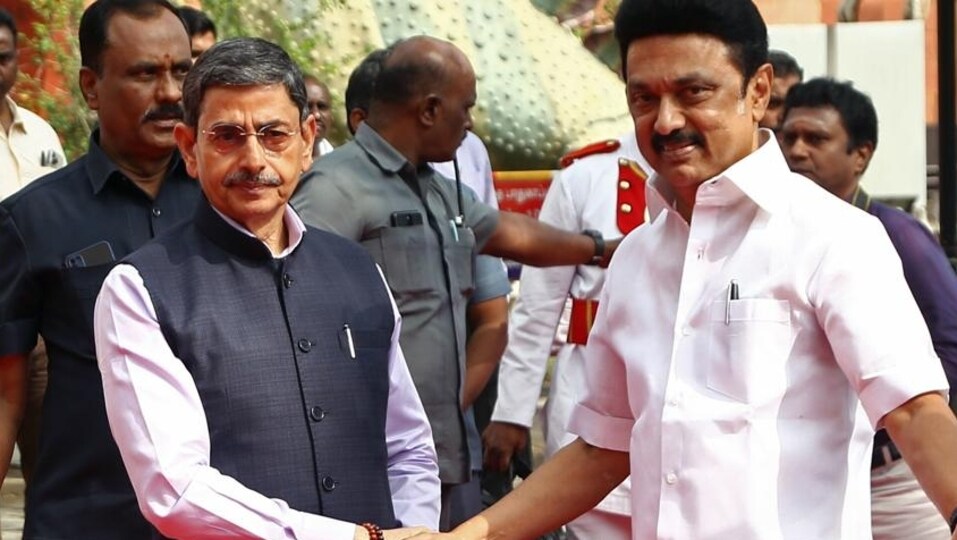
The on-going confrontation between Tamil Nadu governor RN Ravi and the DMK government led by MK Stalin intensified on Thursday with the governor first dismissing arrested DMK minister V Senthil Balaji from the council of ministers, only to back down hours later. Late on Thursday, the governor wrote to Stalin , conveying that the decision to dismiss Balaji “may be kept in abeyance until further communication” since he is approaching the attorney general for legal opinion following Union home minister Amit Shah’s advice.
The unprecedented, and more importantly, unilateral decision by a governor to sack a minister appointed on aid and advice of the chief minister, has raised questions on the legality of such a move by the figurative head of a state, nominated by the Union government.
In October last year, Kerala governor Arif Mohammed Khan wrote to CM Pinarayi Vijayan, asking him take constitutionally appropriate action against finance minister K N Balagopal and cautioned against a possible “withdrawal of pleasure”. Vijayan rejected the suggestion, and responded by saying that governor’s powers were “very limited” on the issue.
The drama in Tamil Nadu merits a recap of pertinent constitutional provisions and some key verdicts of the Supreme Court, mapping out the role, duties and powers of a governor, especially in view of a 2016 constitution bench ruling that explicitly rejected a proposition that the right of governor to “withdraw the pleasure” -- the language of the Constitution says that a minister holds office on the pleasure of the governor -- is absolute and unrestricted. If a governor chooses to “withdraw his pleasure” in respect of a minister, the 2016 judgment held, he must exercise his discretion with the knowledge of the CM and not by keeping him in the dark or unilaterally. The latest disputation also raises sharp questions on federalism which the apex court has held as part of the basic structure of the Indian Constitution.
TN governor’s letter, the pause and constitutional provisions
Balaji, who held the electricity, excise and prohibition portfolios, was arrested by the Enforcement Directorate (ED) on June 14 for allegations that date back to 2014 when he was transport minister in the then AIADMK government. He joined the DMK in 2018. On the day of his arrest, Balaji dramatically collapsed, and later underwent a beating heart coronary artery bypass surgery in a Chennai hospital on June 21 and has been hospitalised since. On Wednesday, his judicial custody was extended by a trial court until July 12 even as the Madras high court is dealing with ED’s demand for Balaji’s custodial interrogation.
On Thursday, the governor sent a missive to the CM dismissing Balaji who has been retained by Stalin as a minister without a portfolio after the arrest. Ravi’s letter claimed that Balaji’s continuance as a minister would “obstruct the due process of law and disrupt the course of justice”. It added: “Under such circumstances and the powers conferred to me under Articles 154, 163 and 164 of the Constitution of India, I hereby dismiss Thiru V Senthil Balaji from the council of ministers with immediate effect.”
Even as the letter drew sharp criticism from the state government that said the governor had no authority to do this, Ravi wrote a second an hour later. This time, Ravi said his decision to dismiss Balaji may not be acted upon until he obtains a legal opinion from attorney general R Venkataramani.
“I have been advised by the Hon’ble Union minister of home affairs that it would be prudent to seek the opinion of the attorney general also. Accordingly. I am approaching the attorney general for his opinion. Meanwhile, the order of dismissal of the minister may be kept in abeyance until further communication from me,” stated the new letter.
Ravi, in his letter on Thursday, harped upon three constitutional provisions -- Articles 154, 163 and 164. Article 154 deals with the executive power of the State. Its first clause stipulates that the executive power of the State shall be vested in governor and shall be exercised by him either directly or through officers, subordinate to him, in accordance with the Constitution.
Article 163 provides there shall be a council of ministers with the chief minister at the head to aid and advise the Governor in the exercise of his functions, “except in so far as he is by or under this Constitution required to exercise his functions or any of them in his discretion.” Article 163 (2) clothes a governor with authority to use his discretion in deciding whether he needs to act on any specific matter. “The decision of the governor in his discretion shall be final, and the validity of anything done by the governor shall not be called in question on the ground that he ought or ought not to have acted in his discretion,” adds this provision.
Article 164 (1) provides that the “ministers shall hold office during the pleasure of the governor”, apart from the fact the chief minister shall be appointed by the governor and the other ministers shall be appointed by the governor on the advice of the chief minister.
The Constituent assembly debate and governor’s discretionary powers
The Constituent assembly debate on Articles 163 (draft Article 143) and 164 (draft Article 144) shed more light on the issue. Notably, the draft Constitution in Article 144(6) said that the functions of the governor under that article with respect to the appointment and dismissal of ministers shall be exercised by him in his discretion. But draft Article 144(6) was totally omitted when Article 144 became Article 164 in the Constitution.
There was an extensive debate on whether or not governors should be endowed with discretionary powers after HV Kamath moved for deletion of the part that empowered governors to override the council of ministers in certain exceptional circumstances. But TT Krishnamachari, PS Deshmukh, Alladi Krishnaswami Ayyar and HV Pataskar, among others, supported the draft provision.
The architect of the Constitution, BR Ambedkar, elucidated the scope of such discretionary powers in unequivocal terms. “It is not a general clause giving governor power to disregard the advice of his ministers in any matter in which he finds he ought to disregard,” said Ambedkar. He further clarified: “Governor under the Constitution has no functions which he can discharge by himself; no functions at all. While he has no functions, he has certain duties to perform.” Ambedkar added that the provision on governor’s discretionary powers must be read in conjunction with such other articles which specifically reserve the power to governor.
Ambedkar also informed the Constituent assembly regarding the ambit of Article 167, which provides that it would be the duty of CM to communicate to governor all decisions of the council of ministers relating to administration of affairs of the state. He clarified that this provision nowhere provides that the governor, in any particular circumstances, may overrule the ministry. “Therefore, the criticism that has been made that this Article somehow enables the governor to interfere or to upset the decision of the cabinet is entirely beside the point, and completely mistaken,” Ambedkar emphasised.
Some of the other draft provisions dropped from the Constitution also highlight the limitations on governor’s power that the framers had envisaged. Draft Article 153(3) said that the governor should be permitted to summon or dissolve the House and that this power shall be exercised by him in his discretion. Draft Article 153(3) was totally omitted when it became Article 174 relating to the governor’s prerogative to summon, prorogue and dissolve the House. Ambedkar, at that time, moved that draft Article 153(3) be omitted, as the same was inconsistent with the scheme of a “constitutional” governor.
Similarly, draft Article 175 (proviso) said that governor “may in his discretion return the Bill together with a message requesting that the House will reconsider the Bill”. The words that governor “may in his discretion” were omitted when it became Article 200. Now, the governor may return a Bill with a message requesting that the House reconsider the Bill. Draft Article 188 dealt with emergency provisions and used the words “in his discretion” in relation to exercise of power by governor. Draft Article 188 was also dropped completely.
Supreme Court on powers and role of governor
What lies under the ambit of a Governor’s discretion has been illustrated by the Supreme Court in a raft of judgments, starting 1955. In Rai Sahib Ram Jawaya Kapur Vs The State of Punjab, the apex court acknowledged the supremacy of the Legislature over the Executive and held that, under the Constitution, the governor who exercises executive power is nevertheless a formal or constitutional head of the executive, with the real executive power vested in the council of ministers. “The Cabinet enjoying, as it does, a majority in the Legislature concentrates in itself the virtual control of both legislative and executive functions,” it held.
The Supreme Court’s 1974 judgment in Samsher Singh Vs State of Punjab underscored the import of Article 154 as it held that the expression “State” occurs in Article 154(1) to bring out the federal principle embodied in the Constitution. It clarified that wherever the Constitution requires the satisfaction of the Governor for the exercise of any power, it is not the personal satisfaction of the President or of the Governor. “But it is the satisfaction of the President or of the Governor in the constitutional sense under the Cabinet system of Government. It is the satisfaction of the council of ministers on whose aid and advice the president or the governor generally exercises all his powers and functions,” underscored the Court. This judgment stressed that the Constitution does not aim at providing a parallel administration within the state by allowing the governor to go against the advice of the council of ministers.” The seven judges on the bench were unequivocal that the principle of cabinet responsibility is firmly entrenched in the constitutional democracy and that the Constitution does not accept any “parallel administration” or “dyarchy”.
The constitution bench ruling in Maru Ram Vs Union of India (1980) also stressed that the Governor is the formal head and sole repository of the executive power but is incapable of acting except on, and according to, the advice of his council of ministers.
A constitution bench judgment in Nabam Rebia and Bamang Felix Vs Deputy Speaker, Arunachal Pradesh Legislative Assembly (2016) may hand out some direct answers to the current controversy. The five-judge bench in 2016 overruled the judgments in the Mahabir Prasad Sharma Case (1968) and the Pratapsing Raojirao Rane Case (1999) by the high courts of Calcutta and Bombay respectively.
In the Mahabir Prasad Sharma Case, the top dealt with a situation where the Governor dismissed West Bengal CM Ajoy Kumar Mukherjee in 1967 and appointed PC Ghose in his place. Similarly, in the Pratapsingh Raojirao Rane Case, the Governor dismissed the then Goa CM in 1998 and appointed another person as the CM in exercise of powers conferred by Article 164(1).
The 2016 constitution bench overruled the judgments delivered by the respective high courts affirming the governors’ actions. Accepting the above position will convert the Governor into an all-pervading super-constitutional authority, said the Court. “An examination of the executive and legislative functions of the governor, from the surrounding provisions of the Constitution clearly brings out, that the governor has not been assigned any significant role either in the executive or the legislative functioning of the State,” said the 2016 judgment.
The top court rejected the contention that the governor has the freedom to determine when and in which situation he should take a decision without the aid and advice of the CM and his council of ministers. “We, accordingly, also turn down the contention, that whenever the governor in the discharge of his functions, takes a decision in his own discretion, the same would be final and binding, and beyond the purview of judicial review,” it held.
In AG Perarivalan Vs State, Through Superintendent of Police CBI/SIT/MMDA, Chennai, Tamil Nadu and Anr (2022), the top court maintained that the Governor is the constitutional or formal head of the state and he exercises all his powers and functions conferred on him by or under the Constitution on the aid and advice of his council of ministers except in spheres where the Governor is required by or under the Constitution to exercise his functions at his discretion. The Court cited promulgation of ordinance, suspension of a member of a public service commission and proclamation of emergency as some of the examples where governor needs to act in his discretion or to the satisfaction of the President. The court, however, was quick to add a caveat.
“The satisfaction required by the Constitution is not the personal satisfaction of the President or of the Governor but is the satisfaction of the President or of the Governor in the constitutional sense under the Cabinet system of Government. It is the satisfaction of the council of ministers on whose aid and advice the President or the Governor generally exercises all his powers and functions,” underscored the bench. Summing up, the Supreme Court held: “The constitutional conclusion is that the Governor is but a shorthand expression for the state government.”
Most recently, on February 28, the top court in the State of Punjab Vs Principal Secretary to the Governor, underlined the role of a governor and a CM in the functioning of a parliamentary democracy. “Political differences in a democratic polity have to be worked upon and sorted out with a sense of sobriety and maturity. The dialogue between constitutional functionaries cannot degenerate into a race to the bottom,” it said.
Neither the Constitution, nor court rulings then, give Ravi the power to do what he initially set out to do.


