
 E-Paper



Contact tracing in Delta variants a challenge: Karnataka
With the cases coming down and the new Delta variant posing a threat, authorities are now looking to revive the contact tracing efforts, at least in the case of Delta variants.


When Bengaluru reported its first Covid-19 case on March 8, 2020, the health department along with the Bruhat Bengaluru Mahanagara Palike (BBMP) made a list of 2,666 primary and secondary contacts of the 40-year-old techie who was diagnosed with the infection after arrival from the United States.
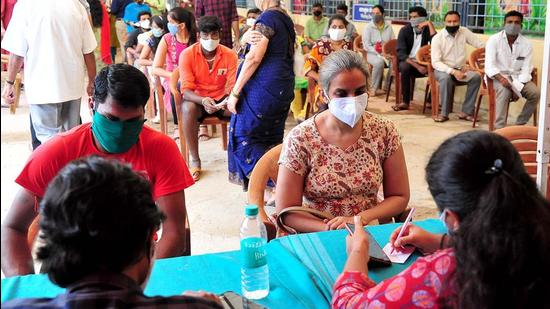
In the following months, BBMP ensured that most of the contacts were traced and tested. This was one of the reasons why Bengaluru had only 385 cases on June 1, 2020, while Chennai, Mumbai and New Delhi had reported 15,770; 40,877 and 20,834 cases respectively on the same day.
More than a year later, during the peak of second wave of Covid cases, authorities were tracing only four contacts, while government guidelines required 20 contacts per patient to be traced. The failure of contact tracing was one of the biggest reasons attributed to the spike in Covid cases in the state, among others.
With the cases coming down and the new Delta variant posing a threat, authorities are now looking to revive the contact tracing efforts, at least in the case of patients infected with the Delta variants. So far, the state has recorded 725 cases of the Delta variants and two cases of Delta plus.
As per BBMP records, out of the 725 cases of patients infecting with the Delta variant, 525 are from Bengaluru, followed by 77 from Vijayapura and 40 from Udupi. Two labs in Bengaluru — Nimhans and National Centre for Biological Sciences are involved in genomic sequences of samples.
A day after the second Delta Plus variant case was detected in Karnataka, on June 23, Karnataka health minister Dr K Sudhakar said that the state was monitoring the emergence of new variants and announced six labs for genome sequencing. “Wherever we have a suspicion, we are doing genomic sequencing. We are doing random checks of 5% of the total samples checked,” Sudhakar had said.
The Delta variant was the most predominant variant circulating in May and June in Karnataka. Nearly 3,000 samples have been processed at the two labs and Nimhans has done more than 1,000 of them. However, health department sources said the samples are almost a month old and results are coming now.
The increased genome sequencing comes with a challenge and also an opportunity for the health department officials. Since the new variants are considered a bigger concern, the health department is now focussing on increasing contact tracing in these cases. “We want to trace as many contacts as possible in these cases,” said a senior health department official, who didn’t want to be named.
He, however, added that the department is facing a big challenge in contact tracing since it takes at least 15 days for genomic sequencing of samples. “Since it takes time for these sequencing results to come, most of the patients have left the hospitals after recovering or it has been a considerable amount of time before we can go back to them,” he said.
He added that contact tracing in normal cases has been affected in recent times because of the spike in cases during the second wave. “In most of the cases, we have to go back to ensure in-depth tracing is done in case of Delta variants. It is a difficult task,” the officials added.
Experts, however, said there is no need to panic over the new variants. “Whether it is more infectious, there is no evidence to show that. They are tracking the patients to find if the virus spreads faster. We will know this soon,” said Dr Ravi, former head of the neurovirology department at NIMHANS and member of Karnataka’s TAC on Covid-19.
He added that it doesn’t seem that the Delta Plus variant is more virulent. “The pattern of disease in Delta Plus is no different from what is seen in the Delta variant. Most of the Delta Plus cases are from samples collected more than a month ago. My reading is that if it was collected one month back, had it (the Delta plus variant) been so deadly, there would have been a higher number of cases and deaths. In fact, the numbers are low now,” he added.


