E-Paper



COP28: No fossil fuel phase-out in new global stocktake text
The text, however, goes on to strengthen the language on coal by now adding “rapidly phasing down unabated coal” and “limitations on permitting new and unabated coal power generation”

 Prefer HTon Google


A new draft of the global stocktake (GST) text landed on Monday evening, suggesting a range of options for mitigation, but had no references to phasing out fossil fuels, an omission experts said could severely hamper attempts to arrest global warming to 1.5°C under the Paris Agreement.
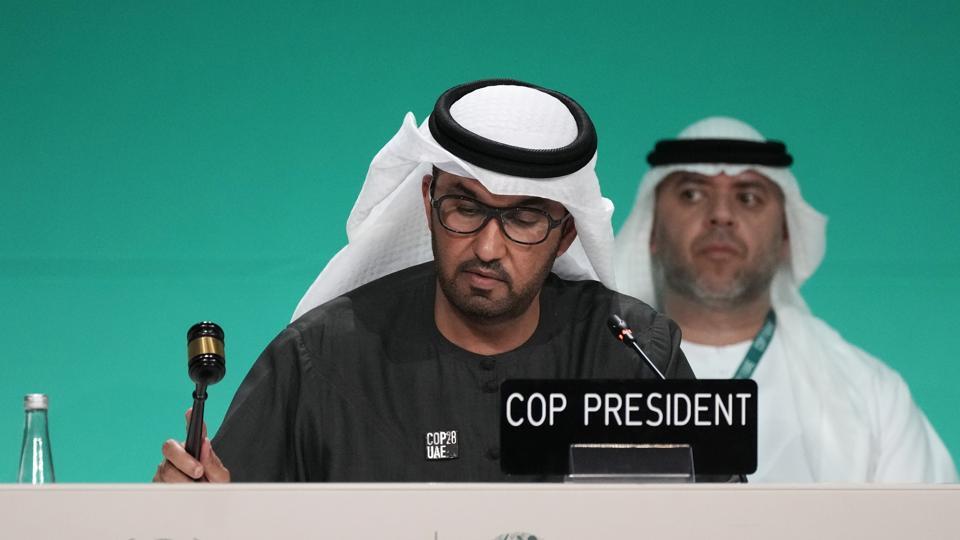
The draft will set the stage for a final round of contentious negotiations, to begin after the final text drops early on Tuesday morning, in the two-week summit in Dubai, which has exposed deep fissures over fossil fuels, climate finance, and adaptation and mitigation measures.
Following the release of the new draft, COP28 President Sultan Al-Jaber called on the attending countries to deliver “the highest ambition on all items, including on fossil fuel language”.
The new draft of the COP28 agreement, published by the United Arab Emirates’ presidency of the summit, proposed various options but did not refer to a “phase out” of all fossil fuels, which was included in a previous draft.
Instead, it listed eight options that countries “could” use to cut emissions, including: “reducing both consumption and production of fossil fuels, in a just, orderly and equitable manner so as to achieve net zero” by or around mid-century.
Other actions listed included tripling renewable energy capacity by 2030; “rapidly phasing down unabated coal”; accelerating zero and low emissions technologies, including, inter alia, renewables, nuclear, abatement and removal technologies, including such as carbon capture and utilisation and storage, and low carbon hydrogen production, so as to enhance efforts towards substitution of unabated fossil fuels in energy systems.
These so-called mitigation options were listed under serial number 39 of the text which states: “Also recognises the need for deep, rapid and sustained reductions in GHG emissions and calls upon Parties to take actions that could include, inter alia…”
In a cause for alarm, the text has deleted all options on phasing out fossil fuels.
“The fourth draft of the GST text is a collation of multiple divergent viewpoints but ambition is watered down by eliminating the call to phase out all fossil fuels. Coal is mentioned twice but oil and gas is missing in the document showing low ambition on tackling 55% of global emissions that come from oil and gas. This is a huge missed opportunity,” said Avantika Goswami, programme manager & researcher climate change at Centre for Science and Environment.
No phase-out of coal
The text, however, goes on to strengthen the language on coal by now adding “rapidly phasing down unabated coal” and “limitations on permitting new and unabated coal power generation”. There is no timeline for the phase out of coal, however.
The focus on coal may be an area of concern for countries like India that depend heavily on coal and other fossil fuels for power production.
The EU rejected the draft with some people saying the bloc might walk out if provisions are not changed.
“Its a very insufficient text. Elements in the text are not acceptable at all. It’s not clear at all how we can proceed in this decade,” said Spanish ecology transition minister Teresa Ribera.
“The text is disappointing. It’s lengthy. There are a couple of good things but it’s entirely inadequate. Scientists are clear about what we need. On the top of that is phasing out fossil fuels... we simply cannot accept this text,” said EU Climate Action Commissioner Wopke Hoekstra
Experts said the text again highlights the “differential treatment” of developing countries.
“The updated GST text furthers the differential treatment meted to the developing south and the developed world. Fossil fuels have to be only ‘reduced’ in a just, orderly and equitable manner, while unabated coal has to be ‘rapidly’ phased down and there need to be limitations on new and unabated coal power generation. There is no need for a just and orderly transition for coal. It will be a surprise if this language is not contested heavily by the global south in the final stages of the negotiations process,” said Vaibhav Chaturvedi, Fellow, Council on Energy, Environment and Water (CEEW) in a statement.
Participating countries said that there is only one way to achieve the Paris Goal, which is a phase out of fossil fuels.
“The Republic of the Marshall Islands did not come here to sign our death warrant. We came here to fight for 1.5°C and for the only way to achieve that: a fossil fuel phase out. What we have seen today is unacceptable. We will not go silently to our watery graves. We will not accept an outcome that will lead to devastation for our country, and for millions if not billions of the most vulnerable people and communities,” John Silk, minister of natural resources and commerce, Republic of Marshall Islands, said.
Experts also called out the heavy dependence on abatement technology that developed nations have pushed for at this year’s negotiations, calling the new text a “watered down menu” of compromises on the crisis.
“There is no text on fossil fuel phase-out. So, what we are seeing is a watered down menu of compromises. We have strong language on abatement technology as if it’s at the same level as renewable energy and energy efficiency,” said Catherine Abreu, senior associate, E3G.
“It has options on reducing fossil fuel production, consumption etc but also several technologies including renewables, nuclear, abatement and removal technologies, including such as carbon capture and utilisation and storage, and low carbon hydrogen production which are less reliable in keeping the 1.5°C goal. The tension is really alarming,” said Tom Evans, policy adviser, E3G’s Climate Diplomacy and Geopolitics programme.
The Sharm El Sheikh Implementation Plan at COP27 last year had a reference to phasing down unabated coal power and fossil fuel subsidies. It called upon parties to accelerate efforts towards the phasedown of unabated coal power and phase-out of inefficient fossil fuel subsidies, while providing targeted support to the poorest and most vulnerable in line with national circumstances and recognising the need for support towards a just transition.
Climate finance
A negotiator working closely with the Presidency pointed out that the text tries to clarify the problems with the delivery of climate finance.
The text “notes with concern that current levels of climate finance, technology development and transfer and capacity-building for adaptation remain highly insufficient to respond to worsening climate change impacts in developing country Parties, especially those that are particularly vulnerable to the adverse effects of climate change; and notes that the estimated costs/needs of adaptation are now approximately 10–18 times as much as international public adaptation finance flows”.
The Presidency, however, maintained that the text reflected ambition.
“The time for discussion is coming to an end. And there is no time for hesitation. The time to decide is now… We have made progress. But we still have a lot to do. You know what remains to be agreed. And you know that I want you to deliver the highest ambition on all items, including on fossil fuel language. You have already shown what a different mindset and a flexible approach can deliver. Now we must all work much faster, much smarter. And we have no option but working together… And we shouldn’t allow for anything to get in between the fact that we have all decided that we will stay laser focused on our North Star,” Al-Jaber told reporters after the release of the fresh text.
A spokesperson for the Presidency said, “The Presidency has been clear from the beginning about our ambitions. This text reflects those ambitions and is a huge step forward. Now it is in the hands of the Parties, who we trust to do what is best for humanity and the planet.”
While admitting the language is not strong enough, a negotiator working with the Presidency said “it is something to work with”.
“The Presidency has put out this draft and now we are expecting countries to come back to us with their responses to the text. The text has been written on hearing to different voices of parties on how we can get something we can move forward on. ‘Could’ is of course not as strong as ‘calls upon’ or anything like that. It is an opening gamble and it is something to work with now,” this negotiator said.
The UN climate chief said “there is nowhere to hide”.
“We are now here to discuss two issues. One - How high is our ambition on mitigation. And two - Are we willing to back this transition with the proper means of support to deliver it. Let me assure you – from our viewpoint at UN Climate Change – the highest levels of ambition are possible for both,” Simon Stiell, executive secretary, UNFCCC said.
“But if we reduce on one, we reduce our ability to get either. So that leaves us with the question: how do we get, from here, a meaningful deal?… The world is watching, as are 4,000 members of the global media, and thousands of observers here in Dubai. There is nowhere to hide,” Stiell added.
HT reported on Monday that the gulf between developed and developing country blocs in how to chart the future of climate action came sharply into view on Sunday, with divisions now appearing to cast a shadow on even some foundational principles the world agreed on in the past, such as the notion that those who historically spewed more carbon emissions take a larger share of responsibility.
Simply put, there are two broad divisions: developed and developing countries, with some other blocs, such as petro-states that rely on oil for their economy, and vulnerable small islands, which face an almost immediate existential risk, taking positions somewhere in between.
But, on Monday several civil society organisations highlighted that developed nations led by US and others were not agreeable to language on equity and common but differentiated responsibilities and wanted no scaling up of climate finance.
“They don’t want any references to equity or common but differentiated responsibility in the text. On finance, across all aspects of negotiations including on the global goal on adaptation text, global stocktake they are diluting finance. They don’t want to talk about scaling up, they don’t wish to talk about predictable resources. All they keep saying is that we commit and we have to shift it to the private sector. There is no meaning to lofty targets,” said Meena Raman, head of programmes at Third World Network.
“We are anticipating that United States might be posturing itself to be supporting a fossil fuel phase-out but we want to be blunt and call it what it is. It is bluff. US is the world’s largest producer of oil and gas. The Inflation Reduction Act (IRA) is completely dwarfed from the projections of fossil fuel emissions from oil and gas projects. This administration has already approved more permits for fossil fuel projects than its infamous predecessor. If US states it wants a fossil fuel phase out we need to see what its actions are telling us,” Rachel Rose Jackson, a research director at Corporate Accountability, said.
UN secretary-general, Antonio Guterres asked countries to “move beyond arbitrary positions and blocking tactics. Second - I urge negotiators to reject incrementalism”.