
 E-Paper



‘Counter-terror efforts boosted by growing consensus’: S Jaishankar after 2+2 meeting
The 2+2 ministerial meeting came amidst growing strategic convergence between the two countries and continuing efforts to resolve the vexatious issue of trade.


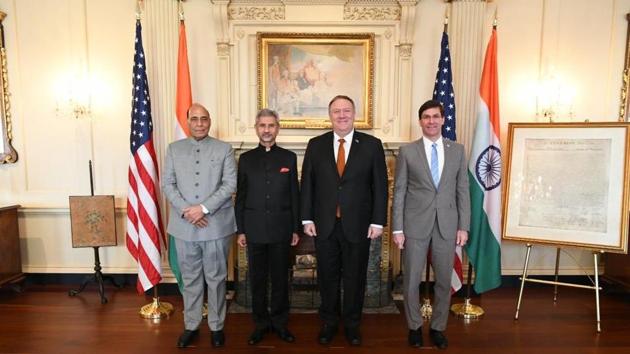
India and the United States on Wednesday announced the conclusion of a key defence agreement to further enhance the interoperability of their militaries and discussed the threat of cross-border terrorism India faces from Pakistan at the second 2+2 ministerial meeting of their foreign and defence ministers.
The two sides also discussed a whole range of issues, including trade, the United States joining the Coalition for Disaster-Resilient Infrastructure - a key global initiative launched by India at the last UNGA; the need for free and open Indo-Pacific and China; and the drawdown of US troops in Afghanistan.
The conclusion of the Industrial Security Annex (ISA) would allow American manufacturers of defence equipment to strike deals with Indian private sector companies, expanding their ability to co-produce and co-develop sensitive defence technologies from the current confines of public sector partners. They also signed three separate pacts with regards to co-production and co-development of defence equipment under and ongoing defense trade initiative.
“Today, we are proud to conclude the Industrial Security Annex, which will facilitate collaboration between our defence industries by supporting the secure transfer of key information and technology,” US Secretary of Defence Mike Esper told reporters after the 2+2 meeting that he Secretary of State Mike Pompeo held with Indian counterparts Rajnath Singh and S Jaishankar. “We also finalised three agreements under the Defence Technology and Trade Initiative, which will enhance our ability to co-produce and co-develop critical technologies.”
Singh said the conclusion of the ISA “will provide the necessary framework for pursuing co-development and co-production linkages in the defence manufacturing sector”.
External Affairs Minister Jaishankar told reporters after the meeting that the two sides discussed “free, open, inclusive, peaceful, and prosperous Indo-Pacific based on the recognition of ASEAN centrality and the cross-border terrorism in the region and agreed to work closely at international forums”.
He said counter-terrorism efforts have been “boosted by a growing consensus on the nature of terror threats in the region, and the dangers of cross-border terrorism and sanctuaries”.
“I appreciate very much the sentiments, appreciate - expressed by Secretary Pompeo on the 11th anniversary of the 26/11 Mumbai attack,” Jaishankar went on to say, and added, “We discussed ways to address these challenges, including by working closely together at the FATF.” The Financial Action Task Force (FATF) has put Pakistan on notice for inclusion in its blacklist of countries with inadequate measures to check funding of terrorism and money-laundering.
The US Secretary of State expanded on the discussions on counter-terrorism in response to a question. “We have been unambiguous in our partnership with the Indian government about terror, terror from wherever it emanates, whether it’s from inside of Pakistan or from anyplace else,” he said, adding, “We are determined to protect the American people from the threat of terrorism and we’re determined to work with our great democratic friends like the Indians to protect the people of India as well, and we’ll continue to work on it.”
On China, Pompeo said the two countries discussed “the risks that Chinese-built communication networks, including 5G, pose to our treasured freedoms and how China’s unfair and predatory economic activity in the Indo-Pacific presents a risk to those very freedoms”.
Rajnath Singh and S Jaishankar met one-on-one with their respective counterparts before the 2+2. Singh later wrote on Twitter he had an “excellent meeting” with Esper and “reviewed the full range of India-US defence cooperation”. Both the countries are “cooperating extensively in strategic & military areas”, he added.
The 2+2 ministerial meeting came amidst growing strategic convergence between the two countries and continuing efforts to resolve the vexatious issue of trade, with a deal still not in sight, not even a modest, scaled down version the two sides have agreed to shoot for, leaving the more difficult issues to a later date, including an ambitious Free Trade Agreement.
The two sides did discuss trade, as was noted by both sides, with Pompeo mentioning the ongoing talks the US trade representative Robert Lighthizer is conducting with Indian commerce minister Piyush Goyal.
The state department noted the importance of trade in the relationship even though it is not in the purview of the ministries participating in the meeting. “The US and #India have shared interests in economic prosperity through trade, investment, and connectivity,” it wrote in a tweet. “In 2018, bilateral trade between our nations was $142 billion, up 13% from the prior year. We look forward to continuing our strong partnership with India.”
One of the key outcomes of the second 2+2 ministerial would be, as a familiar person with the ongoing discussions, was that it took place without the postponements and cancellations that had plagued the first round, delaying it almost a year, forced by the sacking of then secretary of state Rex Tillerson and President Trump’s preoccupation at the time with talks with North Korea.
The highlight of the inaugural, which finally took place in September, in New Delhi, was the signing of Communications Compatibility and Security Agreement (COMCASA), an enabling agreement that would dramatically expand interoperability between the militaries of the two countries. It had capped a year-long series of developments related developments such as the US designation India a Major Defence Partner and according STA-1 status, bringing it at par with its NATO allies for the sharing of sensitive defence technology.


