
Sign in

Counterterrorism, illegal immigration in focus at India-US dialogue

People familiar with the matter said on condition of anonymity that discussions focused on US efforts to restrict access to fentanyl

Updated on: Feb 28, 2024, 20:36:02 IST
Share
Share via
  • facebook
  • twitter
  • linkedin
  • whatsapp
Copy link
  • copy link

New Delhi: Cooperation in counterterrorism, narcotics trafficking and illegal immigration figured in India-US senior officials’ homeland security dialogue on Wednesday, with the two sides signing a memorandum of cooperation on law enforcement training.
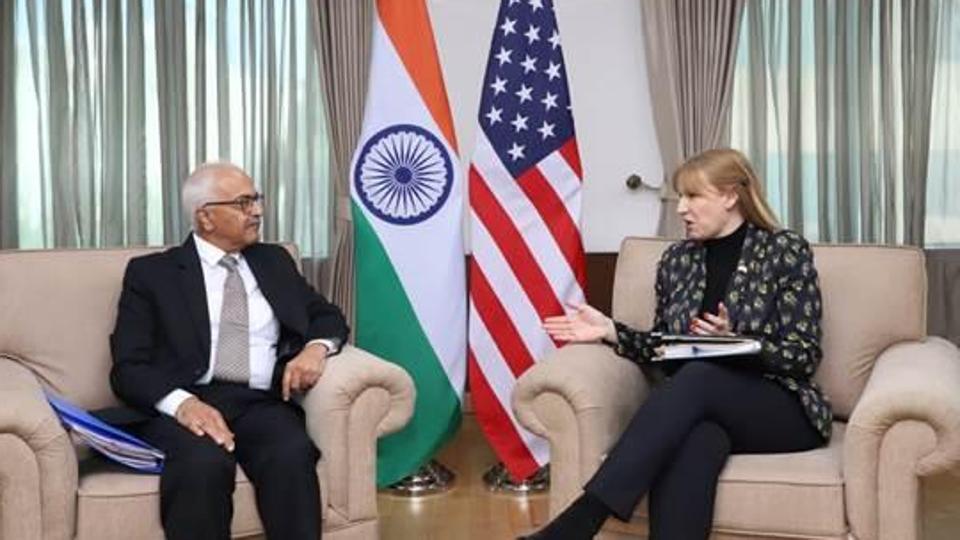
India-US senior officials’ homeland security dialogue was held in New Delhi on Wednesday (Twitter/@PIB_India)

The two sides reviewed ongoing work in counter-terrorism and security, which a readout from the Union home ministry described as a “key pillar” of the bilateral strategic partnership. They discussed steps that can be taken to bolster bilateral efforts to combat terror, violent extremism, drug trafficking and organised crime.

The dialogue concluded with signing a memorandum of cooperation on law enforcement training between the US Federal Law Enforcement Training Centre and India’s Sardar Vallabhbhai Patel National Police Academy.

People familiar with the matter said on condition of anonymity that discussions focused on US efforts to restrict access to fentanyl, the powerful synthetic opioid linked to a sharp rise in drug overdose deaths in the United States.

Following the launch last month of a US-China counter-narcotics working group to curb the production and trade of fentanyl, Washington is looking to work with other key partners to cut off access to illegal supplies of the opioid for foreign drug cartels.

The people said Mexican drug cartels could turn to India, with its extensive pharmaceutical industry, as a possible source of fentanyl, and cooperation could look at joint monitoring of the supply of the lab-made drug. They acknowledged that India already has a good monitoring system, and the joint work will seek to build on this. In this context, the two sides are looking to finalise a memorandum of cooperation on countering narcotics trafficking.

During the dialogue, the two sides looked at ways to speed up the tackling of illegal migration, especially in the context of Mexico, Salvador and India emerging as the top three source countries for such migrants, the people said. One of the measures being looked at to tackle this issue is sharing biometric information since many illegal migrants get rid of their travel documents, the people said.

The issue of handling the cases of all illegal migrants, including detention and deportation, within 30 days also figured in the talks, the people said. At the same time, the two sides have also taken steps to facilitate travel by holders of visas such the H-1B and their families, the people said.

The Indian readout said the two sides reaffirmed their commitment to strengthening people-to-people ties by taking steps to enable safe and legal migration and to counter illegal migration and human trafficking.

Cyber-security was another important element of the dialogue, especially measures to counter phishing attacks and demands for cyber ransom from private companies and to exchange information on the activities of criminal gangs, the people said. The Indian readout said the two sides discussed ways to counter money laundering, cyber-crimes and misuse of the cyber domain for illegal activities, including terror financing.

The issue of Nikhil Gupta, the Indian national named in a US indictment over an alleged plot to kill Khalistani leader Gurpatwant Singh Pannun on American soil, didn’t figure in the dialogue. Gupta was detained in the Czech Republic last June and has challenged a Czech court’s order clearing his extradition to the US.

The US indictment alleged that an Indian government employee ordered the assassination of Sikhs for Justice (SFJ) leader Pannun in New York. The SFJ has been outlawed by India and Pannun was declared a terrorist.

The Indian side at the dialogue was led by home secretary Ajay Bhalla, and the US delegation was headed by Kristie Canegallo, acting deputy secretary in the department of homeland security. They reiterated their interest in consolidating collaboration between law enforcement agencies through exchange of information, capacity building, technical assistance and regular meetings of sub-groups set up under the India-US Homeland Security Dialogue.

Both sides agreed to hold the next round of the senior officials’ dialogue in Washington.
  • Rezaul H Laskar
    ABOUT THE AUTHOR
    Rezaul H Laskar

    Rezaul Hasan Laskar is Foreign Editor with the Hindustan Times, which he joined in 2015. He began as a journalist in his hometown of Shillong in northeast India and has worked in newspapers and wire services over the years. He moved to New Delhi in 1997 and initially focused on defence, national security, Jammu and Kashmir and the northeast, while also working of foreign policy and international relations. He has been part of the media delegation accompanying PMs on foreign visits and has reported from destinations ranging from Tibet to Ukraine. Between 2007 and 2013, he was the Press Trust of India correspondent in Pakistan, one of only two Indian journalists allowed to report from the country. He extensively covered Pakistan’s domestic politics and the life of the common people, as well as the fallout of the 2008 Mumbai attacks on India-Pakistan relations and the subsequent trial in Pakistan of the suspects involved in the attack. As part of his reportage in Pakistan, he travelled the breadth of the country, from the Swat Valley to Balochistan. Reza’s first gig in journalism was writing a weekly music column, and music – especially classic rock – remains a keen interest. He is also a movie buff and a keen photographer.Read More

  • Neeraj Chauhan
    ABOUT THE AUTHOR
    Neeraj Chauhan

    Neeraj Chauhan is a senior journalist with Hindustan Times and an investigative reporter specialising in national security, terrorism, organised crime, narcotics, corruption, financial crime and complex investigations. With over 21 years of experience across Hindustan Times, The Times of India, The Indian Express and The Pioneer, he has built deep expertise in India’s internal security and law-enforcement landscape. Neeraj has extensively covered India’s principal investigative, intelligence and security agencies, including the NIA, CBI, ED, IB, R&AW, MHA and other central security forces. His work has included deeply reported investigations into terrorism, terror financing, cross-border crime, narcotics trafficking, cybercrime, financial fraud and political and corporate corruption. He has reported on some of the most significant terror attacks and security developments in India over the past two decades, including the Delhi serial blasts, the 26/11 Mumbai attacks, the 2019 Pulwama terror attack and the recent Pahalgam attack. His reporting has also chronicled the rise and decline of the Indian Mujahideen, the activities and subsequent crackdown on the Popular Front of India (PFI), Islamist extremist networks, the conflict in Jammu and Kashmir, insurgencies in the Northeast and Maoist violence. Some of Neeraj’s major breaking stories are in Aryan Khan drug case, Sushant Singh Rajput suicide, interception of a 3,000-kg Afghan heroin consignment worth about ₹21,000 crore at Mundra port, Sri Lanka easter bombings, Aarushi-Hemraj murders in Noida, 2G scam, coal block allocation scam, AgustWestland VVIP chopper deal and major bank frauds and extradition cases involving Mehul Choksi, Nirav Modi and Vijay Mallya. His reporting is marked by an ability to cultivate sources, analyse confidential and complex documents, and follow investigations over several years—from the initial breakthrough to chargesheets, trials and international legal proceedings. He specialises in making complicated security and investigative developments accessible while examining their wider implications for governance and public policy. A Chevening South Asia Journalism Programme Fellow at the University of Westminster, Neeraj also spent time at the Financial Times as part of the fellowship. He was also a Robert Bosch Media Ambassadors India-Germany Fellow, studying at the University of Tübingen and working with Der Tagesspiegel in Berlin. He has previously taught investigative journalism and crime reporting as a guest faculty member at the Times School of Journalism. Over more than two decades, Neeraj has established himself as an authoritative voice on India’s national security and investigative landscape, with his reporting closely followed by officials, investigators, lawyers, policymakers and readers seeking insight into some of the country’s most complex and consequential developments.Read More