
 E-Paper



Criminal identification Bill gets Parliament nod
The Criminal Procedure (Identification) Bill, 2022 seeks to update a British-era law to enable police to collect samples of a person’s biometric details, such as fingerprints and iris scans, if they have been arrested, detained or placed under preventive detention on charges that attract a jail term of seven years or more.

 Prefer HTon Google


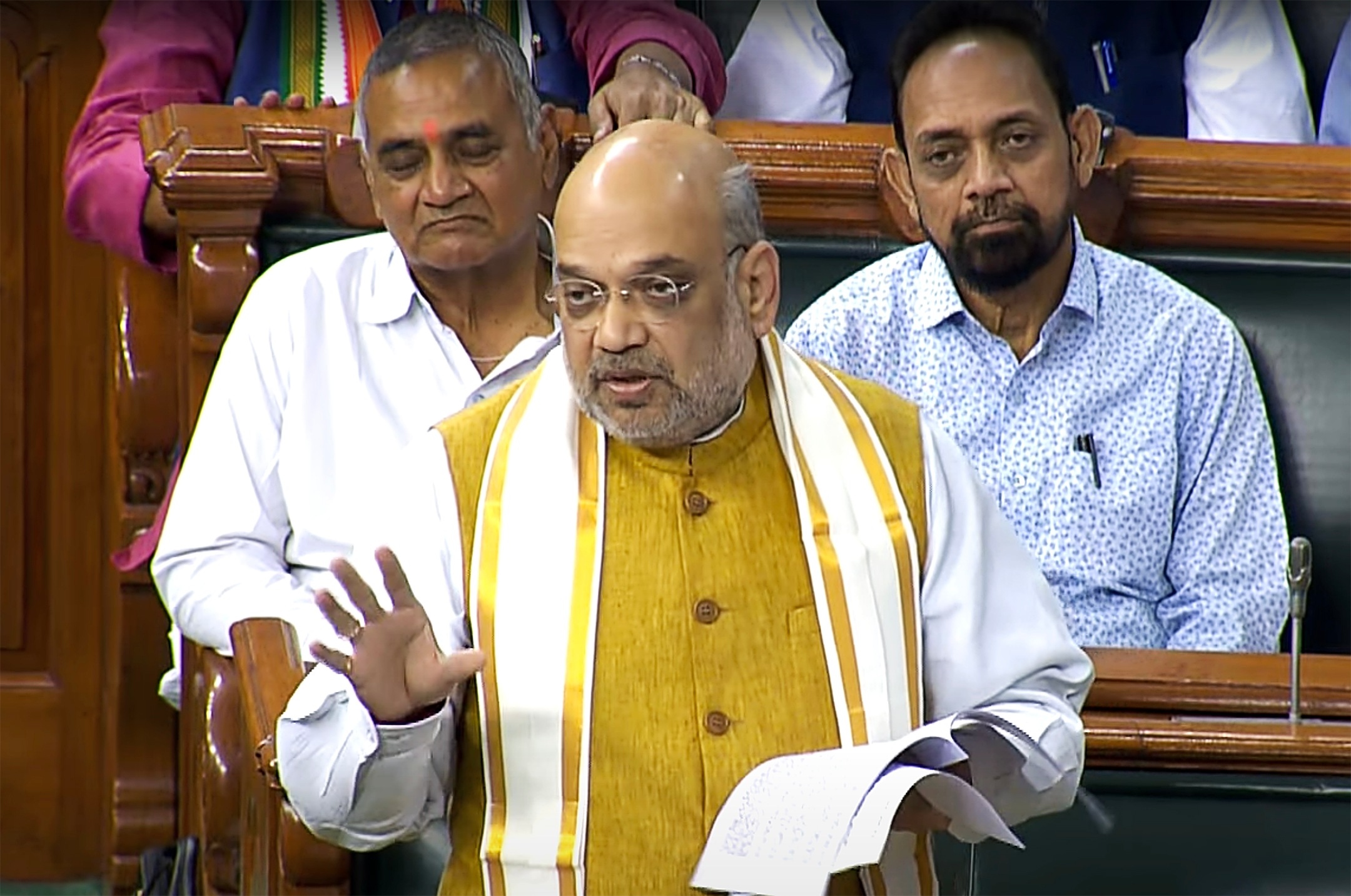
Parliament on Wednesday cleared a contentious Bill that accords sweeping powers to police to collect biometric and physical measurements of people convicted, arrested or detained, after Union home minister Amit Shah assured the Upper House that the data will not be misused.
The Criminal Procedure (Identification) Bill, 2022 seeks to update a British-era law to enable police to collect samples of a person’s biometric details, such as fingerprints and iris scans, if they have been arrested, detained or placed under preventive detention on charges that attract a jail term of seven years or more.
The Bill passed the Rajya Sabha on a voice vote, two days after it cleared the Lok Sabha. The Opposition called the Bill “draconian” and raised concerns about data breaches and violation of privacy, but Shah assured the House that biometric data of political detainees will not be collected and the proposed law will exclude brain mapping and polygraph test.
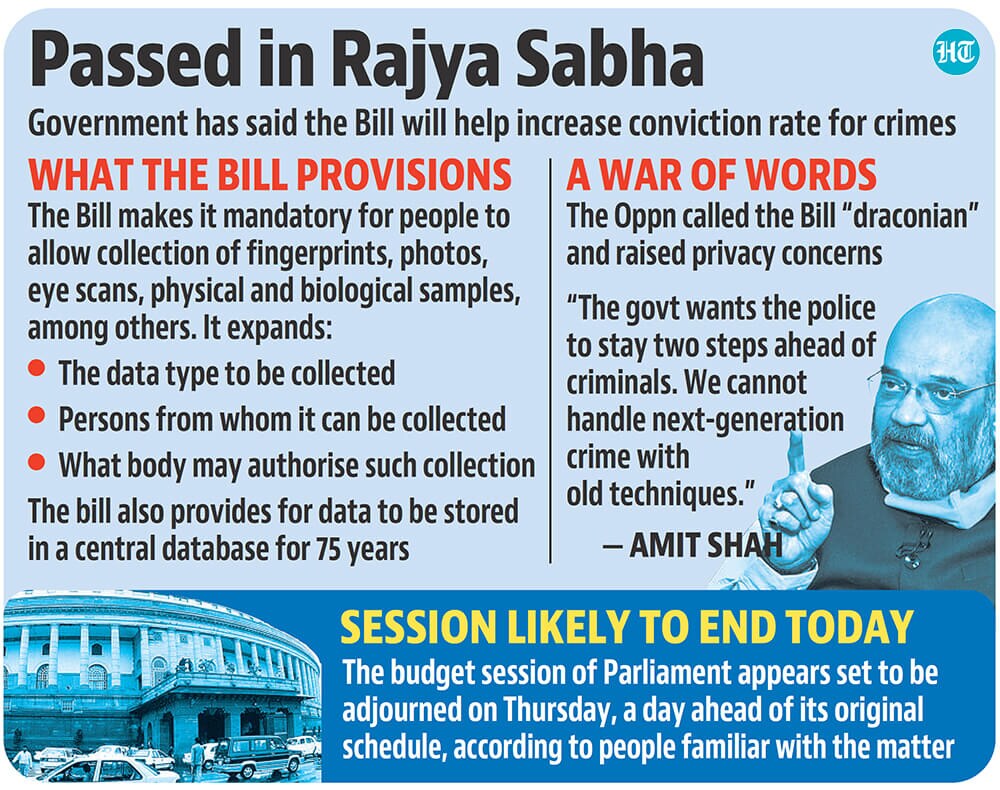
“The Modi government wants the country’s police to stay two steps ahead of criminals. We cannot handle next-generation crime with old techniques, we will also have to adopt next-generation techniques,” Shah said.
The Bill makes it mandatory for police to allow collection of finger impressions, palm print impressions, footprint impressions, photographs, iris and retina scans, physical and biological samples and their analysis, behavioural attributes, including signatures and handwriting, among others. The draft law also empowers the National Crime Records Bureau (NCRB) to collect, store and preserve these records for 75 years and share it with other agencies. Resistance or refusal to allow the collection of data is an offence. The legislation will now be forwarded to the President for approval before it becomes law.
Shah said that the government will make rules to ensure that no person involved in a political agitation has to give (physical and biometric) measurements only for political agitation. “But, if a political leader is arrested in a criminal case, then he will have to be at par with a citizen,” he said. The home minister added no measurements will be taken of any political person for violation of prohibitory orders promulgated by police. “No provision of this bill permits performing narco analysis, polygraph test and brain mapping of any prisoner,” he said.
In the Lok Sabha, Shah gave similar assurances two days ago, saying that rules for the law will be framed after consulting top experts from around the world to make sure there aren’t any privacy concerns. “It is aimed at building capacity for the police and forensic teams,” he said, adding the measure was intended to preclude the use of third degree methods (custodial torture) and making available the benefits of science and technology to prosecuting agencies.
Experts have raised concerns about the Bill, saying its powers are far too broadly defined and might curtail constitutional rights. They have also said that in the absence of a national data protection law, the data collected might not have adequate safeguards against privacy violations.
The Bill also empowers a magistrate to direct any person to give measurements and empowers police or prison officers to take measurements of any person who resists or refuses to give measurements
In the Rajya Sabha, the Opposition flagged several concerns — including of data storage, privacy violations, inadequate safeguards and chilling effect on free speech — but Shah took on Opposition parties and deplored that none of the members rose to say that conviction rates in India are low and should be increased.
According to the minister, 66 out of 100 people charged with murder and 70 of 100 arraigned for dacoity got acquitted. Shah said the Bill was brought to ensure that police and investigators remain two steps ahead of criminals. “I want to assure you that this is not going to violate the privacy of anyone,” Shah said, adding that data collected will be completely secure.
He also said that previous governments had abused laws earlier and had sympathy only for criminals, not victims. “There has been misuse. We have fought and come out of it,” he said.
“The Bill is about safeguarding the human rights of the victims of crimes, and not just criminals…our law is ‘bachha’ (nothing) in terms of strictness as compared to other nations. There are more stringent laws in countries like South Africa, UK, Australia, Canada and the US, which is why their conviction rate is better,” he said.
The minister said police will send fingerprint impressions to NCRB, which will share the name of the person with the investigators only if it matches with the records present in the database. Police will not have access to fingerprint data of others, he said. “We will notify it after making a complete system…the effort is to empower police,” he added.
He said the government created the Crime and Criminal Tracking Network & Systems (CCTNS), which was adopted by 100% police stations across the country.
A total of 17 members participated in the debate. Some Opposition members termed the Bill “unconstitutional” and that it should be sent to the select committee.
Congress leader P Chidambaram termed the bill as “unconstitutional” and said it violates the liberty, privacy and dignity of people.
Aam Aadmi party MP Sanjay Singh said it was nothing short of an expression of brute majority. “The Bill violates the principle of natural justice,” he said, and demanded that the draft law be sent to a parliamentary select committee for vetting. Tiruchi Siva of the Dravida Munnetra Kazhagam (DMK) supported his demand, claiming the government wanted to armour itself with “draconian” laws that could be used even against political and social activists.
Sukhendu Sekhar Roy of the Trinamool Congress said the government wanted to use its “brute majority” to pass the Bill that “violates the principle of natural justice”, and demanded that it be sent to a select committee. Sujeet Kumar of the Biju Janata Dal said the Bill, even if passed, will not withstand judicial scrutiny. Ram Gopal Yadav of the Samajwadi Party opposed the Bill and noted it will be challenged in the Supreme Court even if it is passed in Parliament.
But support for the government came from V Vijaysai Reddy of the YSR Congress Party, who said the draft legislation will help improve the conviction rate, and attacked the Congress for foisting false cases against political adversaries.
A Navaneethakrishnan of the All India Anna Dravida Munnetra Kazhagam backed the bills, calling it the right intervention.
Digital rights organisation Access Now quoted its Asia Pacific Policy Counsel, Namrata Maheshwari, as saying, “The Bill expands the scope and authority for surveillance, and in conjunction with other imminent laws designed to control people’s data, will adversely impact fundamental rights.”


