Crucial to Delhi-Dhaka ties: The resolution of Teesta river sharing
Made evident during Hasina's visit, the lack of an agreement on sharing its waters between the two nations has come to dominate the narrative. Its resolution will only give impetus to developmental programmes.
As guests waited for Bangladesh Prime Minister Sheikh Hasina to arrive for a diplomatic reception on the first day of her visit to India, they didn’t fail to notice that all the tables were named after the rivers of her country, such as Padma, Khowai, Kushiyara, and Meghna.
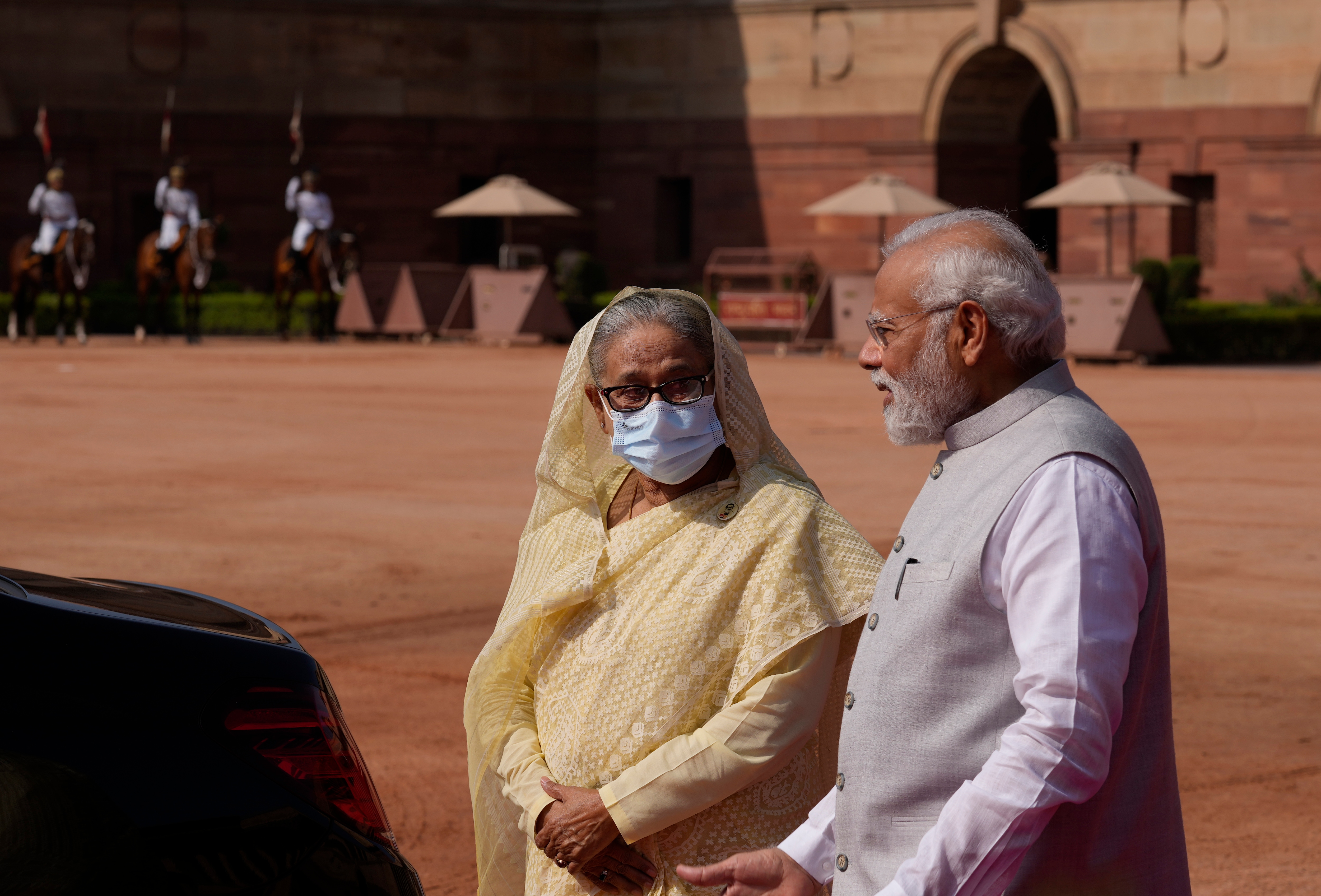
The Teesta originates in the northeastern Indian state of Sikkim and moves through West Bengal, covering more than 290 km in the two states, before entering Bangladesh and flowing for another 120 km. (AP)
Located prominently to the left of the seat assigned for the prime minister was a table named Teesta, after the river that has occupied a central place in almost all meetings between Indian and Bangladeshi leaders since 2011, when the two sides came tantalisingly close to an agreement on sharing the waters of the Teesta river.
During a brief interaction with Indian journalists after the dinner, Hasina jokingly said in Bengali, “If they [India] gave us the water, the hilsa fish would come too. They don’t give water, and so they don’t get the hilsa.”
The remarks, albeit in a lighter vein, once again highlighted how much the Teesta, or rather the lack of an agreement on the sharing of its waters, has come to dominate the narrative. On the Bangladeshi side, it has even been used by Hasina’s detractors to claim that Dhaka has done more to address New Delhi’s concerns and interests without getting much in return.
That, however, is far from the reality of the current status of the relationship. India has repeatedly asserted that Bangladesh occupies a central position at the intersection of its “Neighbourhood First” and “Act East” policies. Bangladesh has benefited from concessional Indian loans worth $9.5 billion for development projects, especially connectivity initiatives, and India has become the biggest market for Bangladeshi exports in Asia.
India and Bangladesh have been working on a formula for sharing the waters of the Teesta for close to four decades and reached an ad hoc arrangement in 1983, whereby India got 39% of the waters, and Bangladesh 36%. Work on the Teesta continued after the Ganges Water Sharing Treaty of 1996 and the two sides were set to ink a pact during former Prime Minister Manmohan Singh’s visit to Bangladesh in 2011 but the proposed treaty was opposed by West Bengal chief minister Mamata Banerjee because of fears that it would lead to a shortage of water in her state during the dry season.
Matters have been stuck at that stage since then, with the Teesta becoming something of an emotive issue on the Bangladeshi side. As expected, Hasina raised the issue of the Teesta river at her meeting with her Indian counterpart, Narendra Modi, on September 6. She “reiterated Bangladesh’s long-pending request for concluding the interim agreement on the sharing of the waters of the Teesta River, the draft of which was finalised in 2011”, according to the joint statement issued after the meeting.
Shafqat Munir, senior research fellow at the Bangladesh Institute of Peace and Security Studies, highlighted the need for an expeditious settlement of the matter to address several pressing issues.
“Adequate sharing of water of the Teesta river is crucial for the biodiversity, economic growth and agricultural productivity in the northern region of Bangladesh. Moreover, it will pave the way for resolving water-sharing issues with the other rivers as well,” he said.
“Bangladesh is a riverine delta and rivers are its lifeblood. Teesta is also an unresolved issue which bedevils an otherwise robust relationship. For over a decade it has been a cause of contention. Hence, a speedy resolution will benefit both sides.”
The Teesta originates in the northeastern Indian state of Sikkim and moves through West Bengal, covering more than 290 km in the two states, before entering Bangladesh and flowing for another 120 km. Significant numbers of people on both sides depend on the river for food, energy and livelihoods.
A study done by The Asia Foundation in 2013 showed the Teesta flood plain covers nearly 14% of Bangladesh’s total cropped area, providing livelihood opportunities directly to about 7.3% of the population, or more than nine million people.
That study also concluded that workable solutions in transboundary water governance will not materialise the discourse on this issue “becomes less nationalistic so that reasonable compromises are possible in water negotiations”. It said: “Benefit sharing is broadly constructed beyond just volumetric measures of water that reduce negotiations to a zero-sum game.”
India, especially its strategic northeastern region, and Bangladesh have much to gain from bilateral connectivity, energy and trade initiatives currently underway and a resolution of the Teesta rivers issue will only give impetus to such developmental programmes.
Get the latest India News, breaking headlines and real-time updates from across the country. Stay informed about politics, government policies, crime, weather and major national developments.
Home/India News/Crucial To Delhi-Dhaka Ties: The Resolution Of Teesta River Sharing

 E-Paper