
 E-Paper



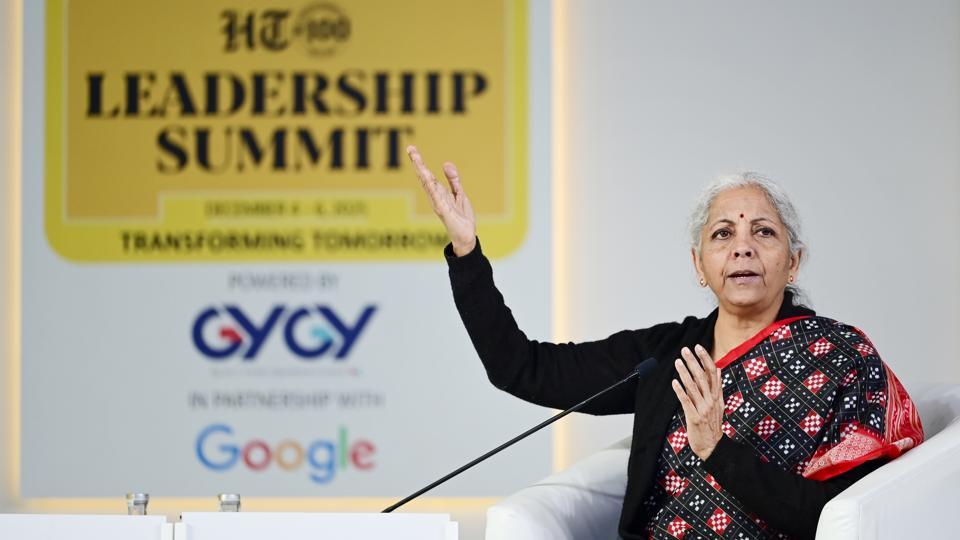
Customs duty regime next in line for reform: Sitharaman at HTLS 2025
HTLS 2025: Nirmala Sitharaman said the proposed customs reforms would be similar to the simplification undertaken in the Income Tax Act

 Prefer HTon Google


NEW DELHI: Reforming India’s customs duty regime—by lowering rates on select goods, increasing transparency, and reducing official discretion—will be the next major economic reform push, finance minister Nirmala Sitharaman said on Saturday.
A comprehensive overhaul of the customs framework would be the continuation of a series of economic and regulatory overhauls that have eased the burden of compliance for businesses and consumers. This year alone, the finance minister streamlined income tax laws with the Income Tax Act 2025, besides lowering slabs in the Union budget, and, as chairperson of the GST Council, ushered in changes that rationalised India’s indirect tax structure.
Speaking at the 23rd Hindustan Times Leadership Summit, the minister said the proposed customs reforms would be similar to the simplification undertaken in the Income Tax Act, which is being administered under a new statute starting this April.
“There are quite a few things to do,” the minister said in response to a question on the next set of reforms being planned by the government.
“It is the complete overhaul of customs. We need to have customs a lot more simplified for people to feel that it is not too tiresome or cumbersome to comply with,” Sitharaman said, adding that rules have to be made more transparent.
The finance minister noted that income tax reforms sought to address taxpayer grievances about the administration of the law on the ground, which was perceived to be “agonising.” Assessments are now being done under a faceless regime to eliminate personal biases.
The proposed customs reforms will be comprehensive and entail duty rate rationalisation. “We have brought down customs duty over the last two years steadily. But in those few items where our rates are considered to be over the optimal level, we have to bring them down as well. Customs is my next big cleaning-up assignment,” Sitharaman said.
The minister highlighted that the Indian economy faced several challenges in recent years, including the Covid-19 pandemic and subsequent supply chain disruptions due to conflicts in Europe. “The key challenge is to speed up growth but keep it sustainable,” she said.
Despite these global uncertainties taking a toll, she emphasised that India has held its head high due to the stable leadership provided by Prime Minister Narendra Modi and the stable policies he insists on,
With lower taxes, consumption will get a boost, she said. “We have seen the second quarter growth. I think, overall this year, growth will be 7% or beyond.”
India’s economy beat expectations in the September quarter with 8.2% growth, which prompted chief economic advisor V. Anantha Nageswaran to upgrade his growth forecast to “the north of 7%” for the full year, up from the 6.3-6.8% projected in the Economic Survey presented in January.
India recorded a retail inflation of 0.25% in October, easing further from September’s 1.54%.
Rupee value and economic context
The minister said that the trend of disinflation does not worry her and that macroeconomic factors, including the rupee-dollar exchange rate, will adjust to their appropriate levels.
The rupee slipped to an all-time low of 90.46 against the dollar on Thursday before pulling back to close at 89.98. The domestic currency settled at 89.96 on Friday.
Responding to a question on public perception of exchange rates as a reflection of economic strength or weakness, the minister acknowledged that the National Democratic Alliance (NDA) had also raised the issue of rupee depreciation in Parliament and outside when it was in the Opposition, doing a “much better” job of it.
However, she drew a sharp distinction between the economic context then and now. When the NDA was criticising rupee depreciation from opposition benches, “inflation rate was high—particularly core inflation—and the economy was fragile,” she said, making the currency weakness far more concerning.
She argued that the economy’s fundamentals now tell a different story. Sitharaman said one must look at India’s growth rate and its global position among other major economies. “Some factors are very important that position India differently today, and as a result of which, this currency debate has to be circumscribed by those realities.”
On the positive side, she noted that exporters should benefit from the weaker rupee and that “our exporters have started to benefit from it.”
Some observers have also pointed out that the rupee’s depreciation, coming at a time when high tariffs are being imposed on Indian goods, provides “some respite.” However, the minister was quick to emphasize this was “by coincidence” and “not planned at all,” adding that it doesn’t satisfy her and that “the economy’s strength will have to be read with it.”
The government’s strategy to revive the economy, sustain the growth rate, and make the country a developed nation by 2047 includes strong investments in the infrastructure sector, income tax and GST rate relief, and continuous reform of the regulatory architecture.
The minister said she would prefer to make a medium-term assessment of how the consumption trend is shaping up after the income tax and Goods and Services Tax (GST) rate cuts this year, rather than making an assessment based on data for one or two months.
While the middle class might not be saving in traditional instruments like post office or fixed deposits, this needs to be seen in the context of more and more of them investing in assets which are growing in value -- whether these are second houses or financial markets, the minister said. “These investments will create value for them going forward,” she said while answering a question about whether lower savings ought to be a matter of concern.
Sitharaman added that the central government is willing to help states restructure their loans for better fiscal performance, while cautioning against borrowing to fund freebies.


