
 E-Paper


Delhi airport issues advisory as flights may get affected amid dense fog; GRAP 4 lifted as AQI improves
Delhi Airport said in its advisory on Wednesday morning that flights that are not CAT III compliant may get affected.

 Prefer HTon Google


Parts of Delhi and its adjoining areas were enveloped by dense fog on Wednesday morning, prompting the Indira Gandhi International (IGI) Airport to issue an advisory over the possible impact on flights. At least 20 trains to Delhi from various parts of the country were running late due to fog conditions on Wednesday.
The Delhi airport said in its advisory on Wednesday morning that flights that are not CAT III compliant may get affected, requesting passengers to contact the airline for updated flight information. IndiGo airline also asked passengers to check the flight status before heading to the Delhi airport.
CAT III is a category of aircraft landing that helps planes land in low visibility conditions. Category I/II/III represent different levels of precision instrument approaches for flights based on visibility and decision height.
Visuals from the Dwarka Expressway in Delhi showed extremely low visibility there, while other parts of the city and its nearby areas of Ghaziabad, Noida and Gurugram were also covered in haze.
The 20 trains to Delhi running late on Wednesday morning included: Goa Express, Poorva Express, Kalindi Express, Rewa - Anand Vihar Terminal SF Express etc.
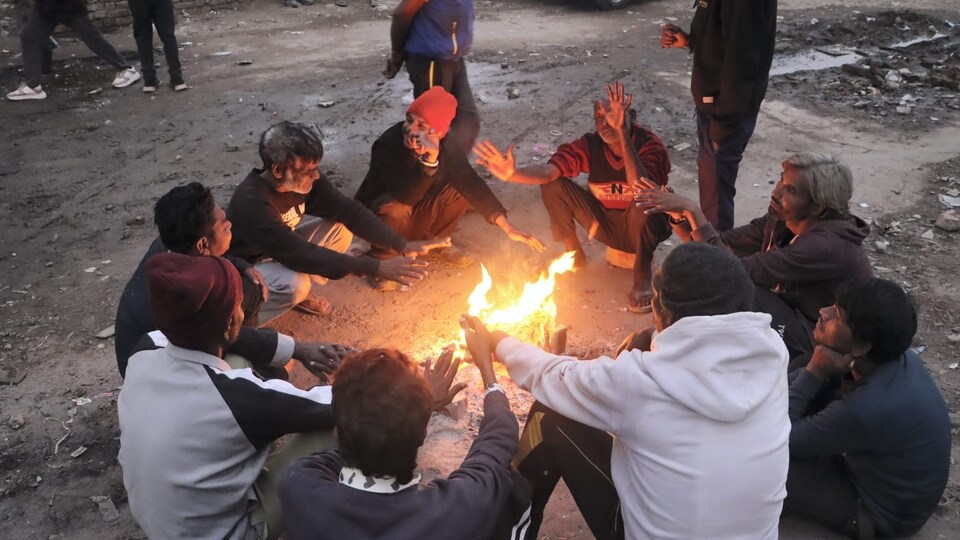
The overall minimum temperature in Delhi on Wednesday morning stood at nine degrees Celsius, as per the India Meteorological Department (IMD).
On Tuesday, Delhi recorded a minimum temperature of seven degrees Celsius amid rain hitting parts of the city for the second straight day. The showers on Tuesday led to traffic snarls as people headed out to soak in festive spirit on Christmas eve on Tuesday.
GRAP 4 lifted
The Central government's air quality monitoring panel on Tuesday revoked Stage IV ('Severe ') measures under the Graded Response Action Plan (GRAP) in Delhi and the National Capital Region (NCR) following an improvement in air quality.
However, actions under Stages I, II, and III will remain in force to prevent any further deterioration of air quality, the Commission for Air Quality Management (CAQM) announced on December 24.
Also Read | Christmas: Delhi Police issues traffic advisory over expected rush at malls
The decision comes after Delhi's Air Quality Index (AQI) improved to 369 ('Very Poor') at 4 PM on December 24. The overall AQI stood at 333 at around 7 am on Wednesday.
As per the Central Pollution Control Board (CPCB), an AQI between 0 and 50 is considered "good," 51-100 "satisfactory," 101-200 "moderate," 201-300 "poor," 301-400 "very poor," 401-450 "severe," and above 450 “severe plus.”
The improvement in air quality was attributed to favourable meteorological conditions, including improved wind speed, according to forecasts from the IMD and the Indian Institute of Tropical Meteorology (IITM), a news agency ANI report said.
In line with the Supreme Court's directives, Stage IV measures were initially invoked when AQI levels breached the 400 mark on December 16.
Temperature likely to drop further in northwest India: IMD
The IMD said on Tuesday that the temperature is likely to drop further in the Delhi-NCR region, Punjab, Haryana, and Rajasthan in the next two days.
IMD scientist Naresh Kumar told news agency ANI that a western disturbance currently situated near Punjab and adjoining areas is expected to bring light rain or snowfall to isolated parts of the western Himalayan region.
"The wind flow will be northwesterly, leading to a temperature drop of about 2°C in Punjab, Haryana, Delhi-NCR, and Rajasthan over the next two days. This may cause a cold wave in Rajasthan and Haryana, with temperatures possibly falling to 4°C," he added.
Naresh Kumar also mentioned that a significant western disturbance is expected to arrive on the night of December 26. This system may bring hailstorms and thunderstorms to northwestern and central India, along with light to moderate snowfall in the Himalayan region on December 27 and 28.


