
 E-Paper



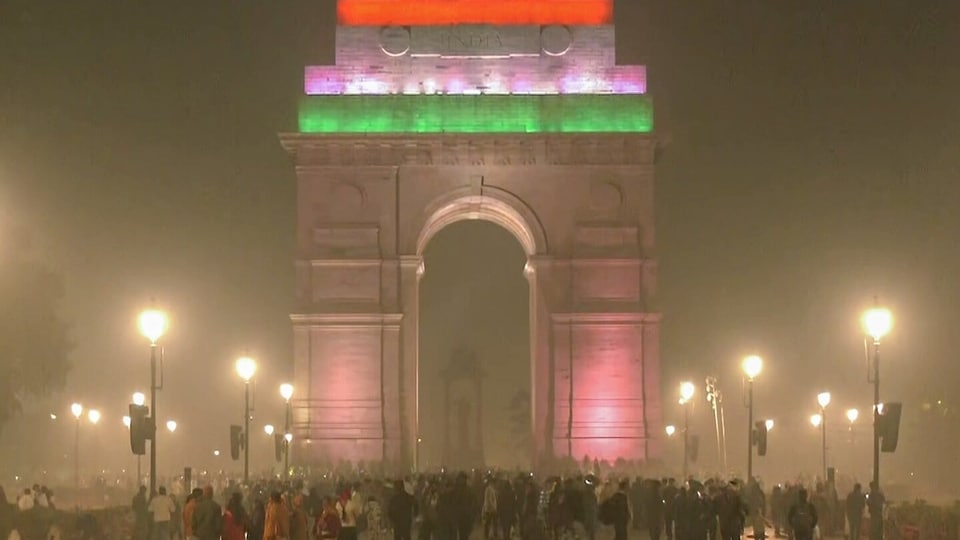
Delhi shrouded in smog as AQI stays in ‘poor’ category; IMD issues cold wave alert for Northern India
Weather alert: The Central Pollution Control Board (CPCB) reported an overall Air Quality Index of 248 on Sunday, placing the city in the 'poor' category.

 Prefer HTon Google


The national capital continues to struggle with poor air quality as residents woke up to a chilly and windy morning, with dense fog reducing visibility in several areas. The Central Pollution Control Board (CPCB) reported an overall Air Quality Index of 248 on Sunday, placing the city in the 'poor' category.
Key monitoring stations recorded 'very poor' air quality levels, including Anand Vihar at 350, Rohini at 361, Chandni Chowk at 355, Mundka at 329, and RK Puram at 322. Meanwhile, locations such as NSIT Dwarka and the Indira Gandhi International Airport recorded comparatively better levels at 177, categorised as 'moderate'. The India Meteorological Department (IMD) recorded Delhi’s minimum temperature at around nine degrees Celsius on Sunday morning.
Also read| Bengaluru weather: IMD forecasts misty mornings and chilly evenings ahead
Republic Day preparations in Delhi
Preparations for the Republic Day parade continued at India Gate despite limited visibility caused by smog. Delhi is expected to experience a maximum temperature between 18 degrees Celsius and 19 degrees Celsius, while the minimum may range from seven degrees Celsius to eight degrees Celsius.
Cold wave alert
Northern and central India are also set to witness a mix of dense fog, cold waves, and fluctuating temperatures over the next few days. Isolated rainfall and snowfall are likely over Jammu and Kashmir, Ladakh, Gilgit-Baltistan, and Muzaffarabad on January 5 and 6, while Himachal Pradesh may experience scattered precipitation on January 6.
Also read| Ludhiana: Foggy weather spurs potato late blight disease risk
Temperature fluctuations
Minimum temperatures are expected to fall gradually in several regions. Northwest India may see a decline of two to three degrees Celsius over the next two days, stabilising thereafter. Central India could record a drop of two to four degrees Celsius in minimum temperatures over the next four days, followed by little change. East India will maintain steady temperatures for the next 24 hours, with a gradual fall of two to three degrees Celsius over the subsequent three days. Conversely, Gujarat is likely to experience a gradual rise of two to three degrees Celsius in minimum temperatures over the next three days. Other areas are expected to remain largely unchanged.
Dense fog alert
Dense fog is forecast over many northern and eastern states during early mornings. Punjab, Haryana, and Chandigarh are expected to experience dense to very dense fog until January 7, while western Uttar Pradesh may see similar conditions until January 5, and eastern Uttar Pradesh until January 8. East Rajasthan and Odisha could face persistent fog until January 4 and 6, respectively. Isolated pockets of fog may also occur in Jammu, Himachal Pradesh, Uttarakhand, Assam, Meghalaya, Nagaland, Manipur, Mizoram, Tripura, West Bengal, Jharkhand, Chhattisgarh, Madhya Pradesh, Bihar, and Odisha.
Cold day conditions are likely in isolated areas of Uttarakhand on January 4, and in Bihar on January 4 and 5. Cold wave conditions may affect isolated pockets of Punjab, Haryana, Chandigarh, and Delhi until January 7, western Rajasthan from January 5 to 8, and eastern Rajasthan from January 4 to 8.
The Sub-Committee on the Graded Response Action Plan (GRAP) under the Commission for Air Quality Management (CAQM) has lifted Stage-III restrictions in the National Capital Region, citing improvement in air quality due to favourable meteorological conditions. Citizens are still urged to follow Stage-I and Stage-II measures to prevent further deterioration. Construction and demolition activities that were previously restricted cannot resume without explicit approval from the Commission.
(With PTI inputs)


