
 E-Paper



Delhi-Dehradun expressway: All about the 210-km road project set to cut travel time
The 210-kilometre expressway is expected to significantly reduce the travel time between Delhi and Dehradun.

 Prefer HTon Google


Commuters between Delhi and Dehradun are in for good news, as the Delhi-Dehradun Expressway has begun a trial run on a section connecting the national capital and Uttar Pradesh's Baghpat.
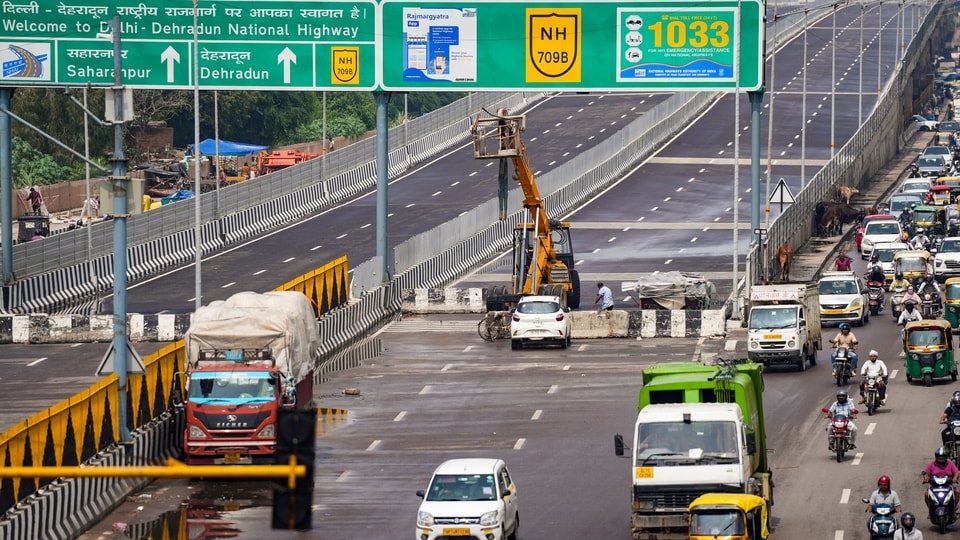
The 210-kilometre expressway is expected to significantly reduce the travel time between Delhi and Dehradun. It was initially set to open for commuters in 2024, but a date in February 2026 is now being targeted for the opening.
With the beginning of the one-month trial period on the 32-kilometre stretch from Delhi to Baghpat, the congestion on the pre-existing routes is expected to ease.
All about the Delhi Dehradun Expressway
- The approximately 210-kilometre-long Delhi-Dehradun Expressway begins close to the Akshardham Metro station in the national capital. It runs through several districts in Uttar Pradesh, including Baghpat, Baraut, Shamli and Sarahanpur and ends in the Uttarakhand capital, Dehradun.
- It is an access-controlled corridor being built with 6 to 12 lanes.
- Prime Minister Narendra Modi laid the foundation stone of the expressway in December 2024. The government initially targeted December 2024 as the completion year, but the ₹11,868.6 crore project saw several delays. It is now expected to be completed and opened up by February 2026.
- Once fully operational, it will reduce travel time between the two cities from approximately six hours to just two and a half hours.
- The Delhi-Dehradun Expressway is being built in four phases. The first phase connects Delhi’s Akshardham to UP’s Baghpat. The second phase, which is reportedly nearly complete, stretches from Baghpat to Saharanpur. The third phase expands the current route from the Saharanpur bypass to Ganeshpur. The fourth phase then connects it to Dehradun and is currently under safety audits.
- A key feature of the project is a 12km elevated wildlife corridor through Rajaji National Park – the longest such structure in Asia – designed with six animal underpasses to enable safe movement for wildlife.
- Ten per cent of all parking capacity being built along the expressway will be reserved for electric vehicles. The facilities will also include food kiosks, ATMs, air-filling stations, Pollution Under Control (PUC) centres, and other permitted utilities.
- Citing officials familiar with the decision, HT had earlier reported that the Delhi-Baghpat section, which has opened for trials, had been ready for at least six months. It remained inaccessible because the Prime Minister’s Office wanted the entire corridor inaugurated as a whole, rather than in parts. An NHAI official, speaking on the condition of anonymity, said that commuters will not be charged tolls for using the stretch for the one-month trial period.
Trial run on the Delhi-Baghpat section of the expressway
The first phase of the much-awaited Delhi–Dehradun Expressway, connecting Delhi’s Akshardham with the Eastern Peripheral Expressway (EPE) near Baghpat, has been opened for trials for the general public, the Union ministry of road transport and highways (MoRTH) announced on Monday.
The 32km-long initial stretch begins at Akshardham Temple, passes through Geeta Colony, Shastri Park, and Mandola Vihar in Ghaziabad, before reaching Khekra in Baghpat.
Officials said the Akshardham–EPE segment will significantly ease traffic by providing a direct high-speed connection, reducing congestion for commuters travelling towards Noida and Ghaziabad. The new route is expected to divert thousands of cars from crowded existing corridors, relieving pressure on other expressways and reducing local traffic through better segregation of through-movement.
To support increased mobility, the NHAI is also developing new parking lots and rest facilities along the Delhi stretch between Akshardham Junction and the Uttar Pradesh border. Three such modern facilities – featuring restrooms, drinking water units, solar-powered lighting, first-aid rooms, and electronic parking systems – will come up near the East Delhi district magistrate's office, Gandhi Nagar market, and Geeta Colony. The Gandhi Nagar site, spanning 1.4 hectares, will be the largest, followed by the DM office site at 0.8 hectares and the Geeta Colony site at 0.78 hectares.


