E-Paper



Demolition drive not action against rioters, UP tells SC
The state clarified that bulldozers razed illegal constructions in accordance with municipal laws, and after providing due opportunity to the violators.


Amid allegations of ”bulldozer politics“ under chief minister Yogi Adityanath, the Uttar Pradesh government on Wednesday told the Supreme Court that no property in the state was demolished to punish people accused of participating in violent protests against remarks by two Bharatiya Janata Party (BJP) leaders on Prophet Mohammed.
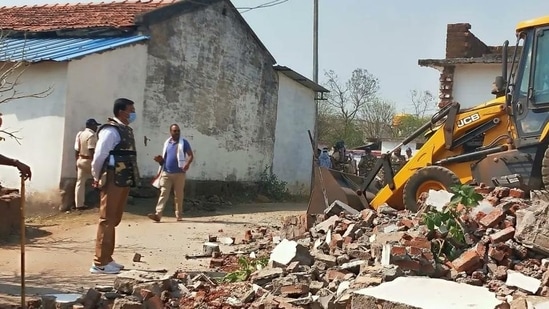
The state clarified that bulldozers razed illegal constructions in accordance with municipal laws, and after providing due opportunity to the violators.
Protests broke out in Kanpur and Prayagraj on June 3 and June 10 against now suspended BJP spokesperson Nupur Sharma and expelled party leader Naveen Jindal for their remarks. Subsequently, the UP government demolished three properties in these cities.
Submitting its affidavit on Wednesday in response to the court notice issued on June 16, the state government justified the action by its municipal authorities.
The government, in its affidavit, has taken the stand that these demolitions “had no relation to the riots”, and that the actions were taken as part of the ongoing demolition drive against encroachment and illegal construction under the Uttar Pradesh Urban Planning and Development Act, 1972.
“It is humbly submitted that in so far as taking action against the persons accused in rioting, the state government is taking stringent steps against them in accordance with completely different set of statutes,” the affidavit said, naming the Code of Criminal Procedure, the Indian Penal Code, the UP Gangster and Anti-Social Activities (Prevention) Act, the Prevention of Public Property Damages Act and the UP Recovery of Damages to Public and Private Property Act as pertinent laws to be invoked against the rioters.
Contending that the two applications, filed by Muslim body Jamiat Ulama-i-Hind asking that the UP government be restrained from any further demolition of properties, must be dismissed with monetary penalty, the affidavit stated that the organisation has “deliberately obfuscated the true facts to paint a nefarious picture of alleged malafide on the part of the administration”.
“The petitioner (Jamiat) has attempted to give a malafide colour to lawful action taken by the local development authorities as per procedure established by law by cherry-picking one sided media reporting of a few incidents and extrapolating sweeping allegations from the same against the state. The same, it is submitted, is completely false and misleading,” the affidavit stated, seeking the dismissal of the plea.
It added that the state government takes strong exception to Jamiat’s “attempt to name the highest constitutional functionaries of the state and falsely colour the local development authority’s lawful actions strictly complying with the UP Urban Planning and Development Act, 1973, as ‘extra-legal punitive measures’ against accused persons, targeting any particular religious community”.
Referring to the two properties that were partly demolished in Kanpur, the affidavit disclosed that proceedings were initiated under municipal law long before the riots in June – in one case, in August 2020 and in another, in February 2020.
Further, in both these cases, the violators admitted to the illegality of the buildings and moved applications for compounding the acts by payment of appropriate charges, besides demolishing the non-compoundable portions, the affidavit said.
With respect to the demolition of a portion of the house of Javed Mohammed in Prayagraj on June 12, the state contended that a show-cause notice was issued on May 10 over unauthorised construction and for illegally utilising residential premises for commercial uses after several residents of the area lodged complaints.
The notice was pasted on the wall of the building since the family members refused to take it , said the affidavit, adding that Mohammed was given a 15-day notice to demolish the illegal construction himself, but to no avail.
As the illegal construction was not demolished by him, another notice was issued on June 10 asking him to vacate the premises, following which the property was demolished on June 12, the affidavit said. Mohammed is an activist and community organiser, and his family has maintained that due process was not followed in the demolition.
The court is expected to take up Jamiat’s application on June 24. On the last date of hearing, the top court sought a response from the state over the demolition of properties, observing that demolitions must take place in accordance with the law.
“We are conscious that no demolition can take place without notice and following due processes... everything should look fair. People must have confidence when the matter is before the highest court of the land... It should not be done without following due process. Our concern is that the rule of law must be followed in every case,” a bench of justices AS Bopanna and Vikram Nath said on June 16.
Admitting the applications by Jamiat, which sought to restrain the UP government from any further demolition of properties of people allegedly involved in any protest or riots in the aftermath of certain contentious statements made by BJP leaders, the bench urged the state government and its authorities to “act with sensitivity”.
In its pleas, Jamiat sought immediate direction to the state government to stall the ongoing demolitions and action be taken against erring officials.
“Adoption of such extra-legal measures is clearly in violation of the principles of natural justice, especially when this court is hearing the present matter (relating to demolitions in New Delhi’s Jahangirpuri),” the Jamiat said in its plea.