
 E-Paper



DGCA committee files report on IndiGo chaos, contents confidential
The four-member government inquiry committee is headed by joint director general Sanjay K Bramhane and its report is confidential, officials told HT.

 Prefer HTon Google


A government inquiry committee submitted its confidential report on IndiGo’s operational crisis Thursday evening, as a separate systemic review found the airline in November employed 891 more pilots than global standards require—revealing that scheduling failures, not crew shortages, were more likely to have triggered the mass cancellations that stranded tens of thousands of passengers earlier this month.
The four-member government inquiry committee is headed by joint director general Sanjay K Bramhane and its report is confidential, officials told HT. The committee was constituted by the DGCA on December 6 to examine the airline’s manpower planning, operational failures, and accountability for the disruption that led to cancellation of over 5,000 flights within six days, which stranded tens of thousands of passengers across the country.
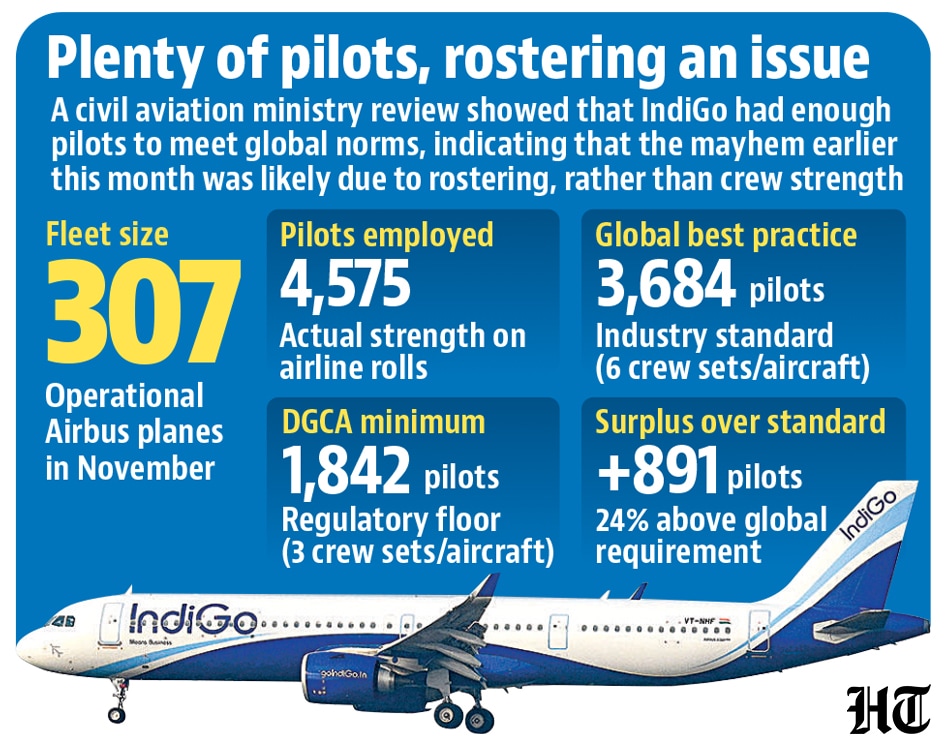
The civil aviation ministry had also ordered a broader systemic review to determine whether the airline’s preparedness was adequate in the context of revised crew fatigue rules. An internal document from this review, accessed by HT, found IndiGo employed 4,575 pilots in November to operate its 307 Airbus-aircraft fleet—a surplus of 891 pilots above the 3,684 required under global best practices that maintain six crew sets per aircraft to cover operations, training, leave and contingencies.
These numbers challenge IndiGo’s explanation that new crew fatigue rules contributed significantly to the operational collapse, and reinforce rostering failures—not pilot strength — as the probable trigger for the crisis that prompted a regulatory rollback in December.
The data, submitted by IndiGo to the Directorate General of Civil Aviation, indicates “pilot strength is more than sufficient” and that “the main challenge lay in scheduling and rostering pilots, not in a shortage of crew,” according to the document.
“The current pilot strength provides a sizeable operational buffer that already covers training, leave, recurrent checks, and seasonal disruptions, even when measured against global industry norms,” the review states, noting that airlines worldwide typically maintain between 5.5 to 6 crew sets per aircraft to ensure smooth operations.
The review also noted, based on the airline’s submissions, that crew utilisation was at 55% of the 100 hours a month utilisation allowed as per regulation. HT reported on December 16 that the utilisation rate was comparable to other airlines, and not much different from before the stricter crew rest rules kicked in --- another indication that the airline’s crew rostering system did not keep up to the changes despite months of notice.
IndiGo’s pilot complement represented approximately six crew sets per aircraft—matching global best practice—yet the airline cancelled over 5,000 flights within six days in early December, stranding tens of thousands of passengers and triggering government intervention including emergency fare caps and show cause notices to senior executives.
The review notes that “the airline had ample flying capacity” during the November period, when the stricter Flight Duty Time Limitations were in force.
DGCA’s minimum standard requires only three crew sets per aircraft, or 1,842 pilots for IndiGo’s November fleet—less than half the number the airline actually employed.
“The data clearly indicates that pilot availability, in terms of permitted flying hours and crew strength, was not the binding constraint during the disruption period,” an official requesting anonymity said. “Airlines are primarily constrained by their own rostering practices and pilot contract clauses, not regulatory limits on flight hours.”
A second official said the analysis formed part of a broader DGCA review conducted after IndiGo cancelled hundreds of flights and refunded more than ₹1,500 crore to passengers between late November and mid-December.


