
 E-Paper



Dip in demand, steep fall in prices hit tomato farmers of Maharashtra, Haryana
Sliding rates of some vegetables amid record horticulture production point toward a vegetable deflation that could crimp farm incomes, analysts say.


Wholesale prices of tomato have fallen steeply to a nearly three-year low, as loss-making farmers in Maharashtra and Haryana dumped produce or fed them to cattle, a repeat of a familiar pattern of price volatility.
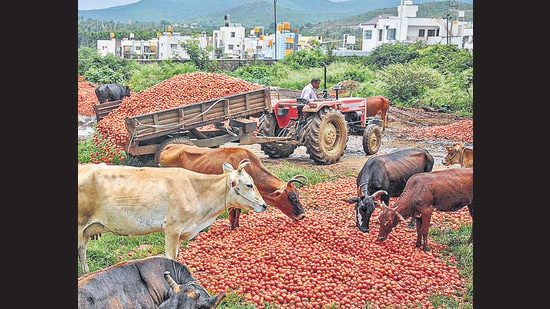
Sliding rates of some vegetables amid record horticulture production point toward a vegetable deflation that could crimp farm incomes, analysts say.
In Haryana’s Toshan on Friday, fresh harvests sold ₹50 per crate of 25 kg, or about ₹2 per kg. On the other hand, the price crash had not moved rates much in cities. In Delhi’s retail markets, the vegetable sold between Rs20-30 per kg.
India’s headline wholesale price index inflation slowed to 12.1% in June 2021, down 1.8% in June 2020. Vegetable prices stood -8.73% (repeat minus 8.73%), against a -0.78 (repeat minus 0.78%) decline in June, official data show.
The current glut, economists say, has to do with the cobweb pattern of agriculture, which means that farmers decide what to grow depending on the previous year’s price realization.
India is set to reap its highest ever horticulture crop production at 329 million tonne in 2020-21, a nearly 3% rise in output, according to latest official estimates.
Farmers in Nashik, a major trade centre, said they were incurring heavy losses and abandoning their produce because selling rates were not enough to cover even transportation costs. Farmers in Haryana too said they weren’t able to recover costs.
According to the Commission for Agricultural Costs and Prices, a federal body, a farmer incurs a minimum of ₹4 to grow a kg of tomato on own land. With leased land and hired labour, the cost of growing one kg of tomato can go up to ₹8-10.
“Forwarding agents are telling us that Delhi, Kolkata and Mumbai wholesale markets have lowered their demand for the past two days between 6-8%. This is the immediate reason for the fall in prices,” said Prakash Kumawat, an official at the agricultural produce marketing committee in Nashik.
Nyay Singh, a grower in Chakri Dadri in Haryana, said he had abandoned his entire produce harvested 10 days ago, of about four crates of 25 kg each.
Three commonly consumed vegetables – tomato, potato and onion – are prone to frequent seasonal price fluctuations. When prices crash, small growers who can’t afford to hold on to their produce are affected the most. On the other hand, sudden price spirals tend to hit household budgets of consumers.
Potato output is set to surge 10.5% over last year’s, while tomato and onion production during the 2020-21 cycle is set to be marginally higher. Official data show onion output will likely be 26.9 million tonne in 2020-21, up from 26.09 million tonne last year. Tomato output is estimated to be 21 million tonne in 2020-21 compared to 20.55 million tonne in 2019-20.
“If the production estimates contained in the agriculture ministry’s advance estimates of horticulture are accurate, such a fall in tomato prices are not to be expected, but this year isn’t likely to be good for vegetable growers,” said Ashok Agrawal, an analyst with Comtrade, a commodities trading firm.
Experts say lack of growers can get consistent prices, while consumers can be shielded from price shocks if there’s adequate food processing facilities to make tomato puree. Wholesale prices of tomato have fallen steeply to a nearly three-year low leading loss-making farmers in Maharashtra and Haryana to dump the produce or feed them to cattle, a repeat of a familiar pattern of price volatility.


