
 E-Paper



Districts in south Bengal receive three times excess rain in last one week
The IMD’s regional office in Kolkata has warned of yet another spell of heavy rain over the coming weekend. A low-pressure system that is likely to form over the sea would trigger rain and thundershower in Kolkata and other districts of south Bengal on September 26 and 27.


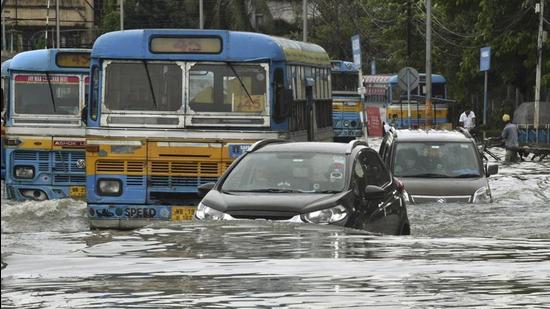
Three districts in south Bengal received more than five to ten times excess rain on Tuesday compared to the climatic normal of three decades, while three other districts in the region, including Kolkata, registered three times excess rain in the last one week, as an intense spell of rain and thundershower, triggered by a cyclonic circulation, hit the state.
But if one considers the rainfall amount the same districts received since the starting of the monsoon season on June 1, then the excess is not even more than 50%.
“This is because monsoon has been vigorous of late. Back-to-back cyclonic circulations are developing over the Bay of Bengal, which on intensifying and approaching the coast, are triggering intense spells of rain. Kolkata received the heaviest rainfall in one day in September in 14 years this week,” said GK Das, director of the India Meteorological Department’s regional office in Kolkata.
In the last one week, Kolkata received 268mm rain. This is 336% extra over the climatic normal of 61.5mm rain, which the city receives between September 16 and September 22.
Similarly North 24 Parganas and West Midnapore received 376% and 335% excess rain over the 30-years of climatic normal during the week. While North 24 Parganas gets around 55m rain but received around 261.6mm rain in the last one-week, West Midnapore usually gets around 48.7mm, but last week it received around 211.7mm.
Bankura, a district in the western part of the state registered 1052% more rain on Wednesday than it has been usually receiving on September 22 over the past three decades. Purulia and West Midnapore received 574% and 896% excess rain on the same day.
But the same districts show very little deviation of the rainfall amount is taken for the period June 1 to September 22. Kolkata has just 31% extra rain, North 24 Parganas registered 48% excess rain and West Midnapore registered 42% excess rain over the climatic normal from June to September.
“One of the primary reasons behind these intense spells is climate change. The water holding capacity of the atmosphere increases by around 7% if there is one degree rise in temperature. Across India incidents of heavy rain spells are increasing. This is just one consequence of climate change,” said KJ Ramesh, former director of India Meteorological Department.
Data available with the Union ministry of earth sciences reveal that while in 2016 around 1864 IMD stations across India recorded very heavy rain and 226 stations recorded extremely heavy rain, in 2020 at least 1912 stations had registered very heavy rain and extremely heavy rain was recorded in 341 stations. In 2018 and 2019 such events were even higher.
The ‘Assessment of climate change over the Indian region’ – a report published by the Union earth sciences ministry in 2020 suggests that there has been a shift in the recent period toward more frequent dry spells and more intense wet spells during the summer monsoon season. The frequency of localized heavy precipitation occurrences has increased worldwide in response to increased atmospheric moisture content.
“Our analysis of 100 years of data of rainfall in West Bengal shows that the overall rainfall in the monsoon season has increased but the number of rainy days has dropped resulting in intense spells. What aggravates the situation is that while on one hand alteration of nature is going on in an unbridled way, we also lack the mitigation and preparedness,” said Tuhin Ghosh, director of School of Oceanographic Studies at Jadavpur University in Kolkata.
The IMD’s regional office in Kolkata has warned of yet another spell of heavy rain over the coming weekend. A low-pressure system that is likely to form over the sea would trigger rain and thundershower in Kolkata and other districts of south Bengal on September 26 and 27.


