
 E-Paper



‘Ease of justice’: Prime Minister Modi calls for speedy release of undertrials
Speaking at the inaugural session of first all India district legal services authorities meet in New Delhi, Modi underscored the role of legal aid in ascertaining access to justice for all, especially the marginalised sections have always reposed faith in the judicial system.

 Prefer HTon Google


Ease of justice is as important as ease of doing business and ease of living, Prime Minister Narendra Modi emphasised on Saturday while imploring the judiciary to speed up the release of undertrials who remain in jail due to want of legal aid.
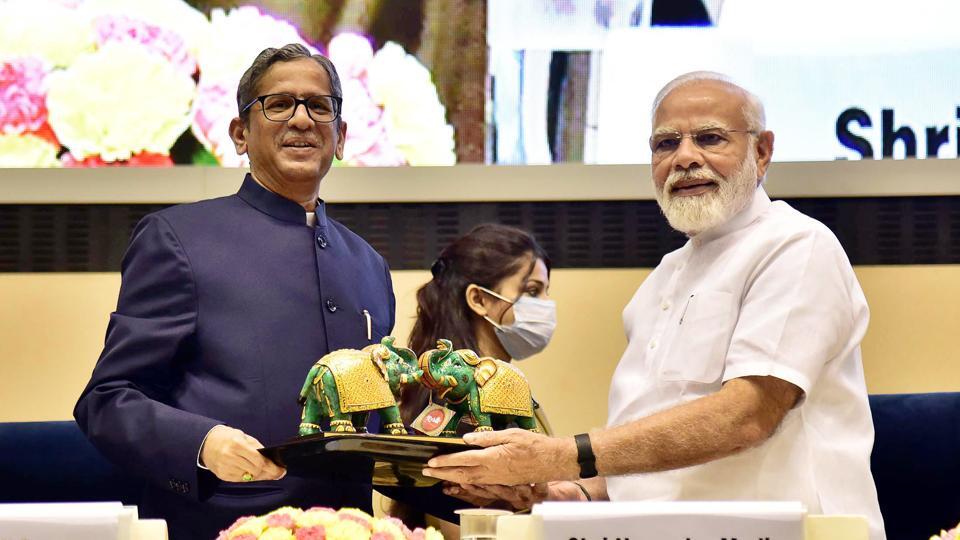
Speaking at the inaugural session of first all India district legal services authorities meet in New Delhi, Modi underscored the role of legal aid in ascertaining access to justice for all, especially the marginalised sections have always reposed faith in the judicial system.
“A few days from today, the country is completing 75 years of its independence. This is the time of the elixir of our freedom. This is the time for taking the resolutions which will take the country to new heights in the next 25 years. Ease of Justice is as important as the ease of doing business and ease of living in this journey of the country,” he said, highlighting the function of legal services authority in achieving this goal.
The common man believes that if no one listens, the doors of the court are always open, Modi said. “This belief in justice makes every countryman realise that the systems of the country are protecting his rights. With this idea, the National Legal Services Authority (NALSA) was established so that even the weakest of the weak could get the right to justice,” the Prime Minister said. “Specifically, our district legal services authorities (DLSAs) are like building blocks of our legal aid system.”
Focussing on the issue of under-trials, who constitute two-thirds of the inmates in prisons across the country, Modi earmarked a role for the DLSAs that are headed by district judges, who also lead the undertrial review committees.
“Sensitivity has been shown several times in the past by the Supreme Court on the humanitarian issue related to undertrial prisoners in the country. There are so many prisoners who have been languishing in jails for years, awaiting legal aid. Our district legal services authorities can take up the responsibility of providing legal aid to these prisoners,” he said.
Referring to the attendance of district judges from across the country to attend the meet, Modi urged the judicial officers to expedite the release of undertrial prisoners in their capacity as chairman of the district level undertrials review committees. He also commended the NALSA for undertaking a focussed campaign on release of undertrials prisoners through legal aid.
Modi spoke after Chief Justice of India NV Ramana’s address, in which the Supreme Court judge also appealed the district judicial officers to intervene in securing “much deserved relief for undertrials”. Earlier, justice Uday U Lalit, the Supreme Court judge who is also the executive chairman of NALSA, spoke at the event, announcing NALSA’s plan to put in place legal aid defence counsel offices in maximum possible districts to institutionalise a system so people could have a better and smoother access of legal assistance.
The issue of undertrial prisoners was also one of the moot points addressed by Modi when he spoke at the joint conference of chief ministers and high court chief justices in April.
“Today, there are about 3.5 lakh prisoners in the country who are undertrials and are in jail. Most of these people are from poor or ordinary families,” he had said. “I would appeal to all chief ministers and chief justices of high courts to give priority to matters on basis of humanitarian sensibility and law.”
On Saturday, Modi further noted the significance of the use of technology in assisting the justice delivery system. “I am happy that under the direction of the Supreme Court, the judicial system of the country is moving fast in this direction. Under the e-courts mission, virtual courts are being started in the country,” he said. “Courts have started functioning round the clock for crimes like traffic violations. Videoconferencing infrastructure is also being expanded in the courts for the convenience of the people.”
Modi addressed the issue of judicial infrastructure, which he said plays a pivotal role in delivery of justice. “In the last eight years, work has been done at a fast pace to strengthen the judicial infrastructure. ₹9,000 crore is being spent to modernise the judicial infrastructure,” he said. “The number of court halls in the country has also increased. This speed in the construction of judicial infrastructure will also speed up justice delivery.”


