
 E-Paper



Effective rule of law key for economic growth: CJI
CJI Chandrachud highlights the importance of rule of law for economic growth and investor confidence at SAT's new Mumbai office inauguration.


The idea of “rule of law” is not only about social and political justice but is also intrinsically linked to better economic outcomes and financial advancement, Chief Justice of India Dhananjaya Y Chandrachud emphasised on Thursday, adding that a legal system with adequate procedural safeguards and fairness builds investor confidence and is crucial for economic growth.
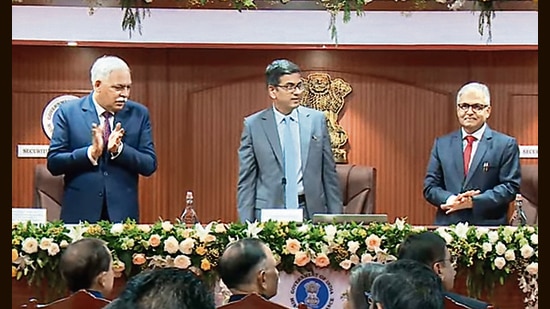
Inaugurating the new office premises of the Securities Appellate Tribunal (SAT) at Mittal Court, Mumbai, the CJI underscored the critical role of SAT in fostering improved economic outcomes and financial growth, which in turn create a stable and predictable investment environment.
Justice Chandrachud noted that SAT, as a pivotal appellate forum for securities markets, ensures that all stakeholders adhere to regulations, thereby maintaining market integrity and investor confidence.
“A legal system that has adequate procedural safeguards, fairness, and forums that dispense justice without arbitrariness, is integral to building investor confidence in a country’s markets and business landscape. Therefore, regulators like SEBI (Securities and Exchange Board of India, the market regulator) and appellate forums like SAT assume immense national importance in fostering a stable and predictable investment environment,” said the CJI, citing the World Bank’s theory from 2005 that protecting the rule of law is intrinsically linked to better economic outcomes.
When investors feel assured that their investments are protected by law and that there are effective mechanisms for dispute resolution, the judge added, they are more likely to invest in the country’s markets. “This influx of investment can lead to better economic outcomes, such as increased capital formation, job creation, and overall economic growth.”
According to the CJI, SAT is like a referee, ensuring that in the “dog-eat-dog” world of finance, all stakeholders play by the rules. “Just like any good referee, SAT has successfully kept pace with the evolving game. As our markets and businesses become more complex and new regulations flood in, the tribunal must consistently rise to the challenge. To effectively adjudicate the appeals before the tribunal, members require not only a deep understanding of intricate financial matters but most importantly, a strong commitment to fair adjudication and procedural safeguards. This is crucial in maintaining market integrity and investor confidence.”
Commending the tribunal for moving its office to new, modern premises equipped with state-of-the-art infrastructure and technology, the CJI stressed the importance of digital infrastructure, stating that the concept of “access to justice” needs to be re-imagined because modernising infrastructure must not limit to physical infrastructure. He said that technology is at the heart of the functioning of the Indian judicial system and that it has been a mission for him as the CJI to promote it.
“In Sarvesh Mathur Vs The Registrar General, High Court of Punjab and Haryana (2023 and 2024), the Supreme Court issued several directions to ensure the continued use of video conferencing facilities across High Courts and Tribunals. It is commendable that SAT has been at the forefront in adopting technology including virtual hearings and e-filing, both during the COVID-19 pandemic and after it subsided,” he said.
With SAT having a bench only in Mumbai, justice Chandrachud underscored the importance of virtual hearings as a matter of right rather than a concession. “A tribunal with jurisdiction across the country must have digital resources to allow lawyers from different regions to appear before the tribunal easily and effectively,” he stated. The judge also praised the decision to revamp SAT’s website, making it more user-friendly and enhancing accessibility and efficiency in accessing legal services.
In his address, the CJI pointed to the urgent need to fill the vacancies at the SAT, commenting on the increasing volume of appeals and disputes related to regulatory non-compliance, market conduct, corporate governance and shareholder issues. “The rapid growth in the number of market participants and the increase in the volume of financial transactions brings with it the likelihood of an increased number of disputes. The vacancies in SAT must be filled at the earliest to allow the tribunal to work effectively and at full capacity,” he urged.
The CJI suggested that it may be worth considering the establishment of additional benches to manage the escalating caseload. “The SEBI Act also allows for the setting up of benches of SAT. It may be worth giving greater thought to the proposals of equipping the tribunal with additional benches and improved infrastructure to manage its escalating case load.”
Justice Chandrachud also praised the dedication and expertise of SAT’s members, registrars, researchers, administrative staff, and other officials who ensure the smooth functioning of the tribunal. “The officials who run the show from behind the scenes are the steel frame of our legal system. They are integral to dispensing justice,” he said.
During his speech, the CJI reminisced about his professional roots in Mumbai, expressing a deep connection to the city that shaped a significant part of his career. “For me, visiting Mumbai is much like coming back home – to a city that shaped a considerable part of my professional life. I spent most of my career, first, as a lawyer frequenting the corridors of Mumbai’s judicial forums and then as a judge of the Bombay High Court.”
In concluding his speech, justice Chandrachud expressed his confidence that the new office premises would empower SAT officials to work with renewed vigour and determination, leading to fair and just decisions.
Justice DK Upadhyaya, Bombay high court chief justice, retired justice PS Dinesh Kumar, SAT’s presiding officer and Dheeraj Bhatnagar and Meera Swarup, technical members of the SAT, were also present at the inauguration of the new office space.


