
 E-Paper



Efforts on to tackle economic impact of Ukraine crisis: Sitharaman
Sitharaman said the entire world is facing disruptions in the global supply chain due to “the full-blown war” in Ukraine, which would impact all countries like the Covid-19 pandemic.


The Indian economy is facing new challenges due to the Omicron wave of Covid-19, the Ukraine war and a spike in global crude oil prices that happened after the budget for 2022-23 was presented, but the central government is committed to sustain the growth recovery without additional taxes, finance minister Nirmala Sitharaman said in Parliament on Tuesday.
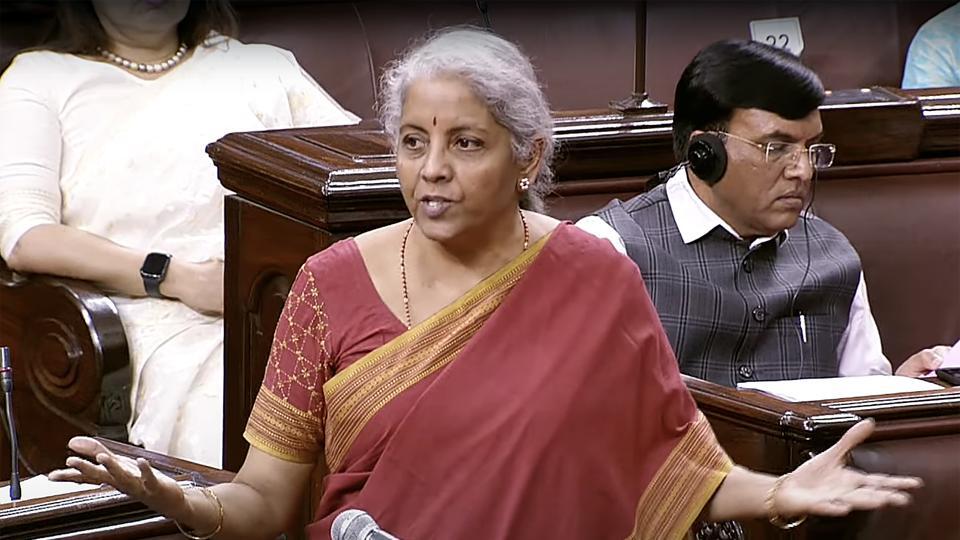
Replying to the discussion on the finance and appropriation bills in the Rajya Sabha, Sitharaman said the entire world is facing disruptions in the global supply chain due to “the full-blown war” in Ukraine, which would impact all countries like the Covid-19 pandemic.
The central government is focusing on “sustained recovery through a predictable taxation regime” as it is “conscious of the need to balance the imperatives of growth and also make sure India’s recovery post-Covid is sustained,” the finance minister said. “The budget reflects this commitment.”
Sitharaman also spoke on the issue of virtual digital assets (VDA), which are yet to be regulated by the government after several MPs raised the issue. She clarified that these are any broadly defined as “information or code or number or even a token providing a digital representation of value… generated through cryptographic means or otherwise” and that the government can in the future choose to notify VDAs from the taxation net or remove those that do not fall in the category,
The budget has proposed taxing earnings from crypto assets at 30%. Taxation matters related to such assets will be handled by the Central Board of Direct Taxes, she said.
The government is yet to decide whether to legalise or ban cryptocurrencies. It will take a final call on the matter after its ongoing discussions are complete.
The Rajya Sabha returned both the finance and appropriation bills without any change other than the amendments proposed by the government after Sitharaman had spoken. This completed the parliamentary process for approval of the budget for 2022-23.
Explaining the global supply chain disruptions due to the geo-political reasons as one of the key reasons for higher oil prices, she rejected the Opposition’s allegation that the war in Ukraine had started long before petrol and diesel prices started rising in India after assembly elections.
Replying to the Opposition’s allegation that the government is unable to attract private investors, the finance minister said: “We believe government and private sector are partners in ushering development in this economy...To set up private investments, the government has launched PLI [production-linked incentive] schemes in 14 sectors, [which is] expected to add additional productive capacity of over ₹30 lakh crore over next five years.”
She said the Indian economy is attractive and resilient, since India continues to remain in the top five foreign direct investment (FDI) recipient countries.
Meanwhile, Prime Minister Narendra Modi said efforts are being made to mitigate the burden on citizens due to the economic crisis which, after the Covid-19 pandemic, aggravated as the world has entered a battlefield, in an apparent reference to the ongoing Russia-Ukraine war. “Earlier, the world faced trouble due to the coronavirus outbreak. Now, the world has entered a battlefield. Due to this, various new crises are arising on the economic front. Efforts are being made to help, as much as possible, to minimise the burden on Indian citizens,” he said while virtually addressing the ‘Grah Pravesham’ (house-warming) programme of 521,000 houses of beneficiaries of the Pradhan Mantri Awaas Yojana-Gramin in Madhya Pradesh.


